
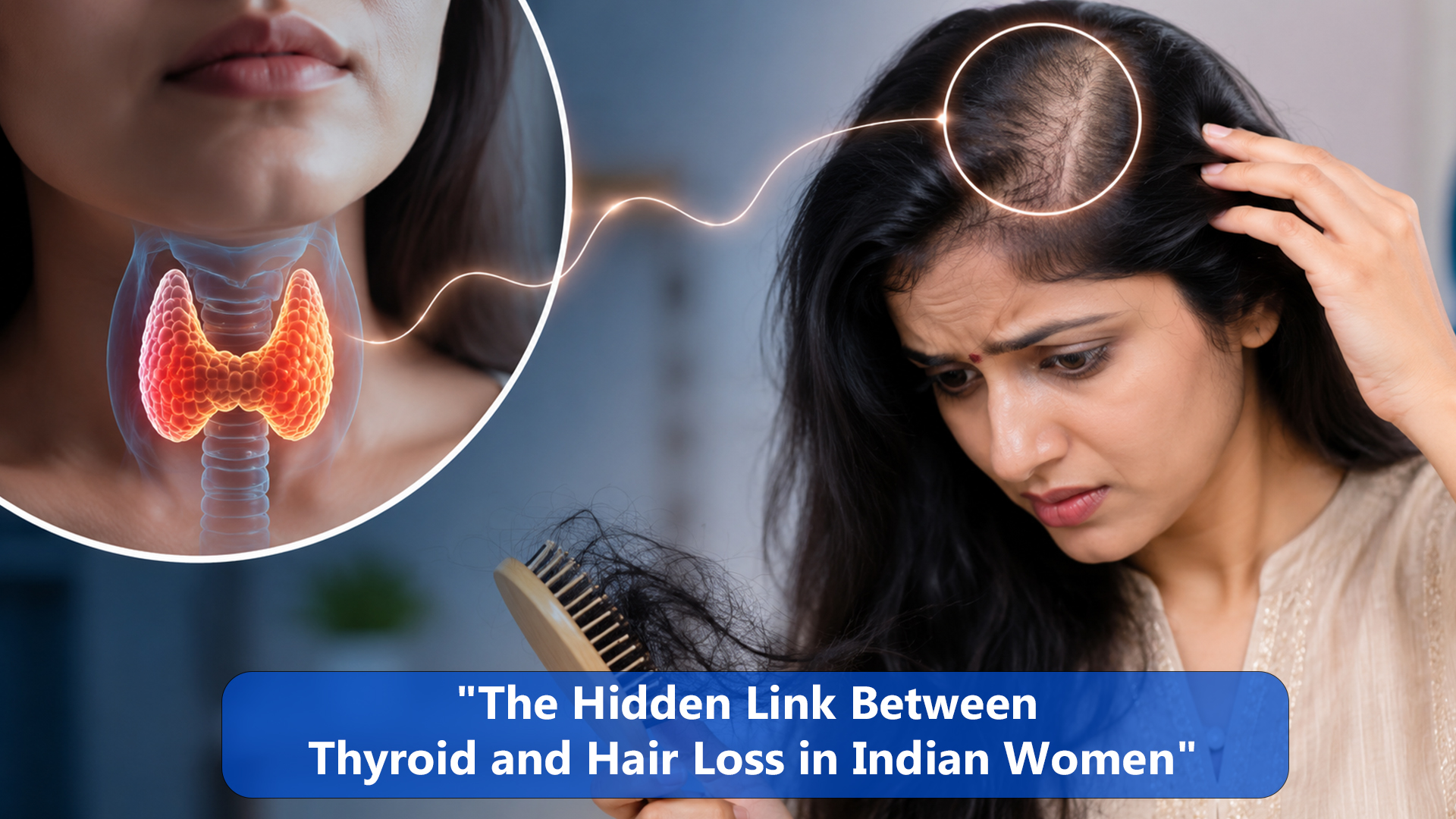
Hair loss in women is investigated less thoroughly than hair loss in men, and thyroid dysfunction is one of the most common reasons why. A woman who presents with diffuse hair thinning is frequently told her hair loss is stress-related, hormonal in the general sense, or simply a phase that will resolve. In a meaningful proportion of these cases, undiagnosed thyroid dysfunction is the primary driver, and it will not resolve until the thyroid condition is identified and treated.
This blog explains the specific mechanisms by which thyroid disorders cause hair loss in women, why the connection is frequently missed in India, what the relevant investigations are, and what treatment looks like when the thyroid is correctly identified as the cause.
If you are a woman experiencing hair loss that has not responded to the treatments you have tried so far, a complete assessment including thyroid function at RECOMB is a sensible starting point.
Book a Female Hair Loss Assessment at RECOMB, Surat →
WhatsApp: +91 7624008000 | www.recombhair.com
How the Thyroid Gland Affects Hair Growth
The thyroid gland produces two primary hormones, thyroxine known as T4 and triiodothyronine known as T3, which regulate the metabolic rate of virtually every cell in the body. Hair follicles are among the most metabolically active structures in the body, cycling through growth, transition, and resting phases continuously and requiring a consistent supply of energy, oxygen, and nutrients at the cellular level to function normally.
Thyroid hormones act directly on the hair follicle through receptors present in the dermal papilla and the outer root sheath of the follicle. They regulate the duration of the anagen growth phase, influence the rate of follicle cell division during active growth, and modulate the production of specific growth factors that support follicle health. When thyroid hormone levels fall outside the normal range in either direction, this regulatory function is disrupted and hair growth is affected.
The disruption is not subtle. Both hypothyroidism and hyperthyroidism consistently produce clinically significant hair changes, though the pattern and texture of those changes differ between the two conditions.
Hypothyroidism and Hair Loss: The More Common Pattern
Hypothyroidism, the underproduction of thyroid hormones, is significantly more prevalent in Indian women than in the general international population. Studies conducted across Indian populations consistently show hypothyroidism rates in women ranging from 8 to 11 percent, with subclinical hypothyroidism, where TSH is elevated but T3 and T4 remain within the low-normal range, present in an additional 10 to 15 percent of women who may have no obvious symptoms beyond fatigue and hair changes.
In hypothyroidism, reduced T3 and T4 levels slow the metabolic rate of the follicle. The anagen phase shortens, cell division within the follicle slows, and the hair cycle is disrupted throughout the scalp. The pattern of hair loss is typically diffuse, affecting the entire scalp relatively evenly rather than concentrating at specific zones. This distinguishes it visually from androgenetic alopecia, which follows defined patterns on the Norwood or Ludwig scale.
Hair quality changes are often the first sign that hypothyroidism is affecting the scalp. Hair becomes coarser in texture, drier, more brittle, and breaks more easily. Individual hair shafts may become irregular in diameter along their length. These changes in texture can precede visible density loss by months.
Patients with hypothyroidism often also experience loss of the outer third of the eyebrows, a pattern clinically associated with thyroid-related hair loss that can help distinguish it from other causes during examination.
The hair loss of hypothyroidism has a delayed presentation relative to the onset of the thyroid dysfunction. Because hair follicles have their own internal cycle that takes weeks to months to shift in response to metabolic changes, patients typically begin noticing hair shedding two to four months after the thyroid dysfunction has become established. This delay means patients and clinicians frequently fail to connect the two, particularly if the thyroid condition itself is mild enough not to have produced obvious other symptoms.
Hyperthyroidism and Hair Loss: A Different Pattern
Hyperthyroidism, the overproduction of thyroid hormones, produces hair loss through a different mechanism but with equally significant clinical impact.
Elevated T3 and T4 levels accelerate the metabolic rate of the follicle, paradoxically shortening the anagen phase rather than extending it. The follicle cycles faster than normal, spending less time in active growth with each cycle and more time in the resting and shedding phases. The result is increased shedding and reduced overall density, presenting again as a diffuse pattern across the scalp.
Hair in hyperthyroidism tends to become finer and softer rather than coarser, the opposite texture change to hypothyroidism. Scalp hair may become limp and without natural body. These texture changes alongside diffuse shedding are a useful clinical clue that thyroid dysfunction may be involved.
Hyperthyroidism is less common than hypothyroidism in Indian women but is associated with autoimmune conditions including Graves disease, which has a meaningful prevalence in the Indian population and is frequently underdiagnosed because its early symptoms are attributed to stress or anxiety.
Why Thyroid-Related Hair Loss Is Frequently Missed in India
Several factors specific to the Indian clinical context contribute to thyroid dysfunction being missed as a cause of hair loss in women.
The most significant is that hair loss in women is frequently attributed to stress, nutritional deficiency, or hormonal changes without a complete blood workup being performed. A woman presenting with hair loss receives iron supplements, a biotin supplement, and advice about stress management. If the ferritin is genuinely low, the iron supplementation helps partially. But if the primary driver is thyroid dysfunction, the supplements address a secondary contributor at best and the thyroid condition continues to worsen.
Subclinical hypothyroidism creates a specific diagnostic challenge because TSH is elevated but symptoms may be mild or attributed to other causes. Standard screening in many primary care settings looks only at TSH. If TSH is mildly elevated but within what is considered an acceptable range at the testing facility, it may not be flagged as a concern even if it is clinically significant for hair loss purposes. Patients whose TSH sits between 2.5 and 5 mU/L may have subclinical hypothyroidism that is contributing meaningfully to their hair loss but is not being identified or treated.
The overlap between thyroid-related hair loss and the presentation of other common causes also contributes to misattribution. Diffuse hair loss, fatigue, dry skin, and mood changes are shared across hypothyroidism, iron deficiency, vitamin D deficiency, and stress-related telogen effluvium. Without targeted investigation, distinguishing between these is not possible from clinical observation alone.
What the Investigations Should Include
For any woman presenting with diffuse hair loss, a thyroid function panel is not optional. The minimum appropriate investigation is TSH, free T3, and free T4 rather than TSH alone. TSH in isolation can miss cases of T3 or T4 abnormality that are clinically significant, particularly in early or subclinical phases of thyroid dysfunction.
Anti-thyroid antibodies, specifically anti-TPO and anti-thyroglobulin antibodies, should be included where autoimmune thyroid disease is suspected, which in practice means any woman with a family history of thyroid disease, other autoimmune conditions, or symptoms beyond hair loss. Elevated antibodies in the presence of normal hormone levels can still indicate a patient at high risk of developing overt thyroid dysfunction within the following years, and monitoring frequency and treatment decisions are affected by antibody status.
The thyroid investigation should be part of a broader panel that also includes serum ferritin, vitamin D, a complete blood count, and where clinically relevant a hormonal panel including prolactin and sex hormone levels. This is because thyroid dysfunction often coexists with other deficiencies, and treating the thyroid condition while leaving concurrent iron deficiency or vitamin D deficiency unaddressed produces incomplete improvement.
What Treatment Looks Like When the Thyroid Is the Cause
Hypothyroidism is treated with levothyroxine, a synthetic T4 hormone taken daily. The dose is titrated over weeks to months based on follow-up TSH measurements until thyroid levels normalise. Hair loss related to hypothyroidism begins to improve within three to six months of thyroid levels reaching the therapeutic range, with full improvement in hair density taking up to 12 months in some patients.
Hyperthyroidism is managed with antithyroid medications, radioactive iodine, or in some cases surgery, depending on the severity and underlying cause. Again, hair improvement follows hormone normalisation with a similar timeline.
Subclinical hypothyroidism with TSH between 2.5 and 5 mU/L and positive anti-TPO antibodies is often treated with low-dose levothyroxine. Whether to treat subclinical hypothyroidism specifically for hair loss is a clinical judgment that should involve an endocrinologist alongside the dermatologist, since the evidence for treatment in this range is nuanced and patient-specific.
The important clinical point is that thyroid treatment, when the thyroid is correctly identified as the cause, produces genuine and often dramatic improvement in hair loss that no topical treatment, supplement, or surgical procedure would have achieved.
When Thyroid Treatment Is Not Enough Alone
Thyroid-related hair loss frequently coexists with androgenetic alopecia in women. A woman with female pattern hair loss who also develops hypothyroidism will notice a significant acceleration of her pattern loss as the thyroid dysfunction reduces follicle metabolic capacity on top of the DHT-related miniaturisation already in progress.
In this situation, treating the thyroid normalises the accelerated component of the loss but does not address the underlying pattern loss. After thyroid levels are normalised, the residual hair loss that persists is the androgenetic component and requires its own treatment approach, which may include topical minoxidil, GFC or PRP therapy, and in suitable patients with established, stable pattern loss, surgical restoration.
This is why a complete assessment that distinguishes between multiple concurrent causes of hair loss produces better outcomes than treating any single factor in isolation.
RECOMB's Approach (2026)
At RECOMB Hair Transplant Centre, Surat, female hair loss is assessed with a structured protocol that includes thyroid function as a mandatory component of initial blood investigations rather than an optional add-on. Dr. Krishna Bhalala's background as a DNB Dermatologist means that the medical causes of hair loss including thyroid dysfunction are evaluated and managed alongside any consideration of non-surgical or surgical hair restoration.
Women who present at RECOMB with diffuse hair loss leave their first consultation with a specific differential diagnosis, a targeted investigation plan, and a clear understanding of what each test is looking for and how the results will shape their treatment. Surgery is not discussed until the medical picture is complete, because operating on a patient with undiagnosed and untreated thyroid dysfunction produces suboptimal graft survival and results that are harder to predict.
Final Takeaway
Thyroid dysfunction is one of the most common and most treatable causes of hair loss in Indian women, and it is one of the most frequently missed. The combination of delayed presentation, overlap with other common deficiencies, and inadequate investigation in many primary care settings means that women with thyroid-related hair loss often spend months or years on treatments that cannot address the actual cause.
A complete thyroid panel including TSH, free T3, free T4, and anti-thyroid antibodies alongside iron and vitamin D investigations is the starting point for any woman experiencing diffuse hair loss that has not responded to initial treatment.
Dr. Krishna Bhalala and Dr. Nilesh Kachhadiya conduct a limited number of personal consultations each week at RECOMB, Surat. If you are a woman experiencing hair loss that has not been adequately explained or treated, this is where a complete, medically grounded assessment starts.
Get a Complete Female Hair Loss Assessment at RECOMB →
WhatsApp: +91 7624008000
We respond within 24 hours, 6 days a week.
www.recombhair.com
Contact RECOMB Hair Transplant Centre
RECOMB Hair Transplant Centre
19, Ground Floor, Zenon Building, Opp. Unique Hospital, near Kiran Motors, Khatodara Wadi, Surat, Gujarat 395001
Phone: +91 7624008000
Website: www.recombhair.com