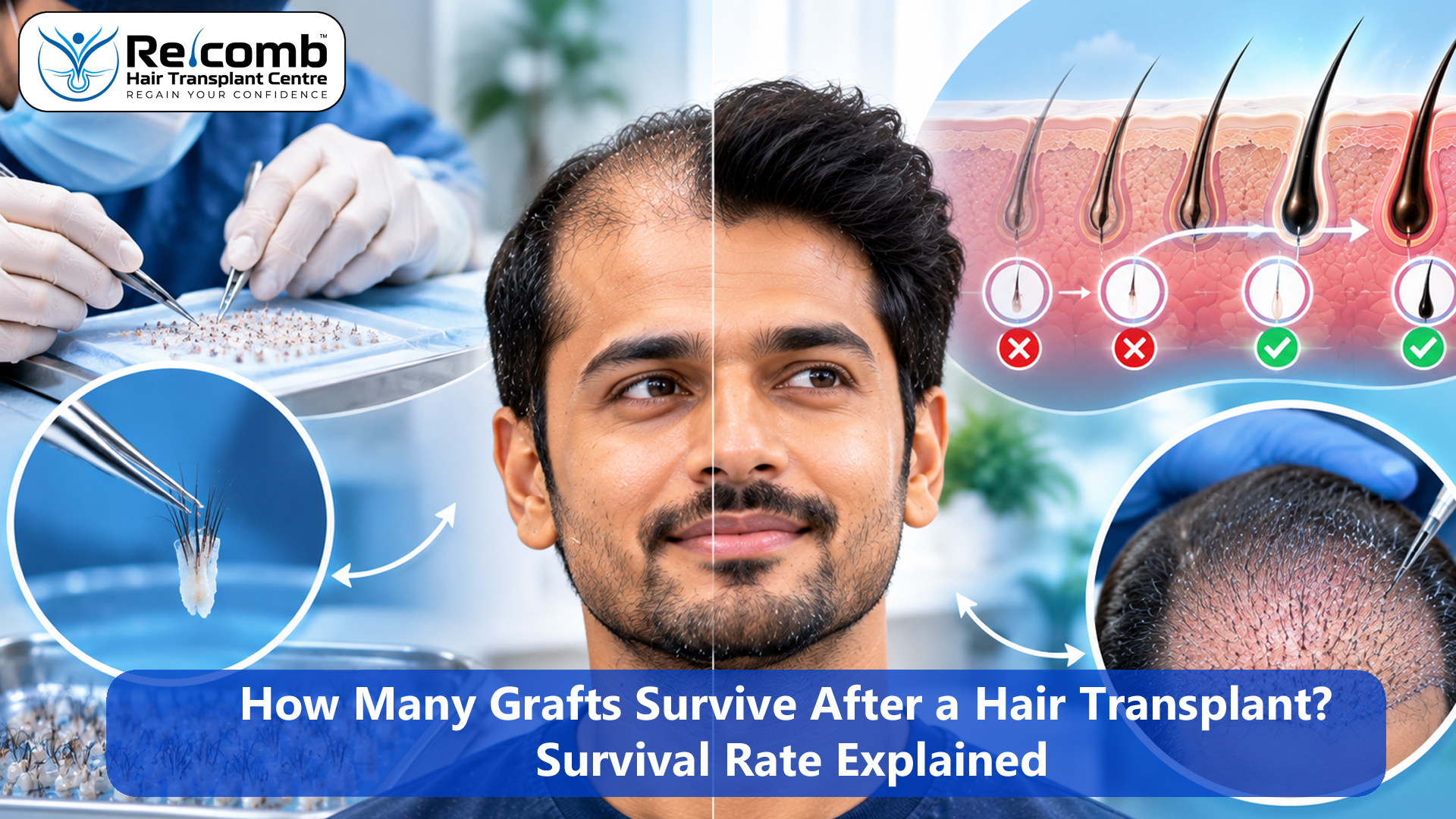

Most patients who undergo a hair transplant have a general sense of what the procedure involves. Hair is taken from the back of the head and placed in the thinning areas. The result grows over 12 months.
What very few patients understand is what actually happens to each graft between those two points, and why that process, the handling, preservation, and placement of follicular units outside the body, is where the quality of the final result is largely determined.
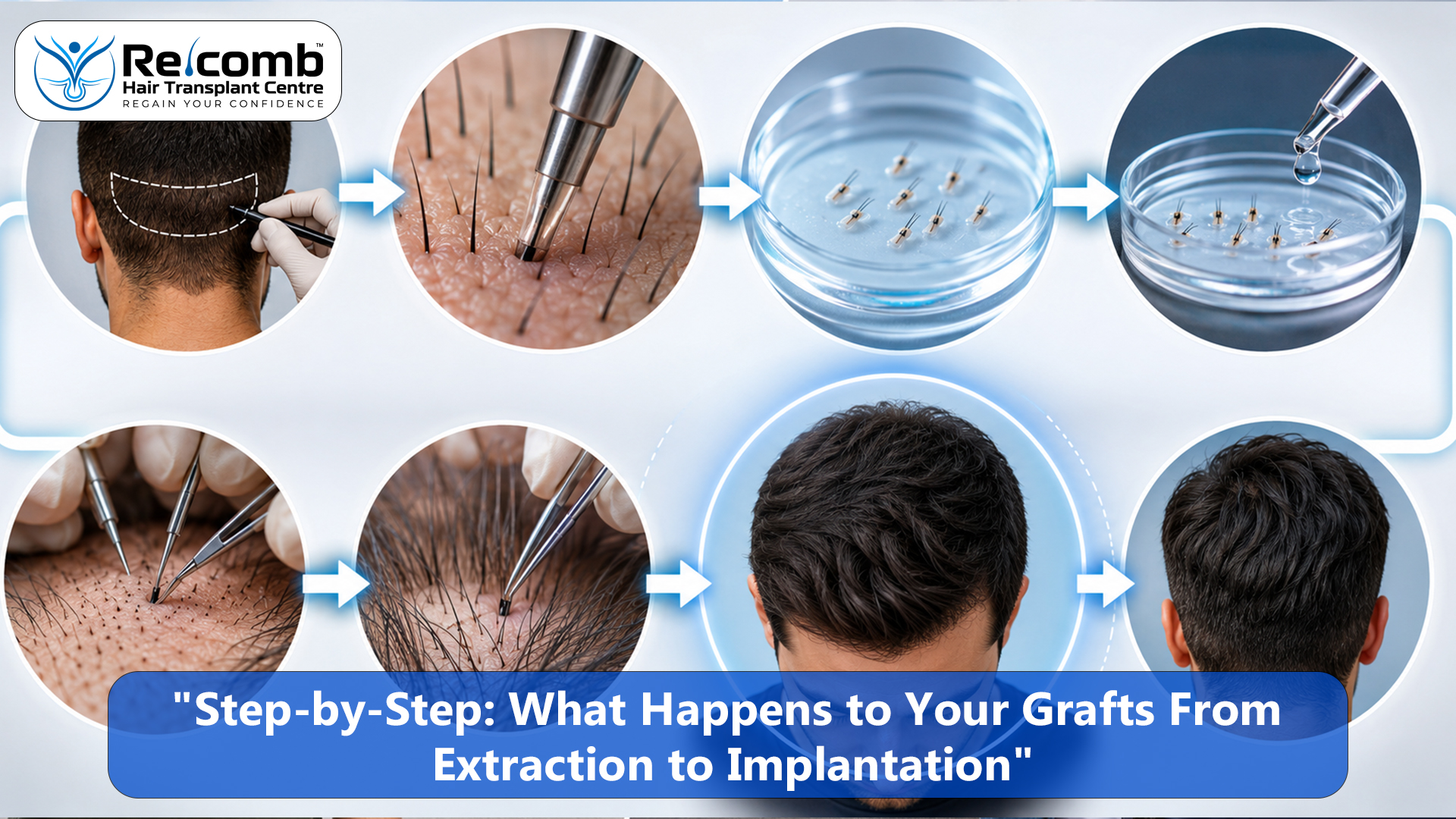
This blog walks through the complete journey of a graft from extraction to implantation, explaining what happens at each stage and why each stage matters clinically.
Before Anything Begins: The Pre-Surgical Assessment and Marking
A procedure does not begin in the operating room. It begins in the consultation where the graft plan is built, the donor density is measured, the recipient zones are mapped, and the hairline is designed.
On the day of surgery, before any extraction begins, the hairline and recipient zone markings are confirmed with the patient standing upright. Hairline position is assessed with the patient in a natural standing posture, not lying down, because the relationship between the hairline and the facial structure is only fully visible in this position.
Donor zone boundaries are marked precisely on the occipital and parietal scalp to define the safe extraction area. Extraction outside this zone risks harvesting follicles that are not DHT-resistant, producing grafts that will eventually miniaturise after transplantation.
Stage 1: Anaesthesia
Local anaesthetic is administered to both the donor and recipient areas before any instrument touches the scalp. At RECOMB, this is done using a combination of ring block anaesthesia and tumescent infiltration, delivering anaesthetic fluid beneath the scalp skin in the donor zone to both numb the area and create a slight firmness in the tissue that protects follicles during extraction.
The tumescent effect is clinically important. It separates the follicles slightly from surrounding tissue and from each other, reducing the risk of inadvertent transection during extraction, which is the cutting of the follicle shaft during the punch incision. Transection rates are a direct measure of surgical quality and are significantly lower with proper tumescent technique than without it.
Stage 2: Extraction
In FUE, extraction is performed using a cylindrical punch tool, typically 0.7 to 0.9 millimetres in diameter, that makes a circular incision around each follicular unit in the donor zone. The punch is rotated and advanced to the appropriate depth, separating the follicular unit from the surrounding tissue, after which the graft is extracted using fine forceps.
The depth of the punch incision is critical. Too shallow and the follicle is not fully separated, causing resistance during extraction that can damage or transect the lower portion of the follicle. Too deep and surrounding tissue is disrupted unnecessarily. The correct depth varies by patient depending on scalp thickness, follicle angle, and follicle depth, all of which are assessed before extraction begins.
Graft extraction is distributed evenly across the donor zone rather than concentrated in one area. Extracting too densely from a small zone creates visible thinning and scarring. A skilled surgeon spaces extractions to maintain a natural donor appearance even after a significant number of grafts have been removed.
At RECOMB, extraction is performed directly by Dr. Krishna Bhalala or Dr. Nilesh Kachhadiya. This is not delegated to technicians. The reason is straightforward: the decisions made during extraction, depth, angle, spacing, and identification of multi-hair units, require surgical judgment that cannot be safely transferred to non-medical personnel.
Stage 3: Graft Handling and Sorting
Once extracted, each graft is placed immediately into a chilled holding solution. At body temperature, a graft outside the scalp begins to deteriorate within minutes. The holding solution, typically a physiological saline-based preparation, maintains graft viability by slowing metabolic activity and preventing cellular dehydration.
Temperature management during this phase is critical. Grafts stored at four degrees Celsius survive significantly longer than grafts stored at room temperature. A graft that is left at room temperature for an extended period without being placed will produce a hair that never grows or one that sheds within weeks of implantation without cycling back. This is a common cause of disappointing density in procedures where graft handling is not properly managed.
While grafts are being extracted and stored, a trained team member examines each graft under magnification to assess its quality and classify it by follicular unit type. Single-hair grafts are separated from two-hair and three-hair units. Damaged or transected grafts are identified and set aside. This sorting process ensures that the right graft type goes to the right recipient zone, single-hair units to the hairline edge and multi-hair units to the density zones, which is the foundation of a natural result.
The time a graft spends outside the body before implantation, the out-of-body time, is one of the most important variables in graft survival. A well-run procedure minimises this time through coordinated staging of extraction and implantation rather than extracting all grafts before beginning any implantation.
Stage 4: Recipient Site Creation
While extraction is underway or immediately after, the recipient sites are created in the scalp. These are the small incisions into which each graft will be placed.
Recipient site creation is a surgical art in itself. Each incision is made at a specific angle, depth, and direction that determines how the transplanted hair will grow. In the hairline zone, incisions are made at an acute angle of 15 to 30 degrees to the scalp surface, pointing in the direction of natural hair growth. In the frontal zone and midscalp, the angle and direction adjust to match the native hair pattern in those areas.
The density of recipient sites, how many incisions per square centimetre, determines the density of the final result. This number is calibrated precisely by the surgeon based on the scalp's blood supply capacity. Creating too many recipient sites in a given area compromises the blood supply to the surrounding tissue and reduces graft survival. The correct density is the maximum that can be supported without vascular compromise, and this varies by zone and by individual patient.
The size of the recipient site incision is matched to the size of the graft being placed there. A site that is too large allows the graft to sit loosely, disrupting its orientation and reducing contact with the surrounding tissue. A site that is too small compresses the graft, damaging the follicle during placement. Precise size matching is achieved by using implanter tools calibrated to the diameter of each graft type.
Stage 5: Implantation
Implantation is the final and most visible stage of the procedure. Each graft is placed into its recipient site using fine forceps or an implanter pen, seated to the correct depth with its natural orientation maintained.
The depth of implantation is critical. A graft placed too shallow sits proud of the scalp surface and is at risk of desiccation and displacement. A graft placed too deep is buried in tissue with insufficient access to blood supply and may not produce hair or may produce an ingrown follicle.
The direction of placement must match the angle of the recipient site exactly. A graft placed at even a slight deviation from the incision angle will grow in a direction inconsistent with the surrounding hair, producing a result that appears artificial under close examination or in certain lighting.
Implantation must be completed within a specific time window to maximise graft survival. At RECOMB, the procedure is staged so that grafts are implanted progressively rather than waiting for all extraction to be complete before any implantation begins. This minimises out-of-body time across the full graft batch and improves overall survival rates.
Stage 6: Immediate Post-Operative Care
Once all grafts are placed, the scalp is gently cleaned and assessed. The donor zone is dressed lightly where needed. Detailed aftercare instructions are provided covering washing protocol, sleep position, activity restrictions, and what to expect in the days and weeks following the procedure.
The first 72 hours after implantation are the period of highest vulnerability for newly placed grafts. During this time the grafts are not yet anchored by new tissue and can be dislodged by direct contact, high water pressure during washing, or significant physical exertion. Understanding and following the aftercare protocol during this window directly affects the final graft survival rate.
Why Every Stage Matters
Patients sometimes ask why the cost of a properly performed hair transplant is what it is. The answer is in this process. Each stage requires clinical skill, appropriate infrastructure, precise execution, and time. A procedure that compresses or compromises any of these stages, rushing extraction, storing grafts at room temperature, using technicians for implantation, or creating recipient sites without precision, produces a lower graft survival rate and a worse result.
The difference between 85 percent graft survival and 95 percent graft survival across 2,500 grafts is 250 grafts. At average densities, that is the difference between a result that looks adequately dense and one that looks fully natural.
Know Exactly What Happens During Your Procedure at RECOMB → WhatsApp: +91 7624008000 | www.recombhair.com
RECOMB's Approach (2026)
At RECOMB Hair Transplant Centre, Surat, every stage of the graft journey described in this blog is performed to a consistent clinical standard. Dr. Krishna Bhalala and Dr. Nilesh Kachhadiya are directly involved at every critical decision point in the procedure. Graft handling follows a temperature-controlled protocol. Recipient sites are created with calibrated instruments matched to each graft type. Implantation is staged to minimise out-of-body time.
Patients at RECOMB are fully briefed before their procedure on exactly what will happen at each stage and why. No part of the process is opaque or unexplained.
Final Takeaway
A hair transplant result is not determined on the day the hair grows. It is determined on the day of the procedure, in the quality of extraction, the handling and preservation of grafts outside the body, the precision of recipient site creation, and the care of implantation.
Understanding this process helps patients ask better questions of any clinic they consider, assess whether the standards described are actually in place, and appreciate why a procedure performed with clinical rigour produces a result that a rushed or poorly managed one cannot.
Dr. Krishna Bhalala and Dr. Nilesh Kachhadiya conduct a limited number of personal consultations each week at RECOMB, Surat. If you want to understand in detail what your procedure would involve and how each stage would be managed, this is where that conversation starts.
Understand Every Step of Your Procedure Before You Commit → WhatsApp: +91 7624008000 We respond within 24 hours, 6 days a week. www.recombhair.com
Contact RECOMB Hair Transplant Centre
Phone: +91 7624008000
Website: www.recombhair.com