
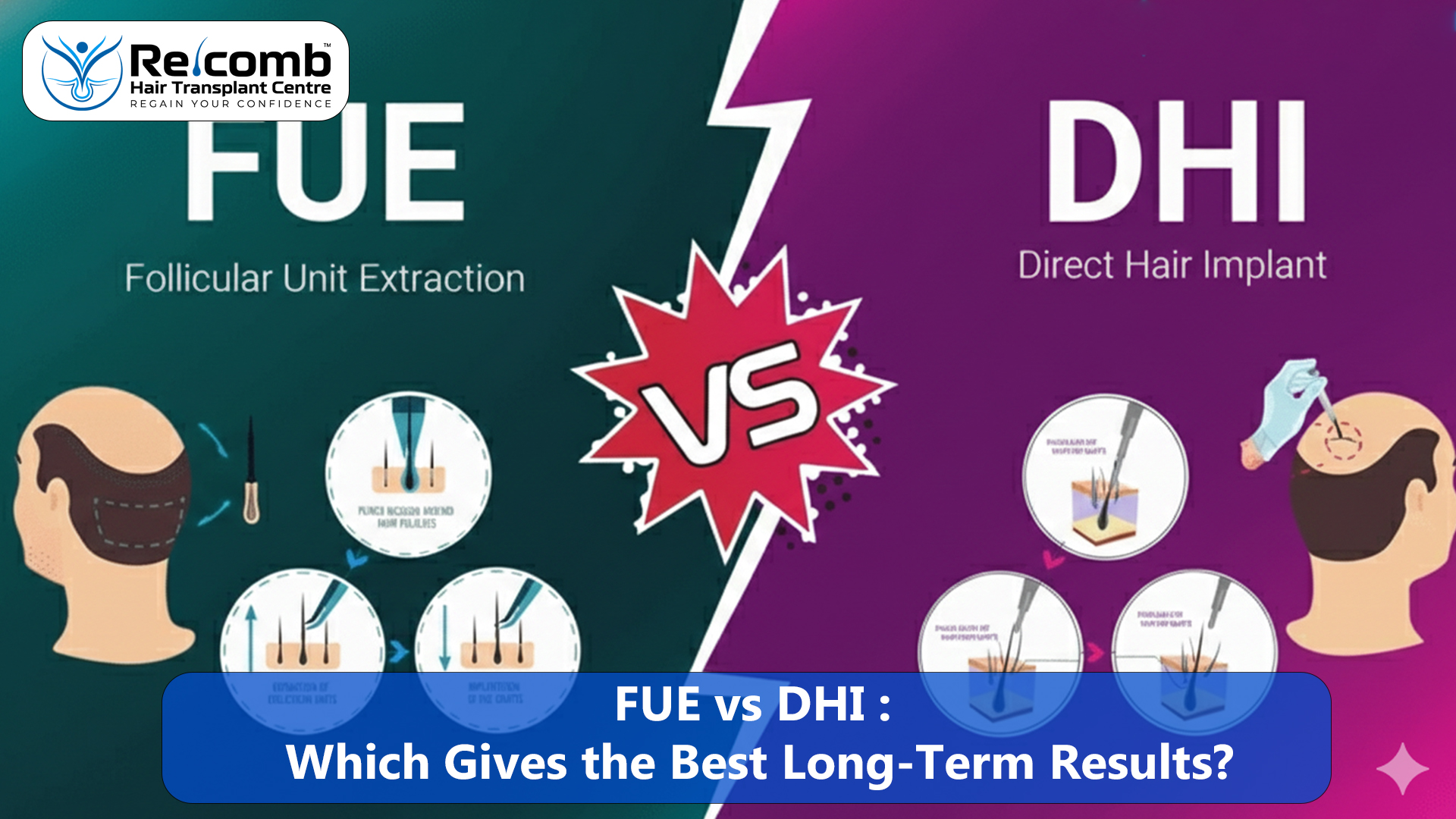
When researching hair transplant options, most patients come across two terms: FUE and DHI. Clinics often market DHI as more advanced, more precise, or superior in growth.
But when we focus strictly on long-term results, the real comparison becomes clearer.
At RECOMB Hair Transplant Centre, treatment decisions are based on long-term follicle survival, donor preservation, and aesthetic planning—not marketing terminology.
Let’s break it down objectively.
What Is FUE?
FUE (Follicular Unit Extraction) involves:
-
Extracting individual follicular units
-
Creating recipient sites using blades or needles
-
Placing grafts manually into those sites
FUE refers primarily to the extraction method, not implantation style.
What Is DHI?
DHI (Direct Hair Implantation):
-
Also uses FUE for extraction
-
Uses a Choi implanter pen
-
Combines channel creation and implantation in one step
So technically, DHI is a modified implantation technique within FUE, not a completely different surgery.
Core Technical Difference
| Factor | FUE | DHI |
|---|---|---|
| Extraction | FUE method | FUE method |
| Channel Creation | Pre-made slits | Created during implantation |
| Tool Used | Blade/needle | Implanter pen |
| Control | High (experienced hands) | High (pen-based precision) |
The extraction is identical in both.
The difference lies in how grafts are inserted.
Long-Term Results: What Truly Matters
When evaluating long-term success, we consider:
-
Graft survival rate
-
Donor preservation
-
Natural hairline design
-
Density planning
-
Progression of native hair loss
Blade or pen alone does not determine these outcomes.
Does DHI Improve Graft Survival?
DHI claims include:
-
Reduced graft handling
-
Shorter out-of-body time
-
Improved survival
In reality:
If graft handling protocol is good, survival rates between FUE and DHI are very similar.
Improper technique can ruin both.
Density Comparison in the Long Term
Some clinics advertise DHI as capable of higher density.
However:
-
Excessive density risks vascular compromise
-
Overpacking reduces survival
-
Blood supply determines safe graft limit
Safe density principles apply equally to both methods.
Natural Hairline Results
Hairline naturalness depends on:
-
Single-hair graft placement
-
Angle and direction control
-
Artistic design
-
Surgeon experience
Both FUE and DHI can produce natural results if performed correctly.
Poor artistry cannot be corrected by tool choice.
Donor Area Preservation
Long-term planning requires:
-
Conservative extraction
-
Even distribution
-
Avoiding overharvesting
This depends on surgical discipline—not FUE vs DHI.
Healing and Recovery
Healing differences are minimal when:
-
Proper technique is used
-
Trauma is minimized
-
Post-op care is correct
Claims of dramatically faster healing are often marketing exaggerations.
When DHI May Be Preferable
DHI can be useful in:
-
Small areas (eyebrows, beard, minor temple work)
-
Cases requiring minimal shaving
-
High precision in confined zones
It is not universally superior.
When Standard FUE Is Preferable
FUE is efficient for:
-
Large bald areas
-
Mega sessions
-
High graft counts
-
Structured density layering
It allows flexibility and scalability.
What Actually Determines Long-Term Results
The most important factors are:
-
Surgeon involvement
-
Graft hydration protocol
-
Proper storage solution
-
Controlled implantation timing
-
Realistic density planning
-
Ongoing hair loss management
Tool selection is secondary.
RECOMB’s Ethical Position (2026)
At RECOMB:
-
Both FUE and DHI are tools—not marketing labels
-
Technique is chosen based on case requirement
-
Long-term donor safety is prioritized
-
Density is planned scientifically
-
Patient education comes first
We focus on results that look natural 10 years later, not just on day one.
Final Medical Verdict
Which gives better long-term results?
Neither FUE nor DHI automatically wins.
Long-term success depends on:
-
Proper planning
-
Ethical extraction
-
Controlled implantation
-
Ongoing hair stabilization
Choose the right surgeon—not just the right technique.
Contact RECOMB Hair Transplant Centre
Phone: +91 7624008000
Website: www.recombhair.com