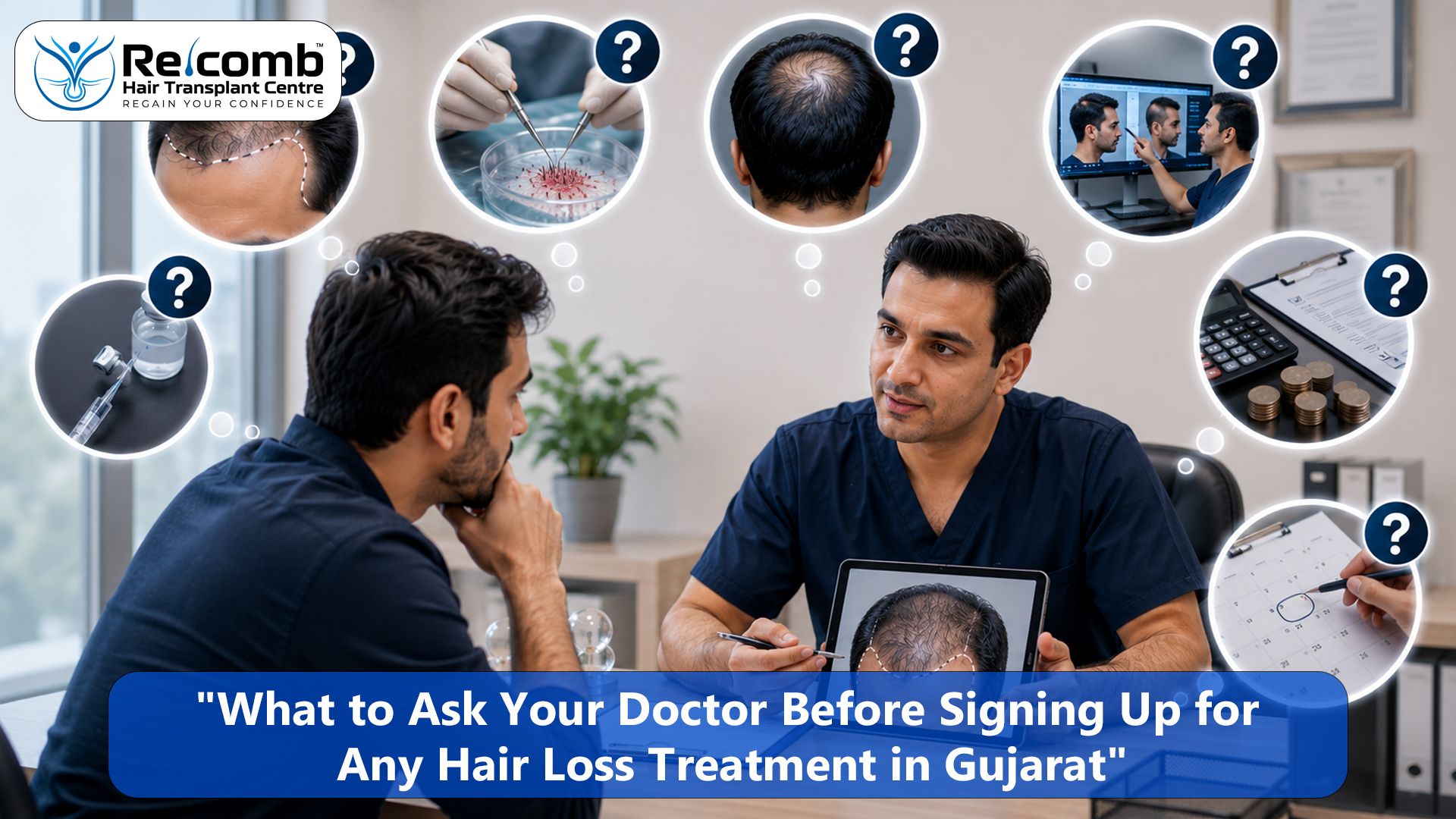
Most patients walk into a hair loss consultation prepared to listen and answer questions, not to ask them. They describe their concern, the doctor examines their scalp, a recommendation is made, and the patient agrees because the doctor is the expert and questioning feels presumptuous.
This dynamic works reasonably well when the recommendation is sound. It works very badly when it is not, because the patient has no framework for evaluating what they were just told. Hair loss treatment in Gujarat spans a wide range of clinical quality, from rigorous, evidence-based practice to commission-driven upselling, and the only reliable way to tell the difference is to ask specific, informed questions before agreeing to anything.
This blog provides the exact questions worth asking, why each one matters clinically, and what a good answer versus a concerning answer sounds like.
If you want to go through these questions directly with a doctor who will answer them transparently, a consultation at RECOMB is the place to do that.
Book a Transparent Hair Loss Consultation at RECOMB, Surat →
WhatsApp: +91 7624008000 | www.recombhair.com
Question 1: What Type of Hair Loss Do I Have, and How Was That Determined?
This is the foundational question and it should never be skipped. Hair loss has multiple distinct causes, androgenetic alopecia, telogen effluvium, nutritional deficiency, thyroid dysfunction, alopecia areata, and scarring alopecias among others, and each requires a different treatment approach.
A good answer specifies the diagnosis clearly and references what examination or test confirmed it: trichoscopy findings, blood test results, or a specific clinical pattern observed. A concerning answer is vague, such as simply stating "hair loss" or "thinning" without a specific diagnosis, or moving directly to a treatment recommendation without explaining how the diagnosis was reached.
If trichoscopy was not performed and blood tests were not discussed, ask directly why not. There are limited circumstances where a diagnosis is visually obvious enough not to require further testing, but this should be explained, not assumed.
Question 2: What Is Causing This Specifically, and Is It Reversible?
Beyond the type of hair loss, the underlying cause matters for treatment planning. Androgenetic alopecia driven by DHT requires a different long-term strategy than hair loss driven by an iron deficiency or a thyroid condition, even though both might present with similar visible thinning.
A good answer explains the specific mechanism believed to be at work and is honest about what can and cannot be reversed. Hair loss from a corrected nutritional deficiency is largely reversible. Follicles that have completely miniaturised from androgenetic alopecia are not. A concerning answer promises reversal of all hair loss regardless of cause or fails to distinguish between what medical treatment can restore versus what can only be addressed surgically.
Question 3: What Are All My Treatment Options, Including the Option to Do Nothing or Wait?
This question reveals whether a doctor is presenting a full clinical picture or steering toward a specific revenue-generating treatment.
A good answer outlines the realistic range of options relevant to the specific diagnosis, which might include medical management, PRP or GFC therapy, mesotherapy, surgical restoration, or in some cases, monitoring without active intervention if the condition is early or uncertain. A concerning answer presents only one option, typically the most expensive one, without acknowledging alternatives or explaining why other options were not recommended for this specific case.
If a patient with early, mild thinning is recommended directly for a hair transplant without any discussion of medical management first, that is worth questioning specifically.
Question 4: If Surgery Is Recommended, Who Will Actually Perform It?
This is one of the most important questions in the entire Gujarat hair transplant market, where technician-led procedures are common at lower price points.
A good answer is direct and specific: the consulting surgeon performs the extraction and implantation personally, or describes precisely what portions of the procedure involve qualified staff versus the surgeon. A concerning answer is evasive, refers vaguely to "our team," or becomes uncomfortable when pressed for specifics about who does what during the actual procedure.
This question deserves to be asked plainly: "Will you personally be performing my extraction and implantation?" A hesitant or qualified response to this direct question is itself meaningful information.
Question 5: How Many Grafts Do I Actually Need, and How Was That Number Calculated?
Graft numbers should follow from a specific assessment, not from a standard package the clinic offers to everyone.
A good answer references the patient's specific donor density, the size of the recipient area requiring coverage, and the desired density target, explaining how these factors combine to produce the recommended graft number. A concerning answer offers a round, package-style number without reference to any specific measurement of the patient's own scalp, or recommends a graft count significantly higher than what the visible hair loss would seem to require.
A useful follow-up question: "What is my estimated lifetime donor capacity, and what percentage of that does this procedure use?" Few low-cost clinics can answer this because few perform the density measurement required to know.
Question 6: What Is My Donor Area's Total Lifetime Capacity?
This question specifically tests whether the clinic thinks about treatment in terms of a single transaction or a lifetime relationship with the patient's hair loss.
A good answer gives a specific estimated range, typically between 4,000 and 6,000 grafts for most patients, based on the trichoscopic density measurement taken during assessment, and explains how the current recommendation fits within that lifetime budget. A concerning answer is unable to provide any estimate, suggests the donor area is essentially limitless, or has never discussed lifetime capacity as a concept.
Any clinic using language like "unlimited grafts" has failed this question definitively. No legitimate answer to this question includes the word unlimited.
Question 7: How Will My Hairline Be Designed, and Why That Specific Position?
This question tests whether hairline placement is a considered clinical decision or an arbitrary line drawn to satisfy the patient's immediate preference.
A good answer explains the reasoning: the patient's current age, facial structure, projected future hair loss, and why the proposed position will remain appropriate as the patient ages. A concerning answer simply asks the patient where they want the hairline and draws it there without further discussion, or recommends a position notably lower than what would be conservative for the patient's age and projected hair loss trajectory.
Question 8: What Does Aftercare and Follow-Up Actually Involve?
The months following a procedure matter as much as the procedure itself, and follow-up commitment varies enormously between clinics.
A good answer describes a specific schedule of follow-up appointments, typically at one month, three months, six months, and twelve months, and clarifies whether these are included in the quoted price or billed separately. A concerning answer is vague about follow-up, suggests it is unnecessary, or reveals that follow-up would require travelling back to a different city or country with limited accessibility.
Question 9: What Happens If There Is a Complication?
This question is uncomfortable to ask but important, particularly for any clinic where the operating team is not easily accessible after the procedure.
A good answer describes a clear process: who to contact, how quickly they can be seen, and what the clinic's role is in managing any post-operative issue. A concerning answer is dismissive of the question, suggests complications essentially never happen, or cannot describe a clear escalation process.
Question 10: Can I See Verified Results From Patients With a Similar Hair Loss Pattern to Mine?
Generic before-and-after galleries are easy to curate for maximum visual impact. Asking specifically for results comparable to your own case is more revealing.
A good answer can show or describe results from patients at a similar Norwood or Ludwig stage, similar age, and similar donor characteristics, and is transparent about the range of outcomes rather than only the best cases. A concerning answer shows only dramatic transformation photos without context about graft count, technique, or how representative that result actually is.
Question 11: What Is Included in the Total Price, and What Could Add to It Later?
This question protects against the gap between an attractive headline price and the actual total cost of treatment.
A good answer itemises clearly: the procedure, anaesthesia, medications, follow-up consultations, and any adjunct treatments included, alongside an honest statement of what is not included and what those additional items would cost if needed. A concerning answer is reluctant to itemise, or the quoted price changes significantly once the patient is further along in the consultation process.
Why These Questions Matter More Than They Might Seem
None of these questions are aggressive or distrustful by nature. They are the questions a thorough, ethical doctor expects and welcomes, because the answers reflect exactly the process that should have already taken place during a proper assessment. A doctor who becomes defensive or evasive when asked these questions directly is providing information just as valuable as a doctor who answers them clearly and specifically.
Patients in Gujarat researching hair loss treatment are often comparing clinics primarily on price and proximity. These eleven questions provide a far more reliable comparison framework, because they reveal the clinical process behind the price rather than the price alone.
RECOMB's Approach (2026)
At RECOMB Hair Transplant Centre, Surat, every one of these questions is addressed proactively during the consultation process, before the patient even needs to ask. Dr. Krishna Bhalala and Dr. Nilesh Kachhadiya explain the diagnosis and how it was reached, present the full range of treatment options relevant to the specific case, confirm directly who performs the procedure, walk through the lifetime graft budget calculation, explain the hairline design reasoning, and itemise the complete cost including follow-up.
Patients are welcome and encouraged to ask every question on this list directly. A consultation that cannot withstand this level of scrutiny is not one we would consider adequate for our own patients.
Ask Us Everything on This List at Your Consultation →
WhatsApp: +91 7624008000 | www.recombhair.com
Final Takeaway
The single biggest difference between patients who are satisfied with their hair loss treatment a decade later and those who regret their decision is rarely the technology used or even the specific clinic chosen. It is whether the patient understood, at the time of the decision, exactly what was being recommended, why, and what the realistic long-term picture looked like.
Asking these eleven questions before signing up for any treatment, surgical or non-surgical, gives every patient in Gujarat the information needed to make that decision well, regardless of which clinic they ultimately choose.
Dr. Krishna Bhalala and Dr. Nilesh Kachhadiya conduct a limited number of personal consultations each week at RECOMB, Surat. If you want straight answers to all of these questions for your own specific case, this is where that conversation starts.
Get Straight Answers Before You Decide on Any Treatment →
WhatsApp: +91 7624008000
We respond within 24 hours, 6 days a week.
www.recombhair.com
Contact RECOMB Hair Transplant Centre
RECOMB Hair Transplant Centre
19, Ground Floor, Zenon Building, Opp. Unique Hospital, near Kiran Motors, Khatodara Wadi, Surat, Gujarat 395001
Phone: +91 7624008000
Website: www.recombhair.com