
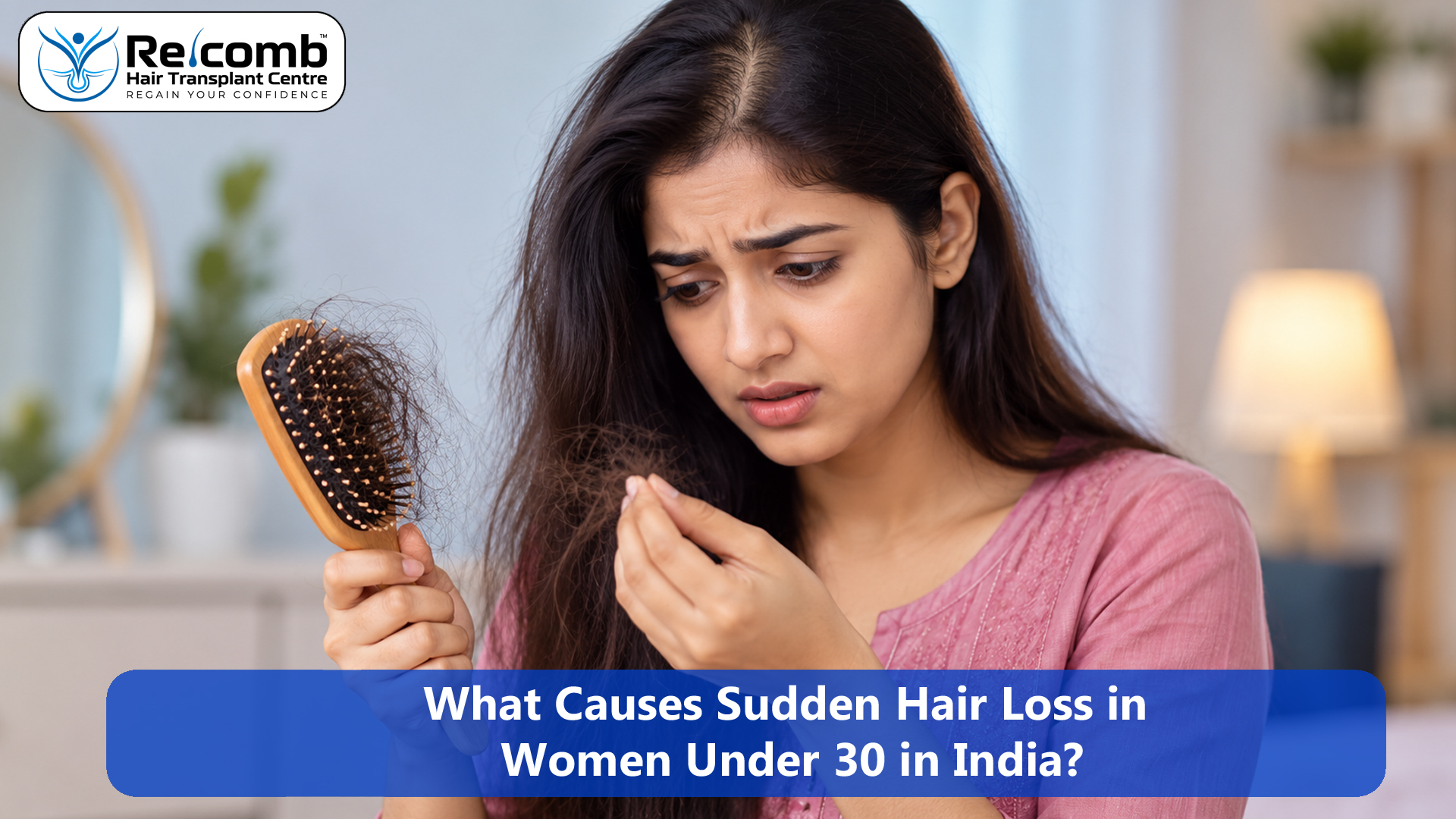
Hair loss in women under 30 is frequently dismissed as stress or attributed to the wrong cause, leading to months of ineffective treatment while the actual driver continues unmanaged. In Indian women specifically, the combination of dietary patterns, hormonal conditions, and environmental stressors creates a clinical picture that is more complex than simple stress-related shedding in a significant proportion of cases.
The causes discussed below are the most commonly identified drivers in young Indian women presenting with sudden or rapidly progressing hair loss. Most are diagnosable through a combination of clinical assessment and targeted blood investigations. Most are treatable when correctly identified.
If you are a woman under 30 experiencing sudden or worsening hair loss, a clinical assessment at RECOMB gives you a specific diagnosis rather than a generalised explanation.
Book a Female Hair Loss Assessment at RECOMB, Surat →
WhatsApp: +91 7624008000 | www.recombhair.com
Iron Deficiency and Low Ferritin
This is the most common and most underdiagnosed driver of hair loss in young Indian women. A predominantly vegetarian diet, heavy menstrual bleeding, and inadequate dietary iron together create a high-prevalence iron deficiency environment that directly impairs hair follicle function.
The relevant investigation is serum ferritin, not just haemoglobin. A patient can have a normal haemoglobin but critically low ferritin, the storage form of iron that follicles draw on during the metabolic demands of the anagen phase. Ferritin below 30 nanograms per millilitre is associated with increased hair shedding. Below 12, the effect on hair quality and growth cycle is significant.
Correction through dietary management and supplementation under medical supervision produces visible improvement in shedding and shaft quality within three to four months of bringing ferritin levels to an optimal range. This is one of the most completely reversible causes of hair loss in this age group.
Thyroid Dysfunction
Hypothyroidism is significantly more prevalent in Indian women than global averages suggest, and it frequently presents in the late twenties with hair loss as an early or prominent symptom. As discussed in the thyroid and hair loss blog, both hypothyroidism and hyperthyroidism disrupt the hair growth cycle through thyroid hormone receptors in the dermal papilla.
The important clinical point is that subclinical hypothyroidism, where TSH is mildly elevated but T3 and T4 remain within low-normal range, can drive meaningful hair loss without producing the classical symptoms of thyroid dysfunction. A TSH-only test misses this in a proportion of patients. A full thyroid panel including free T3 and free T4 is required.
Thyroid-related hair loss is largely reversible when thyroid levels are corrected through appropriate treatment. Patients who have been losing hair for months while being told their thyroid is fine based on a TSH-only result deserve a complete panel repeat.
Polycystic Ovarian Syndrome
PCOS affects a substantial proportion of Indian women in their reproductive years and is one of the primary hormonal drivers of early androgenetic alopecia in women under 30. Elevated androgens including testosterone and DHT in PCOS accelerate follicle miniaturisation in genetically susceptible patterns, producing a Ludwig-type diffuse thinning that progresses faster than it would in the absence of androgen excess.
PCOS-related hair loss does not respond adequately to treatments that do not address the hormonal component. Topical minoxidil supports density but does not reduce the androgenic driver. Anti-androgen medications including spironolactone or low-dose oral contraceptives with anti-androgenic activity, prescribed under appropriate medical supervision, address the hormonal component directly and are often the most effective intervention for PCOS-related hair loss in this age group.
The investigation includes a hormonal panel covering free and total testosterone, DHEAS, and LH/FSH ratio alongside pelvic ultrasound. Patients with irregular menstrual cycles, acne, and hair loss should be specifically assessed for PCOS rather than having the hair loss managed in isolation.
Telogen Effluvium From Identifiable Triggers
Acute telogen effluvium is the temporary diffuse shedding that follows a significant physiological stressor by six to twelve weeks. In women under 30, the most common triggers in India are:
Crash dieting or rapid weight loss, common in this age group, deprives follicles of the nutritional support needed during the anagen phase and pushes a large cohort into telogen simultaneously.
Post-illness shedding following fever, viral infection, or COVID-related illness is well-documented and typically produces a wave of shedding two to three months after the acute illness.
Stopping oral contraceptives produces a hormonal shift that mimics post-partum shedding in some women. The shedding begins within weeks to months of stopping the pill and resolves within six months in most cases.
Post-partum shedding itself, while less common in under-30 patients, is relevant for women who have recently delivered. The post-delivery oestrogen withdrawal that normalises after pregnancy produces significant synchronised shedding that is temporary and self-limiting.
All of these are reversible when the trigger resolves. The clinical management is identifying and confirming the trigger, giving accurate timeline expectations, and investigating for any nutritional contributors that may be prolonging the shedding beyond the expected window.
Alopecia Areata
Alopecia areata, the autoimmune condition discussed in the dedicated blog, has a significant incidence in young women. It presents as discrete patchy loss that can be mistaken for traction alopecia or fungal infection. Trichoscopy distinguishes it definitively. It is treated with intralesional corticosteroids in most cases and responds well when caught early.
Nutritional Deficiencies Beyond Iron
Vitamin D deficiency has a high prevalence in India, including in young women, due to indoor lifestyles, sun avoidance, and pigmented skin that reduces UV synthesis efficiency. Low vitamin D is associated with disruption of the hair cycle and increased resting phase proportion.
Protein deficiency in a predominantly vegetarian population that does not actively manage protein intake, as discussed in the Gujarat hair loss blog, reduces the shaft quality and growth cycle robustness of every follicle. Young women who follow calorie-restricted or low-protein diets for weight management are particularly susceptible.
Zinc deficiency, less commonly measured but relevant, is a cofactor in keratin synthesis and follicle cycling. Its deficiency compounds the effect of other nutritional gaps.
A targeted blood panel covering ferritin, vitamin D, zinc, complete blood count, thyroid function, and hormonal markers gives a complete nutritional and hormonal picture in most young women presenting with sudden hair loss.
RECOMB’s Approach (2026)
At RECOMB Hair Transplant Centre, Surat, young women presenting with sudden hair loss receive a diagnostic-first consultation that does not assume stress or genetics as the explanation without evidence. Dr. Krishna Bhalala’s background as a DNB Dermatologist means that the full differential diagnosis specific to this age group is evaluated through trichoscopy and targeted blood investigations before any treatment is recommended.
Surgery is rarely the answer for women under 30 with sudden hair loss. The correct answer in most cases is identifying and treating the specific medical, nutritional, or hormonal driver. When that is done correctly, the majority of patients in this age group see meaningful improvement without any surgical intervention.
Get a Diagnosis-First Assessment for Female Hair Loss at RECOMB →
WhatsApp: +91 7624008000 | www.recombhair.com
Final Takeaway
Sudden hair loss in women under 30 in India is almost never simply stress. It has specific, identifiable causes, most of which are treatable when correctly diagnosed. Iron deficiency, thyroid dysfunction, PCOS, telogen effluvium from a specific trigger, alopecia areata, and nutritional deficiencies are the most common drivers. Each requires its own investigation and management approach.
Getting the diagnosis right is the step that changes the outcome. A patient with low ferritin who receives iron supplementation and recovers fully needed a blood test and a supplement. The same patient given biotin and reassurance about stress lost months on the wrong treatment.
Dr. Krishna Bhalala and Dr. Nilesh Kachhadiya conduct a limited number of personal consultations each week at RECOMB, Surat. If you are a woman under 30 experiencing sudden or worsening hair loss, this is where the right investigation starts.
Get a Specific Diagnosis for Your Hair Loss at RECOMB →
WhatsApp: +91 7624008000
We respond within 24 hours, 6 days a week.
www.recombhair.com
Contact RECOMB Hair Transplant Centre
RECOMB Hair Transplant Centre
19, Ground Floor, Zenon Building, Opp. Unique Hospital, near Kiran Motors, Khatodara Wadi, Surat, Gujarat 395001
Phone: +91 7624008000
Website: www.recombhair.com