
FUE and DHI are the two most commonly discussed hair transplant techniques in India today. Both extract grafts using the FUE punch method. The difference lies entirely in how grafts are implanted. Understanding this distinction is useful because marketing has made it seem more complex and more consequential than the clinical reality warrants.
The technique choice at RECOMB follows from the patient’s specific clinical parameters, not from a default preference or a premium pricing structure. This blog explains what the actual difference is and how the decision is made.
What FUE and DHI Actually Mean
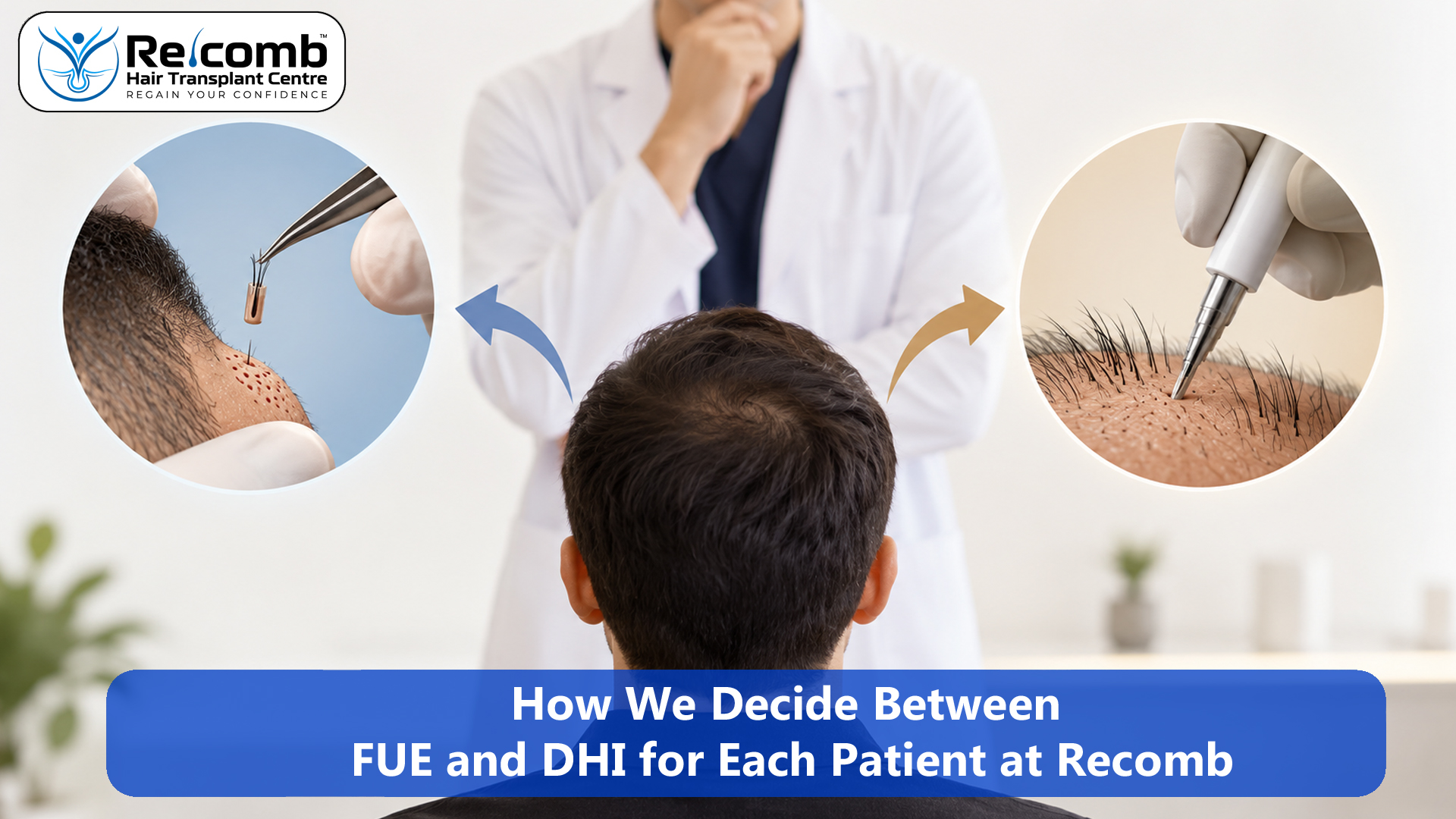
In standard FUE, the procedure has two distinct phases. First, the surgeon creates recipient sites across the thinning area using a blade or needle. Then grafts are implanted into those pre-made sites using fine forceps.
In DHI, Direct Hair Implantation, grafts are loaded into a Choi implanter pen and placed directly into the scalp without pre-made sites. The implanter creates the site and deposits the graft simultaneously in a single motion.
Both techniques use the same FUE extraction. The difference is in implantation method only.
What DHI Offers Clinically
The Choi implanter provides two specific advantages over standard forceps implantation in the right clinical context.
Reduced graft handling time. Because the graft is loaded into the pen and implanted in a single step, the time each graft spends exposed between extraction and placement is reduced. This is most meaningful in the later stages of a procedure when early-extracted grafts have been waiting longest.
Consistent implantation depth. The implanter pen controls depth mechanically, reducing the variation in depth that can occur with forceps implantation across a long procedure. Consistent depth across all grafts is a factor in uniform growth distribution.
These advantages are real but modest. The difference between well-executed forceps implantation and well-executed DHI, in terms of graft survival and result naturalness, is smaller than marketing suggests.
Where Standard FUE Has the Advantage
Standard FUE with pre-made sites gives the surgeon greater control over recipient site density planning. Because sites are created before any grafts are placed, the surgeon can assess the full recipient zone, adjust density decisions zone by zone based on what is seen, and calibrate the size of each site precisely to the graft type being placed there.
This flexibility is particularly valuable in the frontal hairline zone where the transition from single-hair grafts at the very front edge to progressively denser multi-hair grafts behind requires fine density calibration. It is also valuable in dense packing sessions where site density must be carefully managed to respect the scalp’s vascular capacity.
DHI implanters are manufactured in specific sizes. Using an implanter sized for a single-hair graft to place a two-hair graft, or vice versa, compromises the implantation quality. In procedures with a mixed graft type distribution, as most natural-looking results require, the standard FUE approach allows more precise graft type matching to site size.
How RECOMB Decides
The decision at RECOMB is based on the specific clinical profile of each patient and procedure, not on a standing preference for one technique.
DHI is favoured when graft survival optimisation is the primary concern, particularly in larger sessions where out-of-body time for late-implanted grafts is most significant. It is also favoured when the recipient area requires implantation without shaving, which the Choi pen facilitates, allowing the procedure to be performed in a largely unshaved field where the existing hair helps guide natural angulation.
Standard FUE with pre-made sites is favoured when the recipient zone requires fine density calibration across multiple graft types, when the hairline design requires the detailed site-by-site planning that is easier to execute before grafts are placed, and when the total graft mix includes a high proportion of two and three hair units that need precisely sized sites for optimal placement.
In many procedures, both approaches are used in different zones. The frontal hairline may be executed with pre-made sites for precision, while the midscalp and crown are implanted with the Choi pen for density and handling efficiency.
What This Means for Patients
The technique used is less important than the surgeon using it. A DHI procedure performed by an experienced surgeon produces excellent results. FUE performed by the same surgeon produces equally excellent results when the clinical parameters call for it. A DHI procedure performed by technicians with limited supervision does not produce better outcomes than well-executed standard FUE because the technique advantage is negated by the execution deficit.
Patients who arrive requesting DHI specifically because they read that it is more advanced or produces better results are often surprised to learn that the evidence does not support a categorical superiority claim. They are less surprised when it is explained that the reason is that both techniques, in the right hands with the right patient selection, produce outcomes that are clinically equivalent at the result level.
Book a Technique Planning Consultation at RECOMB, Surat →
WhatsApp: +91 7624008000 | www.recombhair.com
RECOMB’s Approach (2026)
At RECOMB Hair Transplant Centre, Surat, Dr. Krishna Bhalala and Dr. Nilesh Kachhadiya are experienced with both techniques and apply each based on clinical indication. The technique decision is made as part of the pre-surgical planning process, explained to the patient with the specific reasoning behind it, and may involve a combination of approaches across different zones of the same procedure.
Patients are never upsold DHI as a premium option that will produce a better result than standard FUE when their clinical profile does not specifically indicate it. The technique serves the patient’s result, not the clinic’s pricing structure.
Final Takeaway
FUE and DHI differ in implantation method only. Both have specific clinical advantages in specific contexts. The decision between them should follow from the patient’s individual clinical parameters, the zones being treated, and the graft mix planned, not from marketing positioning or patient preference for a technique name.
At RECOMB, the technique is chosen to serve the result. The result is planned to serve the patient for decades.
Dr. Krishna Bhalala and Dr. Nilesh Kachhadiya conduct a limited number of personal consultations each week at RECOMB, Surat. If you want to understand which technique is appropriate for your specific case and why, this is where that clinical decision is explained transparently.
Understand Which Technique Is Right for Your Case at RECOMB →
WhatsApp: +91 7624008000
We respond within 24 hours, 6 days a week.
www.recombhair.com
Contact RECOMB Hair Transplant Centre
RECOMB Hair Transplant Centre
19, Ground Floor, Zenon Building, Opp. Unique Hospital, near Kiran Motors, Khatodara Wadi, Surat, Gujarat 395001
Phone: +91 7624008000
Website: www.recombhair.com