
Mesotherapy is one of the most commonly offered non-surgical hair loss treatments in India, yet most patients who undergo it have only a vague understanding of what it actually does. They know it involves injections into the scalp. They know it is supposed to help with hair loss. Beyond that, the mechanism is unclear.
This matters because understanding how a treatment works helps patients set realistic expectations, follow through on the correct number of sessions, and make informed decisions about whether it is the right treatment for their specific type and stage of hair loss.
This blog explains what mesotherapy does at the cellular level, in plain language, without unnecessary complexity.
If you are considering mesotherapy for hair loss and want to know whether it is appropriate for your specific condition, a clinical assessment at RECOMB gives you a direct answer.
Book a Hair Loss Treatment Consultation at RECOMB, Surat → WhatsApp: +91 7624008000 | www.recombhair.com
What Mesotherapy Actually Delivers to the Scalp
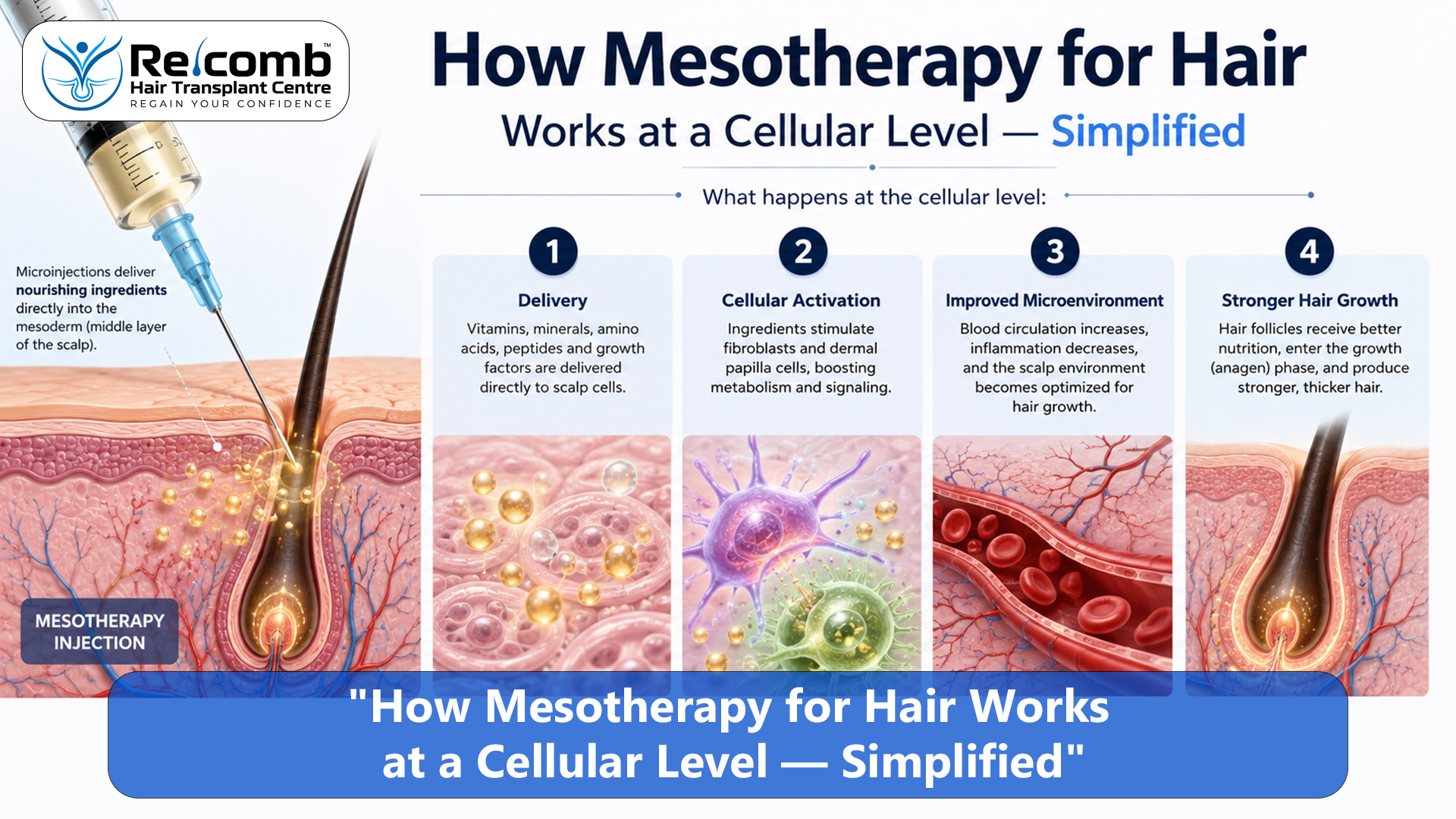
Mesotherapy is a microinjection technique. Using a very fine needle or a multi-needle device, small volumes of a prepared solution are injected directly into the mesoderm, the middle layer of tissue in the scalp, at the level of the hair follicle.
The solution delivered is not a single compound. It is a formulated mixture whose composition varies depending on the clinical indication and the practitioner. For hair loss treatment, a standard mesotherapy solution typically contains a combination of the following:
Vitamins, particularly biotin, vitamin B complex including B5 and B6, and vitamin C, which support keratin synthesis, cellular energy production in the follicle, and collagen formation in the dermal papilla.
Minerals including zinc and copper, which are cofactors in the enzymatic processes that regulate hair follicle cycling and protect against oxidative damage at the follicular level.
Amino acids including cysteine, methionine, and taurine, which are the primary building blocks of keratin, the structural protein that makes up the hair shaft.
Pharmaceutical agents in clinically indicated cases, most commonly minoxidil at low concentration for direct vasodilatory effect on scalp microcirculation, and in some formulations DHT-blocking compounds such as finasteride or saw palmetto extracts delivered locally to reduce androgenic activity at the follicle without systemic absorption.
Hyaluronic acid in some formulations, which supports the extracellular matrix surrounding the follicle and maintains the hydration and structural integrity of the dermal environment.
The key principle is local delivery. These compounds are placed directly at the follicular level rather than being taken orally or applied topically. This bypasses the systemic route, avoids first-pass metabolism, and achieves higher local tissue concentrations than conventional administration methods.
What Happens at the Follicle After Injection
To understand the cellular effect, it helps to briefly understand the structure of the hair follicle and what controls its behaviour.
The hair follicle is not a passive tube. It is a dynamic, cycling organ that alternates between growth phases, resting phases, and shedding phases across a regular cycle. The active growth phase, called anagen, typically lasts two to six years in a healthy follicle. The transitional phase, catagen, lasts a few weeks. The resting phase, telogen, lasts approximately three months before the cycle restarts.
In androgenetic alopecia, DHT shortens the anagen phase progressively with each cycle. The follicle produces shorter, thinner hairs with each successive growth cycle until it produces no visible hair at all. This is miniaturisation.
Mesotherapy acts on this cycle through several mechanisms simultaneously.
Improved Microcirculation
The minoxidil component, where included, acts as a vasodilator on the capillary network supplying the follicle. The dermal papilla at the base of each follicle is entirely dependent on this capillary network for oxygen, glucose, and the raw materials needed for cell division and hair shaft production. Poor scalp circulation is a significant contributor to follicle miniaturisation, particularly in patients with sedentary lifestyles or chronic stress. Improving local blood flow directly improves the metabolic environment of the follicle.
Nutritional Repletion at the Follicular Level
The vitamins, minerals, and amino acids in the mesotherapy solution address follicular nutritional deficiency directly. A follicle that is producing thin, slow-growing hair due to inadequate local availability of zinc, biotin, or cysteine responds to direct replenishment of these nutrients. The advantage of local delivery over oral supplementation is concentration: the amount reaching the follicle via the bloodstream from an oral supplement is a fraction of what is delivered by direct injection into the surrounding tissue.
DHT Reduction at the Receptor Level
Where DHT-blocking agents are included in the formulation, they act locally on the androgen receptors in the follicle's dermal papilla. The dermal papilla is the structure at the base of the follicle that regulates the anagen phase. DHT binding to receptors here is the primary mechanism of miniaturisation in androgenetic alopecia. Blocking this locally, without the systemic DHT reduction that oral finasteride produces, is particularly relevant for patients who cannot tolerate or do not wish to take oral finasteride.
Dermal Matrix Support
The extracellular matrix surrounding the follicle provides structural support and signalling cues that regulate follicle cycling. Hyaluronic acid and the amino acid components of the solution support this matrix, improving the microenvironment in which the follicle operates and reducing the collagen degradation that contributes to follicle miniaturisation in chronic hair loss.
Reduction of Scalp Inflammation
Chronic low-grade inflammation around hair follicles is a contributing factor in several types of hair loss including androgenetic alopecia and seborrheic dermatitis-related loss. Certain components of mesotherapy formulations, including antioxidant vitamins and some botanical extracts, have anti-inflammatory activity at the follicular level. Reducing this inflammatory load improves the follicular environment and supports the anagen phase.
What Mesotherapy Can and Cannot Do
This is the section that matters most for setting correct expectations.
Mesotherapy can extend the anagen phase of follicles that are still active, reducing the rate at which they progress toward miniaturisation. It can improve hair shaft diameter and hair quality in miniaturising follicles that have not yet stopped producing hair. It can reduce diffuse shedding caused by nutritional deficiency or scalp inflammation. It can deliver DHT-blocking activity locally in patients who cannot take systemic medication.
Mesotherapy cannot restore follicles that have completely miniaturised. It cannot regrow hair in areas that are visibly bald. It cannot replace medical management with finasteride and minoxidil in patients with confirmed androgenetic alopecia who are suitable for those treatments. It cannot replace a hair transplant in patients whose loss has advanced beyond what preservation therapy can address.
The clinical role of mesotherapy is preservation and support, not restoration. Used at the right stage, in the right patient, as part of a broader treatment plan, it contributes meaningfully to maintaining hair density over time. Used as a standalone treatment for advanced loss, or marketed as a substitute for surgery when surgery is indicated, it will disappoint.
Who Benefits Most From Mesotherapy
Mesotherapy is most clinically relevant in the following patient profiles.
Patients with early androgenetic alopecia, Norwood Grade 1 to 3, who want to slow progression while medical management is being initiated or in patients who cannot tolerate systemic medication.
Patients with diffuse hair thinning related to nutritional deficiency where local replenishment complements dietary correction.
Patients with telogen effluvium where scalp inflammation and poor circulation are contributing factors alongside the primary trigger.
Patients post hair transplant surgery where mesotherapy is used to support the survival and growth of transplanted grafts and to maintain the density of surrounding native hair.
Patients who are not yet surgical candidates but want active management of their current hair density.
Mesotherapy is less relevant and less cost-effective in patients with advanced androgenetic alopecia where the majority of follicles in the affected zone have already miniaturised beyond the point of response.
The Treatment Protocol and What to Expect
A standard mesotherapy course for hair loss involves six to eight sessions spaced two weeks apart, followed by monthly maintenance sessions for six months, and then quarterly maintenance thereafter.
Visible results typically begin between the second and fourth session. Patients notice reduced shedding first, followed by improved hair texture, and progressively improved density over three to six months. Full benefit from a course takes approximately six months to assess.
The procedure involves minimal discomfort. Topical anaesthetic cream is applied before the session and the microinjections are quick, with each session lasting 20 to 30 minutes. There is no downtime and patients return to normal activity immediately.
RECOMB's Approach (2026)
At RECOMB Hair Transplant Centre, Surat, mesotherapy is offered as part of a comprehensive, assessment-based treatment plan, not as a standalone offering for anyone who requests it.
Dr. Krishna Bhalala and Dr. Nilesh Kachhadiya assess each patient's follicular health through trichoscopy, blood investigations, and clinical staging before recommending any non-surgical treatment. Mesotherapy is recommended when the clinical profile indicates that local nutritional and circulatory support will produce a meaningful result. It is not recommended when a patient's loss is advanced enough that preservation therapy will not produce visible benefit, or when the correct treatment is surgery.
The formulation used at RECOMB is selected based on the individual patient's clinical picture, addressing the specific deficiencies and mechanisms identified in their assessment rather than applying a standard solution to every patient.
Get a Clinical Assessment Before Starting Any Hair Treatment → WhatsApp: +91 7624008000 | www.recombhair.com
Final Takeaway
Mesotherapy works by delivering a targeted combination of nutrients, circulatory agents, and where indicated DHT-blocking compounds directly to the follicular level, improving the cellular environment in which follicles operate and supporting their continued function through the hair growth cycle.
It is not a dramatic treatment. It does not produce visible transformation in the way a hair transplant does. What it does, used correctly and consistently, is slow the progression of hair loss in follicles that are still active, and do so through a mechanism that is biologically rational and clinically supported.
Understanding what it actually does at the cellular level allows patients to use it appropriately, with realistic expectations, as part of a treatment plan that matches their specific stage and type of hair loss.
Dr. Krishna Bhalala and Dr. Nilesh Kachhadiya conduct a limited number of personal consultations each week at RECOMB, Surat. If you want to know whether mesotherapy is the right treatment for your hair loss, this is where that question gets a clinical answer.
Find Out If Mesotherapy Is Right for Your Hair Loss → WhatsApp: +91 7624008000 We respond within 24 hours, 6 days a week. www.recombhair.com
Contact RECOMB Hair Transplant Centre
Phone: +91 7624008000
Website: www.recombhair.com