
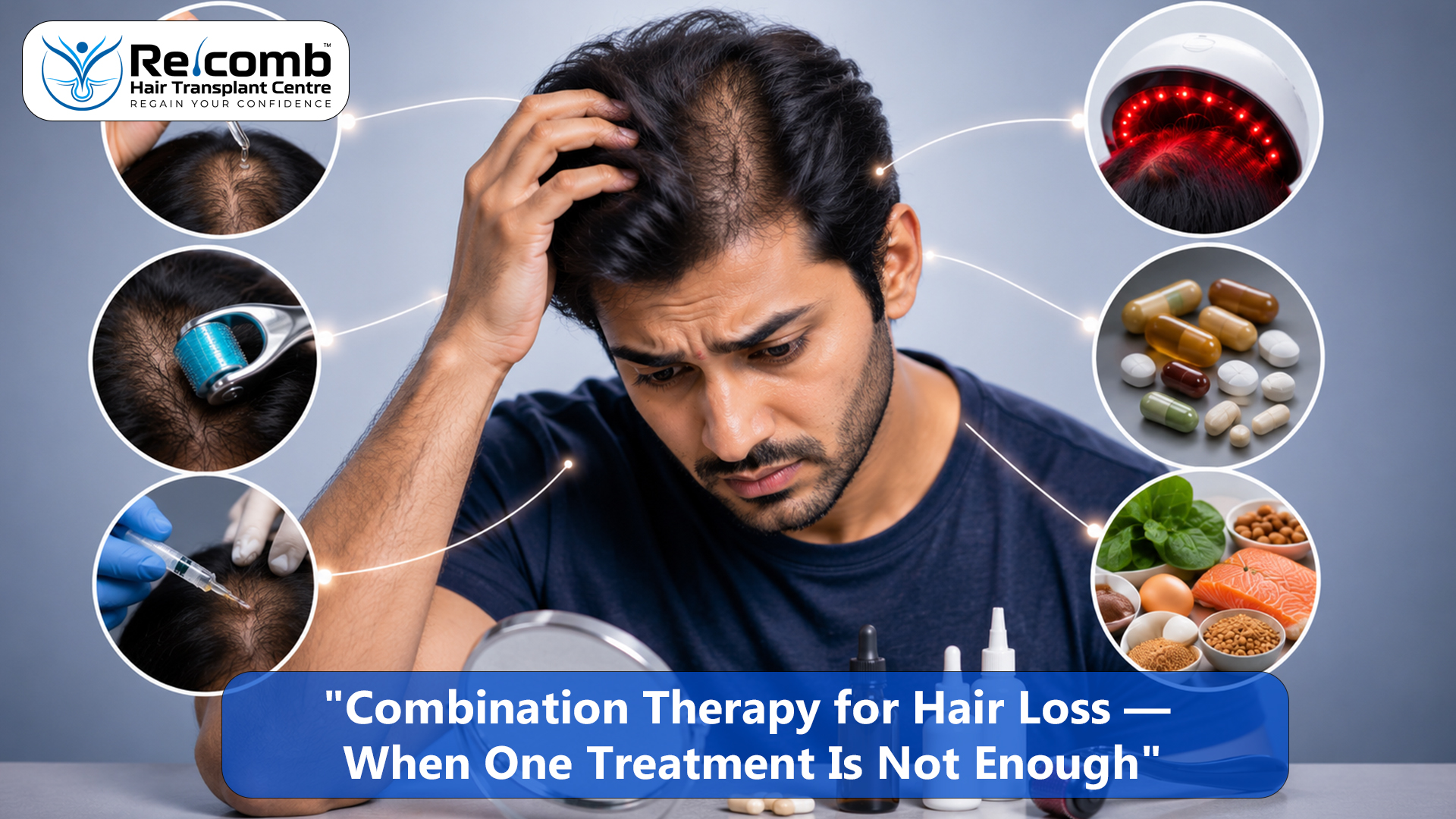
Most patients who seek hair loss treatment arrive with a single treatment in mind. They have read about PRP and want PRP. They have decided they need a transplant. They have been prescribed finasteride and are wondering why it is not enough on its own. The instinct to identify one solution and apply it is understandable, but it reflects a simplified picture of how hair loss actually works.
Hair loss in most patients is not a single-cause problem. Androgenetic alopecia, the most common driver, acts through DHT at the follicle. But the severity and speed of that process is modified by nutritional status, scalp health, circulation, stress, concurrent medical conditions, and the stage at which any intervention begins. A treatment that addresses only one of these dimensions will produce limited results in a patient where multiple factors are active simultaneously.
This blog explains the clinical logic behind combination therapy for hair loss, which combinations are supported by evidence, and how the decision about which treatments to combine and in what sequence is made at RECOMB.
If you have been on a single hair loss treatment without satisfactory results and want to understand what a more complete approach would look like for your specific case, a consultation at RECOMB is the right starting point.
Book a Hair Loss Combination Treatment Assessment at RECOMB →
WhatsApp: +91 7624008000 | www.recombhair.com
Why Single Treatments Frequently Fall Short
Understanding why single treatments are often insufficient requires understanding the multi-layered nature of the problem they are addressing.
Androgenetic alopecia involves DHT binding to follicle receptors, shortening the anagen phase, reducing follicle blood supply, increasing scalp inflammation around susceptible follicles, and over time destroying the dermal papilla structure that sustains the growth cycle. Each of these is a distinct mechanism. Finasteride addresses the DHT binding. Minoxidil addresses circulation and anagen prolongation. GFC and PRP address inflammation and growth factor support. Surgery addresses the structural loss of follicles in affected zones. No single agent addresses all of these simultaneously.
In practice this means a patient on finasteride alone may slow the progression of loss significantly but still experience ongoing thinning because the circulatory and inflammatory components are not addressed. A patient using minoxidil alone may see improvement in density but continued recession because DHT suppression is not in place. A patient who has a hair transplant without medical management post-operatively may see the transplanted grafts perform well while native hair surrounding them continues to thin, progressively undermining the overall result.
Combination therapy is not polypharmacy for its own sake. It is the recognition that a multi-mechanism problem requires a multi-mechanism response, with each treatment contributing to a dimension that others cannot cover.
The Foundation Combination: Finasteride and Minoxidil
For men with confirmed androgenetic alopecia, the evidence base for combining finasteride and minoxidil is more robust than for either agent used alone. This is the most well-studied combination in androgenetic alopecia management and it is the foundation on which other treatments are layered.
Finasteride reduces DHT production by inhibiting 5-alpha reductase, removing the primary driver of follicle miniaturisation. Minoxidil prolongs the anagen phase and improves scalp microcirculation through a completely separate mechanism. Together they address both the hormonal cause and the growth cycle support in parallel, producing better density maintenance and in some patients better partial recovery of miniaturising follicles than either achieves alone.
The clinical expectation from this combination is stabilisation of ongoing loss in the majority of patients and modest density improvement in a proportion of them. It does not restore hair to areas where follicles have already miniaturised completely. It is a maintenance strategy that works best when started early in the loss process.
Adding GFC or PRP: The Biological Support Layer
GFC and PRP therapy add a third dimension to the finasteride and minoxidil foundation. While finasteride reduces the DHT signal and minoxidil improves circulation, GFC and PRP deliver concentrated growth factors directly to the follicular environment, reducing local inflammation, supporting the dermal papilla structure, and stimulating the growth cycle through biological signalling pathways that neither oral nor topical medications address.
The combination of finasteride, minoxidil, and GFC or PRP has a stronger evidence base for density maintenance and modest recovery in early to moderate androgenetic alopecia than any of these used alone or in pairs. The sequencing typically involves establishing finasteride and minoxidil as the ongoing foundation and adding GFC or PRP as a course of four sessions spaced four weeks apart, with maintenance sessions every four to six months thereafter.
This three-layer combination is appropriate for patients who want active management of early to moderate loss without surgery, for patients who are not yet candidates for surgery but want to preserve what remains while stabilisation occurs, and for patients post-transplant who want to support the native hair surrounding their transplanted grafts.
Adding Mesotherapy: The Nutritional and Local DHT Dimension
Mesotherapy adds a fourth dimension relevant for specific patient profiles. As discussed in the mesotherapy blog, it delivers vitamins, amino acids, minerals, and where indicated local DHT-blocking compounds directly to the follicular level, addressing nutritional deficiencies at the site where they matter most and providing localised anti-androgenic activity in patients who cannot or do not wish to take systemic finasteride.
For patients with confirmed nutritional deficiencies contributing to their hair loss alongside androgenetic alopecia, mesotherapy provides follicular nutritional support that oral supplementation alone may not achieve at adequate local concentrations. For patients with oily scalp and seborrheic dermatitis contributing to follicular inflammation, specific mesotherapy formulations address the inflammatory component directly.
Mesotherapy is most useful as an addition to the combination when a specific gap exists that it can address, not as a replacement for any of the three layers described above.
Hair Transplant Surgery Within a Combination Framework
Surgery addresses the dimension that no medical treatment can: the restoration of hair to areas where follicles have already miniaturised and stopped producing visible hair. But surgery within a combination framework means the medical management surrounding it is as deliberately planned as the surgical procedure itself.
Pre-operatively, patients who are on finasteride and minoxidil before surgery tend to achieve better graft survival outcomes because the scalp environment, blood supply, and inflammatory status are better managed than in patients who approach surgery without any prior medical treatment.
Post-operatively, continuing finasteride and minoxidil protects the native hair surrounding transplanted grafts from the ongoing DHT-driven loss that would otherwise continue unchecked. Without this continuation, the result of a technically well-performed transplant progressively deteriorates as surrounding native hair thins, even though the transplanted follicles themselves remain stable.
The addition of GFC or PRP therapy in the three to six month post-operative period is increasingly used to support graft growth during the active phase and to maintain the health of surrounding native hair simultaneously. This combination of surgery plus medical management plus biological support during the growth period produces more consistent and durable outcomes than surgery used as a standalone intervention.
Combination Therapy for Women: A Different Framework
The combination approach for women with hair loss differs significantly from the male framework because the cause profile is different.
Female pattern hair loss is less commonly managed with finasteride, and the evidence base for minoxidil in women is well-established as a first-line agent. For women with confirmed androgenetic alopecia, topical minoxidil forms the medical management foundation rather than the systemic DHT suppression that anchors the male combination.
For women with concurrent thyroid dysfunction, iron deficiency, or vitamin D deficiency, these must be corrected as a prerequisite to assessing the remaining androgenetic component. No combination of topical or injectable treatments will produce optimal results in a woman whose ferritin is critically low or whose thyroid is unmanaged.
GFC therapy in women with early to moderate female pattern hair loss has strong clinical support and is typically combined with minoxidil rather than as an alternative to it. The combination targets both the growth cycle support dimension and the circulatory dimension simultaneously.
For women who are surgical candidates, typically those with established stable pattern loss with adequate donor density, surgery within a combination framework follows a similar principle to the male approach: surgery to restore lost areas, medical management to protect what remains.
How the Combination Is Sequenced
The sequence in which treatments are introduced matters as much as which treatments are chosen.
The typical sequence for a male patient with early to moderate androgenetic alopecia begins with finasteride and minoxidil started simultaneously as the foundation. After three to four months, during which the hormonal and circulatory dimensions are addressed, GFC therapy is introduced as a course to add the biological support layer. Mesotherapy is added where a specific indication exists, such as confirmed nutritional deficiency or localised DHT-blocking need.
After six to twelve months on this combination, the response is assessed through trichoscopy and clinical staging. If stabilisation is achieved and the patient is a surgical candidate, a procedure is planned at this point when the scalp environment is optimally prepared. Post-operatively, the medical combination continues and GFC is used during the growth phase.
This sequence ensures that each treatment is introduced when it can contribute most, that the scalp environment is optimised before any surgical intervention, and that the combination is tailored to the patient's actual response rather than applied uniformly from the outset.
RECOMB's Approach (2026)
At RECOMB Hair Transplant Centre, Surat, combination therapy is planned from the initial consultation based on the clinical assessment findings rather than a standard protocol applied to all patients. Dr. Krishna Bhalala and Dr. Nilesh Kachhadiya assess each patient's specific combination of causative factors, stage of loss, response to prior treatment where relevant, and surgical candidacy before determining which combination of treatments addresses their situation most effectively.
Patients are not prescribed treatments that are not relevant to their clinical picture. A patient with early loss who needs finasteride, minoxidil, and GFC is not recommended mesotherapy unless a specific indication exists. A patient who is not yet a surgical candidate is not recommended surgery. The combination is built from the clinical findings upward, not from a menu downward.
Get a Combination Treatment Plan Built for Your Specific Hair Loss →
WhatsApp: +91 7624008000 | www.recombhair.com
Final Takeaway
Hair loss is a multi-mechanism problem in most patients, and treating it with a single agent addresses only one dimension of that mechanism. Combination therapy, when built on a clinical assessment that identifies which mechanisms are active in a specific patient, produces outcomes that no individual treatment achieves alone.
The key is not combining as many treatments as possible. It is identifying the specific mechanisms driving loss in each patient and selecting the combination of treatments that addresses those mechanisms precisely, in the right sequence, with realistic expectations for what each layer contributes.
Dr. Krishna Bhalala and Dr. Nilesh Kachhadiya conduct a limited number of personal consultations each week at RECOMB, Surat. If you have been on a single treatment without the results you expected, or want to understand what a more complete approach would look like for your case, this is where that conversation starts.
Build a Treatment Plan That Addresses Every Layer of Your Hair Loss →
WhatsApp: +91 7624008000
We respond within 24 hours, 6 days a week.
www.recombhair.com
Contact RECOMB Hair Transplant Centre