
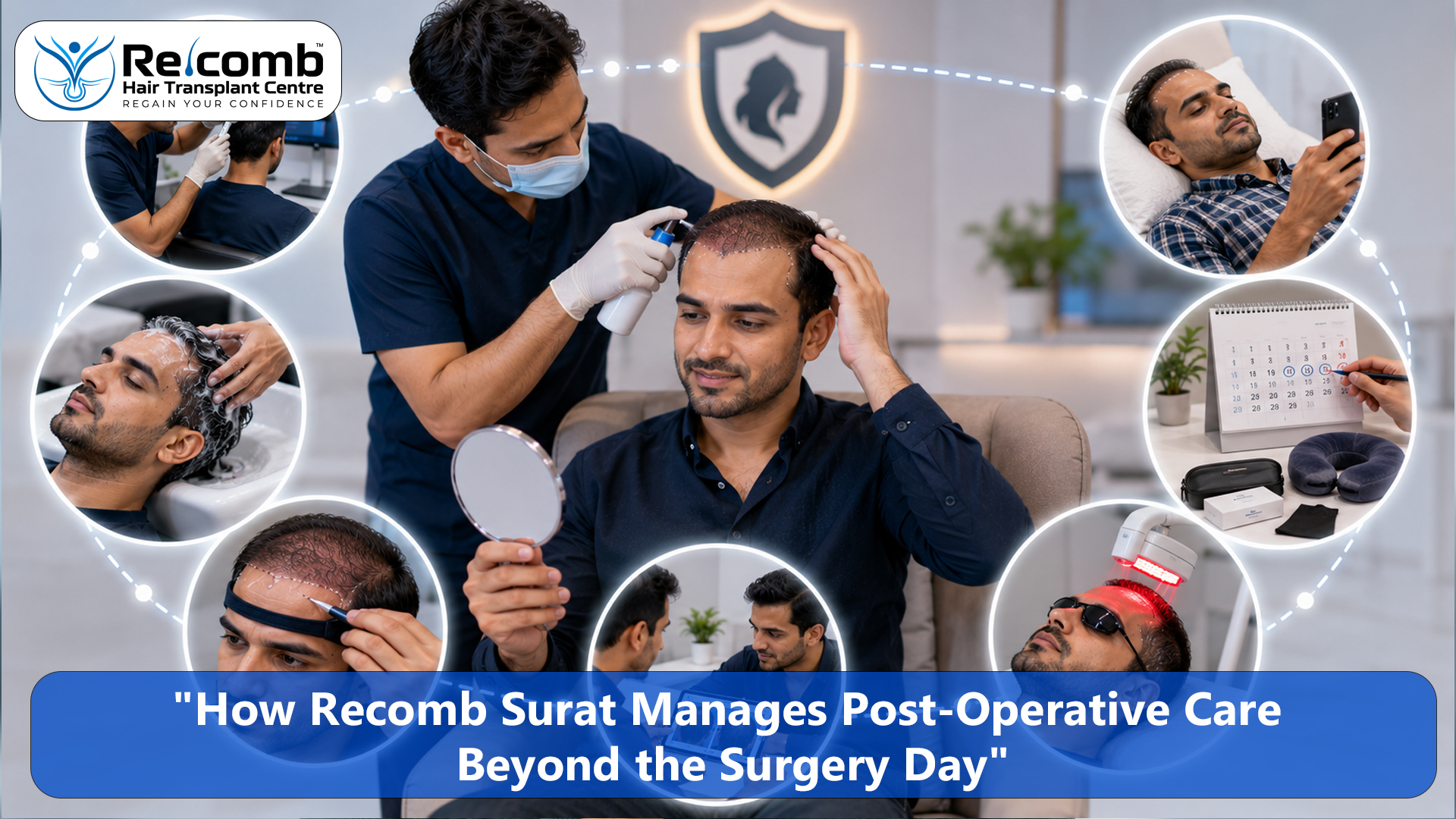
Most patients researching hair transplants focus their attention on the procedure itself: the technique, the surgeon, the graft count. Comparatively little attention goes to what happens after the patient leaves the clinic on surgery day, even though the result of a hair transplant develops over the following 12 to 18 months, not in the hours spent in the operating chair.
Post-operative care is not a courtesy add-on. It is the part of the process where graft survival is protected, complications are caught early, and the final density and naturalness of the result is actively managed rather than left to chance. This blog details exactly how that period is structured at RECOMB.
If you want to understand the complete post-operative protocol before committing to a procedure anywhere, this blog gives you the benchmark to evaluate any clinic against.
Book a Consultation to Discuss Your Full Care Plan at RECOMB →
WhatsApp: +91 7624008000 | www.recombhair.com
The First 72 Hours: The Critical Window
Newly implanted grafts are at their most vulnerable in the first three days after surgery. They have not yet anchored into the surrounding tissue through new blood vessel formation, which means they can be dislodged by direct trauma, excessive friction, or aggressive washing.
At RECOMB, patients leave the clinic on surgery day with specific written instructions covering sleep position, recommended at a 45-degree elevation using extra pillows for the first three to five nights to reduce swelling and protect the recipient area from contact pressure, and activity restriction, avoiding any activity that causes sweating or increases blood pressure to the scalp during this window.
Patients are given a direct contact number for the clinical team during this period, not a general reception line. If swelling extends to the forehead or around the eyes, which is a normal and expected occurrence for many patients around day two to three, patients are instructed on what is normal versus what warrants a call. Excessive swelling is managed with guidance on ice application to the forehead, away from the grafted area, and in some cases a short corticosteroid course if swelling is significant.
Days 4 to 10: The First Wash and Wound Care
The first wash after a hair transplant is a specific clinical procedure, not a return to normal hair washing. At RECOMB, patients are either guided through their first wash at the clinic or given detailed instructions with a video demonstration, depending on patient preference and proximity.
The technique involves a specific sequence: softening the scabs in the recipient area with a saline or prescribed lotion application before any direct contact, gentle dabbing rather than rubbing to remove softened scabs over several days rather than attempting full scab removal in one session, and the use of a mild, prescribed shampoo without harsh sulphates that could irritate the healing scalp.
This stage typically extends from day four through day ten to fourteen, by which point most scabbing has resolved. Patients are checked in with via WhatsApp during this period for photo review if they are not local, or seen in person for local patients, to confirm healing is progressing normally and to address any specific concerns about scab removal technique.
The Shedding Phase: Weeks 3 to 8
This is the period that causes the most anxiety for patients who do not understand what is happening, and proactive communication during this phase is a core part of RECOMB's post-operative protocol.
Transplanted hairs typically shed between the third and eighth week after surgery. This is expected and is not a sign of graft failure. The hair shaft sheds while the follicle beneath the scalp surface remains intact and enters a resting phase before beginning new growth.
Patients are informed about this shedding phase before surgery even takes place, as part of the pre-surgical counselling, and are reminded again around the three-week mark as it begins. Without this preparation, many patients interpret shedding as failure and experience significant unnecessary distress during this period. At RECOMB, this is addressed proactively rather than reactively, with patients knowing in advance exactly what to expect and when.
The One Month Check-In
At approximately one month post-procedure, patients have their first formal follow-up assessment. By this stage, the donor area has fully healed externally, any initial redness in the recipient area has resolved, and the scalp generally looks normal aside from the early shedding process that may be underway.
This appointment confirms that healing has progressed as expected, addresses any patient concerns that have arisen during the first month, and for patients on medical management, reviews how finasteride or minoxidil are being tolerated and whether any adjustment is needed.
Months 2 to 4: The Quiet Period
This period is often the most psychologically difficult for patients because visible change is minimal. Shedding has occurred, the scalp looks largely as it did before the transplanted hair grew in, and the dramatic improvement patients are anticipating has not yet arrived.
RECOMB maintains contact during this period through scheduled check-ins, typically via WhatsApp at the six and ten week marks, to confirm there are no concerns and to provide reassurance about the expected timeline. This proactive communication during the quiet period is one of the most valued aspects of follow-up care that patients describe, because it prevents the anxiety and second-guessing that often accompanies an unexplained gap between procedure and visible result.
The Three Month Assessment
By three months, early regrowth typically becomes visible for many patients, though density at this stage remains well below the final result. This assessment evaluates the rate and pattern of early growth, checks the donor area for any signs of concern, and is a key checkpoint for deciding whether any supportive treatment such as PRP or GFC therapy would benefit the patient during the active growth phase.
For patients who are not on medical management already, this is also typically when the conversation about finasteride and minoxidil for protecting surrounding native hair is revisited, since by this stage the patient has direct experience of the transplant process and is often more receptive to understanding why ongoing protection of native hair matters for the long-term result.
The Six Month Assessment
Six months represents a significant milestone where most patients can see a meaningful improvement in density, though growth is still ongoing. This is typically the point where patients themselves report being satisfied with visible progress, even though the result is not yet final.
The six month assessment at RECOMB includes a detailed comparison against pre-surgical photographs taken from standardised angles, an evaluation of whether growth in different zones is progressing at expected rates, since the frontal zone often shows visible growth slightly before the crown in combined procedures, and a discussion of the projected timeline for the remaining six to nine months of growth.
The Twelve Month Assessment: Result Evaluation
At twelve months, the majority of growth has occurred and the result can be meaningfully evaluated against the original plan. This assessment is the most comprehensive of the post-operative schedule.
It includes standardised photography compared directly against pre-surgical and prior follow-up images, a clinical evaluation of density achieved against the planned target, an assessment of hairline naturalness and any areas that may benefit from minor touch-up consideration, and importantly, a review of how the native hair surrounding the transplant has responded, particularly for patients who started medical management as part of their post-operative plan.
For patients with a staged treatment plan involving a future second session, this is typically when the timing and graft allocation for that next phase is discussed based on actual observed results rather than the projection made a year earlier.
Why This Schedule Exists
Every checkpoint in this schedule exists to catch and address a specific issue at the point in the recovery timeline where it is most likely to occur and most actionable. Swelling and early wound concerns are addressed in the first 72 hours when they are most likely to arise. Scab management guidance is provided exactly when the first wash becomes necessary. Shedding anxiety is pre-empted before it happens rather than addressed after a patient has already spent weeks worried. Growth rate concerns are assessed at three and six months when meaningful comparison against expected timelines becomes possible. Final result evaluation and any second session planning happens at twelve months when the result has matured enough to assess accurately.
A clinic that performs the surgery well but has no structured follow-up schedule is leaving the second half of the process, the half where the actual result develops, to chance.
RECOMB's Approach (2026)
At RECOMB Hair Transplant Centre, Surat, this complete post-operative protocol is built into every patient's treatment plan from the outset, not offered as a paid add-on or assumed to be unnecessary. Dr. Krishna Bhalala and Dr. Nilesh Kachhadiya personally review follow-up assessments, ensuring continuity between the surgeon who performed the procedure and the clinician evaluating its progress.
For patients travelling from Ahmedabad, Vadodara, or other cities, the schedule is adapted where necessary while maintaining the clinically important checkpoints, particularly the three, six, and twelve month assessments where physical examination provides information that cannot be substituted by photographs alone.
Understand Exactly How Your Recovery Will Be Managed →
WhatsApp: +91 7624008000 | www.recombhair.com
Final Takeaway
A hair transplant result is not finished on the day of surgery. It is shaped over the following 12 to 18 months through a process that requires structured monitoring, proactive patient communication, and clinical responsiveness at specific points where issues are most likely to arise or decisions need to be made.
Patients evaluating any clinic should ask specifically what the post-operative schedule looks like, not assume that a well-performed surgery alone guarantees a well-managed recovery. The two are related but distinct, and the second is where many otherwise competent procedures fall short of their potential.
Dr. Krishna Bhalala and Dr. Nilesh Kachhadiya conduct a limited number of personal consultations each week at RECOMB, Surat. If you want to understand the complete care plan that would accompany your procedure, this is where that conversation starts.
Get the Full Picture Before You Commit to Any Procedure →
WhatsApp: +91 7624008000
We respond within 24 hours, 6 days a week.
www.recombhair.com
Contact RECOMB Hair Transplant Centre
RECOMB Hair Transplant Centre
19, Ground Floor, Zenon Building, Opp. Unique Hospital, near Kiran Motors, Khatodara Wadi, Surat, Gujarat 395001
Phone: +91 7624008000
Website: www.recombhair.com