

Age is one of the most searched variables in hair transplant research, and understandably so. Patients in their twenties worry they are too young. Patients in their forties wonder if they have waited too long. Patients in their fifties ask whether surgery is still worthwhile.
The honest clinical answer is that there is no single ideal age. There is an ideal set of conditions, and those conditions can be present or absent at different ages in different patients. Age matters as one factor in the assessment, not as a standalone determinant of candidacy.
What this blog does is explain what the clinical picture typically looks like at each decade of life, what the specific risks and advantages are of operating at each stage, and what the decision framework looks like regardless of the number on your birthdate.
If you want to know specifically whether your current age and hair loss stage make you a good candidate right now, a consultation at RECOMB gives you that clinical answer directly.
Book an Age and Candidacy Assessment at RECOMB, Surat →
WhatsApp: +91 7624008000 | www.recombhair.com
Why Age Alone Does Not Determine Candidacy
Before addressing each decade, it is worth establishing why age alone is an incomplete criterion.
Two 30-year-old men with identical ages can have completely different candidacy profiles. One may have Norwood Grade 2 loss that began six months ago and is still progressing rapidly with no medical management in place. The other may have Norwood Grade 4 loss that has been stable for two years, has been on finasteride for eighteen months, and has a strong donor area with a clearly established pattern to plan around. The first is not a good candidate. The second likely is.
Age matters because it correlates with several clinically relevant variables: how long hair loss has had to progress and establish a pattern, how much of the donor area will likely be needed across the patient's lifetime, and how the transplanted result will age relative to the patient's face. But these variables must be assessed individually, not inferred from age alone.
In Your Twenties: Caution Before Commitment
The twenties are the age group that requires the most clinical caution in hair transplant planning, and the age group where the most damaging errors are made when caution is not applied.
Hair loss that begins in the early to mid-twenties is almost always still progressing. A 23-year-old at Norwood Grade 3 has a high probability of reaching Grade 5 or beyond over the following two decades. Operating at Grade 3 without accounting for this progression risks creating an isolated frontal result surrounded by advancing baldness within ten years.
The specific risks at this age include using a significant portion of the lifetime donor budget on a procedure designed for a hair loss pattern that will continue to change, placing a hairline that will look age-inappropriate on a 40-year-old face, and having insufficient donor grafts available for the additional coverage that progressive loss will require in future sessions.
This does not mean surgery is never appropriate in the twenties. A patient aged 27 to 29 whose loss has been stable for 18 to 24 months on finasteride, whose family history suggests a limited eventual loss pattern, and whose donor area is strong relative to their projected lifetime need may be a reasonable candidate with conservative planning.
The key word is conservative. Hairline placement in this age group must account for the face the patient will have at 45, not at 27. Graft use must leave significant reserve for future sessions. And medical management must be established as a non-negotiable part of the ongoing plan.
Patients under 22 are almost never suitable surgical candidates regardless of how established their loss appears, because the eventual pattern cannot be predicted with sufficient confidence to plan a result that will remain appropriate across their lifetime.
In Your Thirties: Often the Optimal Window
The thirties represent the window where hair transplant candidacy most commonly aligns across the relevant factors simultaneously.
By the early to mid-thirties, most patients with androgenetic alopecia have a pattern that is established enough to plan around. Loss has typically been progressing for eight to twelve years. The Norwood stage is often between Grade 3 and Grade 5, giving the surgeon a defined area to address with enough donor reserve still available to cover it with natural density.
At this age the face has matured enough that a hairline designed for appropriate adult proportions will remain fitting for another 20 to 25 years. The donor area, if not over-harvested, typically remains strong. And patients in their thirties have usually tried medical management first, giving both the surgeon and the patient useful information about how the loss responds to DHT suppression.
The specific advantages of operating in this decade are that the pattern is clear enough to plan accurately, the donor supply is typically intact enough to execute a high-quality result, and the patient is far enough from the peak of potential future loss to have meaningful options for subsequent sessions if needed.
The risks at this age are primarily of proceeding without adequate assessment of how far the loss will ultimately progress. A 34-year-old with a strong family history suggesting Grade 6 or 7 eventual loss requires a more conservative plan than one whose family history suggests Grade 3 to 4 as the likely endpoint.
In Your Forties: Still Very Appropriate With Adjusted Planning
Patients in their forties frequently ask whether they have waited too long, and in most cases the answer is no. The forties are a clinically appropriate age for hair transplant surgery, with some specific adjustments to planning expectations.
By the early to mid-forties, hair loss in most patients has progressed to near its eventual extent. This is actually an advantage for surgical planning because the pattern is now substantially complete and the uncertainty that complicates planning in younger patients is significantly reduced. The surgeon can plan with greater confidence that the area being covered today is close to the final area that will need coverage.
The donor area in most forty-year-old patients remains adequate for a meaningful result. Hair characteristics, shaft diameter, and donor density typically remain strong through the forties in most patients, though this varies and must be measured rather than assumed.
The adjustments required in this decade relate primarily to expectations about density and hairline placement. A hairline designed for a 42-year-old should sit slightly higher than one designed for a 35-year-old to remain age-appropriate. Density targets should account for the naturally reduced follicle output that accompanies ageing. And the overall plan should be realistic about what a first session can achieve relative to the extent of loss that typically exists by this age.
A second session may be more likely than for a patient who operated in their early thirties, because the area requiring coverage is larger. This should be discussed openly and planned for in the donor budget from the outset.
In Your Fifties and Beyond: Still Worthwhile for the Right Patient
The fifties are often a stage where patients have accepted their hair loss for years and are now reconsidering whether surgery could improve their appearance. The clinical answer is that surgery can absolutely be worthwhile in this decade, with realistic expectations and appropriate patient selection.
The advantages of operating in this decade include a fully established loss pattern that removes all uncertainty from planning, a face whose proportions make a conservative, mature hairline design straightforward, and a patient who typically has very clear and realistic expectations after decades of living with hair loss.
The considerations specific to this age group include the reduced donor density and slightly lower follicle output that may be present compared to younger decades, the importance of a careful medical assessment to ensure surgical fitness, and the realistic understanding that a procedure at 55 is not restoring the hair of a 25-year-old but creating an age-appropriate improvement that meaningfully enhances appearance.
Patients in their fifties and sixties who are medically fit, have adequate donor density, and approach the procedure with appropriate expectations consistently report high satisfaction with their results. The common thread is not age itself but the combination of realistic expectations and clinical suitability.
What Determines Readiness More Than Age
Across all age groups, the clinical factors that most directly determine readiness for surgery are consistent: stability of hair loss or active management with finasteride, adequate donor density for the coverage required, realistic expectations aligned with what the donor area can deliver, medical fitness for surgery, willingness to maintain medical management post-operatively, and a surgeon who assesses these factors specifically rather than relying on age as a proxy.
These factors can be present at 28 in one patient and absent at 38 in another. They can be absent at 32 and present at 35 in the same patient after two years of medical stabilisation. Age informs the assessment. It does not replace it.
RECOMB's Approach (2026)
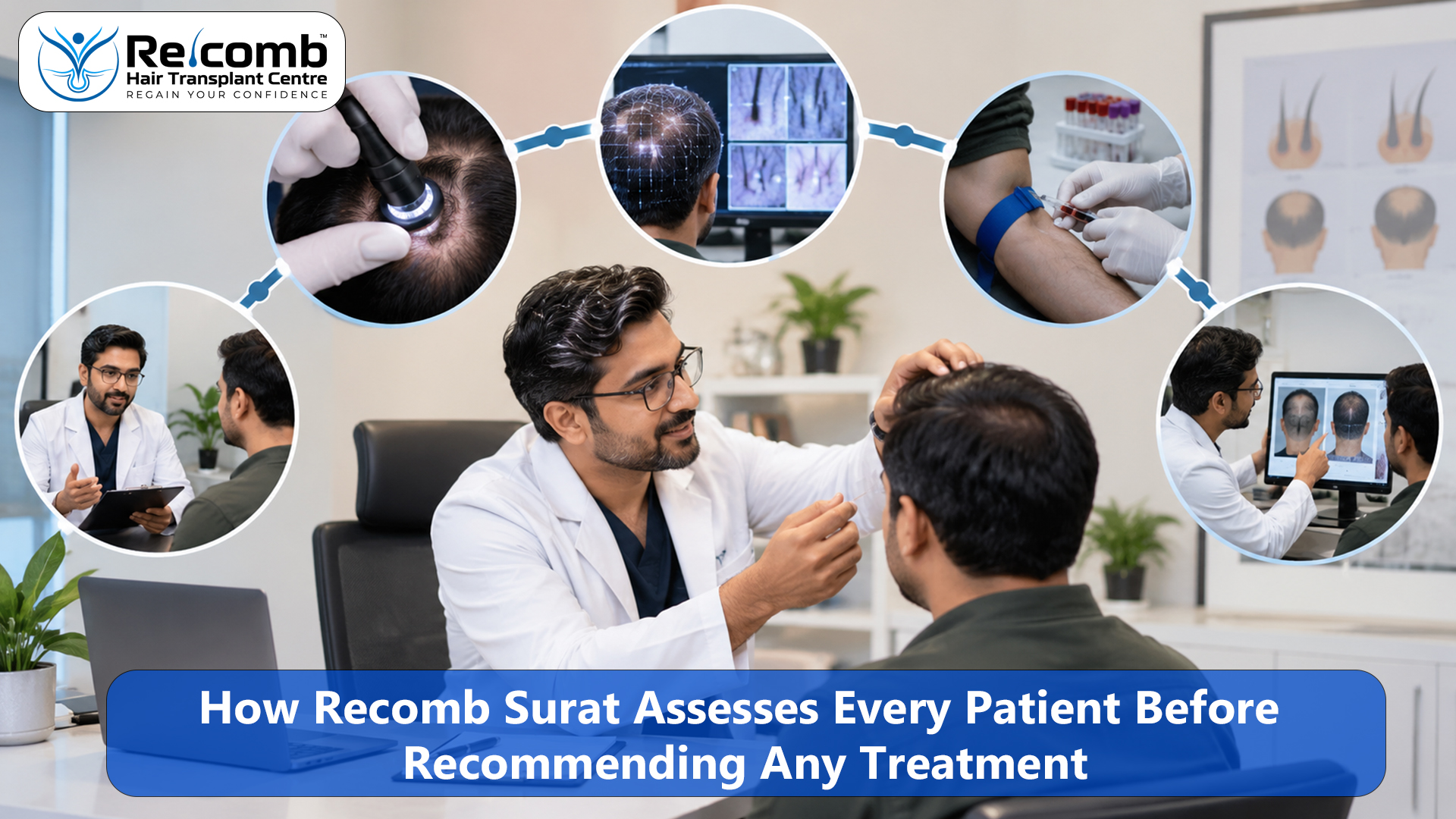
At RECOMB Hair Transplant Centre, Surat, age is documented as part of every patient's assessment but it is never the sole or primary determinant of the recommendation that follows. Dr. Krishna Bhalala and Dr. Nilesh Kachhadiya assess every patient against the clinical factors described above regardless of age, and the recommendation reflects those findings specifically.
Young patients who are assessed and found to be suitable candidates receive conservative plans with detailed donor budget management and mandatory medical management as part of the post-operative protocol. Older patients who consult for the first time receive honest assessments of what can realistically be achieved given the donor area available and the extent of loss present, and clear discussions of what to expect from a single session versus a staged approach.
The goal is the same at every age: a result that looks natural, appropriate for the patient's face, and remains satisfying across the decades ahead.
Final Takeaway
There is no universally ideal age for a hair transplant in India. There is an ideal clinical profile, and that profile includes a stable or managed hair loss pattern, adequate donor density, realistic expectations, medical fitness, and a plan that accounts for where the hair loss is heading, not just where it is today.
The twenties require the most caution. The thirties often present the best alignment of candidacy factors. The forties and fifties remain clinically appropriate for the right patient with adjusted planning. What matters in every decade is not the number but the clinical picture behind it.
Dr. Krishna Bhalala and Dr. Nilesh Kachhadiya conduct a limited number of personal consultations each week at RECOMB, Surat. If you want to know specifically whether your age and hair loss stage make you a candidate right now, this is where that conversation starts.
Find Out Whether Your Age and Profile Make You a Candidate Now →
WhatsApp: +91 7624008000
We respond within 24 hours, 6 days a week.
www.recombhair.com
Contact RECOMB Hair Transplant Centre