
Most men who experience hair loss have heard the term DHT. Very few understand what it actually does, why it affects some follicles and not others, and how the treatments available in 2026 work at the biological level to slow or address its effects.
This matters beyond academic interest. A patient who understands the DHT mechanism understands why medical management needs to start early, why a hair transplant does not stop ongoing loss in untreated areas, and why some treatments that sound compelling produce no meaningful result for androgenetic alopecia specifically.
This blog explains the DHT mechanism clearly, without unnecessary complexity, and maps each available treatment to the specific point in that mechanism where it acts.
If you want a clinical assessment of how DHT-driven hair loss is progressing in your specific case and what the right treatment sequence is, a consultation at RECOMB gives you that directly.
Book a Hair Loss Assessment at RECOMB, Surat →
WhatsApp: +91 7624008000 | www.recombhair.com
What DHT Is and Where It Comes From
DHT stands for dihydrotestosterone. It is an androgen hormone, meaning it belongs to the same class of hormones as testosterone, and it is produced in the body through a conversion process rather than being produced directly by the endocrine glands.
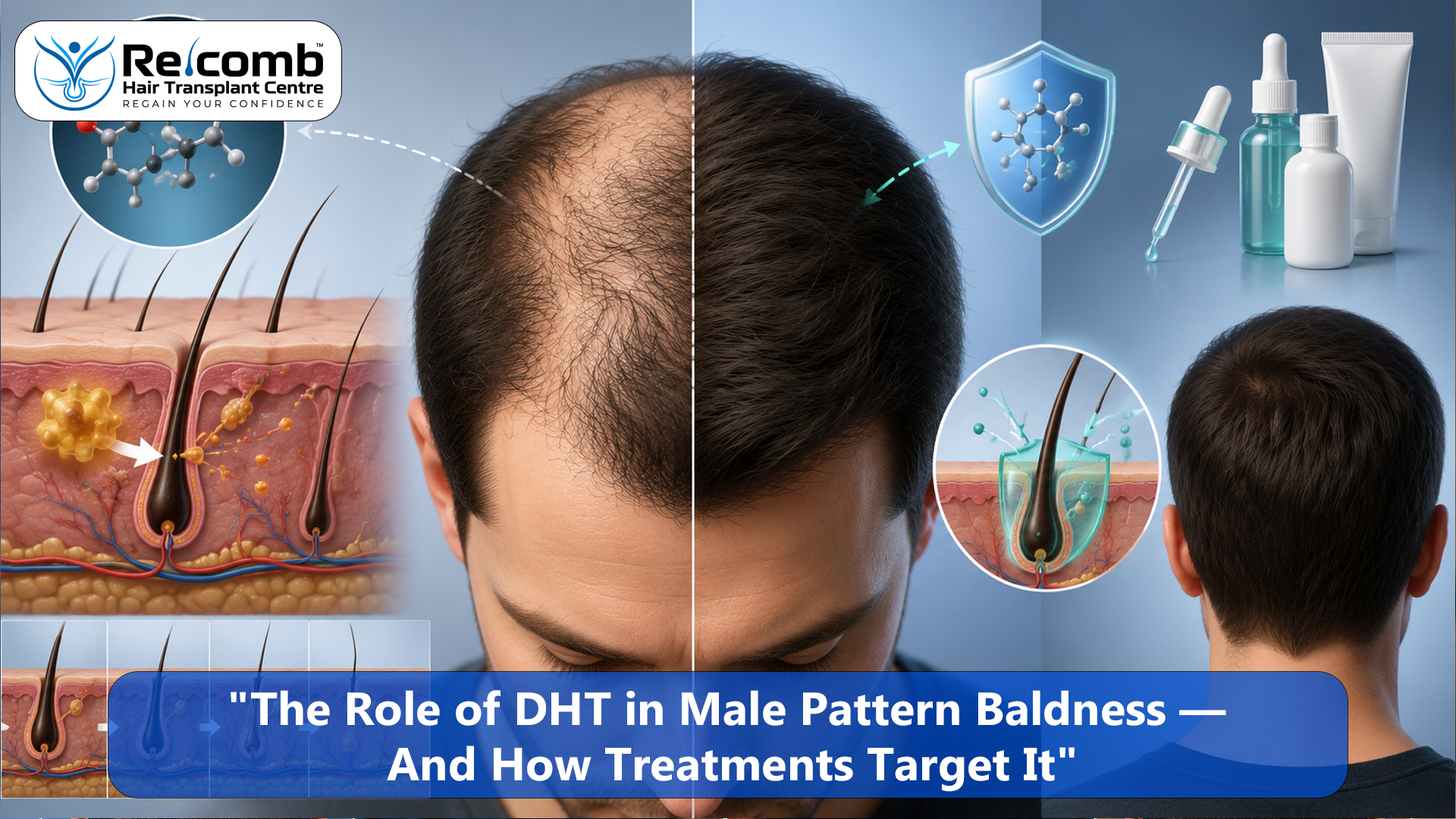
Testosterone, produced primarily by the testes in men and in smaller amounts by the adrenal glands, is converted to DHT by an enzyme called 5-alpha reductase. This enzyme is present in multiple tissues throughout the body including the skin, the liver, and critically, the hair follicle itself. The conversion happens locally within the follicle, meaning DHT is produced at the site where it causes its effect rather than simply arriving there through the bloodstream.
DHT is approximately five times more potent than testosterone at the androgen receptor. In most tissues, DHT serves normal physiological functions related to male sexual development and other processes. In genetically susceptible hair follicles, however, DHT binding to androgen receptors triggers a progressive and destructive process.
How DHT Destroys Hair Follicles Over Time
The hair follicle is a cycling structure that alternates between a growth phase called anagen, a transition phase called catagen, and a resting phase called telogen before the cycle restarts. In a healthy follicle, the anagen phase lasts two to six years, producing a full-length hair shaft. The resting phase lasts approximately three months.
In genetically susceptible follicles, DHT binds to androgen receptors in the dermal papilla, the small structure at the base of the follicle that regulates the entire growth cycle. When DHT binds here, it alters the signalling environment within the dermal papilla in ways that progressively shorten the anagen phase over successive hair cycles.
The first affected cycle might shorten anagen from five years to four. The next cycle might shorten it to three years. The cycle after that to eighteen months. With each successive cycle, the hair produced is shorter and thinner because there is less time to grow. Eventually the anagen phase shortens to weeks rather than years, and the hair produced is so fine and short it is effectively invisible. At this point the follicle appears clinically bald even though it technically still exists as a structure.
This process is called miniaturisation. It is gradual, which is why hair loss from androgenetic alopecia develops over years rather than appearing suddenly, and it is progressive, meaning it continues advancing until the follicle is completely inactive unless the DHT signal is interrupted.
The follicles most susceptible to this process are those in the frontal, temporal, and crown regions of the scalp. Follicles in the occipital and lateral regions, the permanent zone used as the donor area in hair transplantation, have significantly fewer androgen receptors and are therefore resistant to the miniaturisation process regardless of DHT levels. This genetic difference between follicles in different scalp regions is the biological basis of both the pattern of hair loss and the principle of donor dominance that makes hair transplantation possible.
Why DHT Levels Alone Do Not Predict Hair Loss
This is a point that confuses many patients. Men who lose hair significantly do not necessarily have higher circulating DHT levels than men who retain a full head of hair throughout life. The determining factor is not the amount of DHT present but the sensitivity of the follicle's androgen receptors to DHT.
Two men with identical DHT blood levels can have completely different hair loss outcomes based entirely on how their individual follicles respond to the same hormone signal. This receptor sensitivity is genetically inherited, which is why hair loss runs in families, and it is the reason why reducing DHT systemically, as finasteride does, produces significant benefit in most men but not in every man equally.
How Each Treatment Targets DHT
Finasteride
Finasteride is a 5-alpha reductase inhibitor. It works by blocking the enzyme that converts testosterone to DHT, reducing DHT levels in the scalp and bloodstream by approximately 60 to 70 percent in most patients. With DHT levels reduced, the signal that shortens anagen phase is weakened, allowing follicles that are miniaturising but still active to stabilise and in some cases partially recover.
Finasteride does not eliminate DHT entirely and does not reverse miniaturisation in follicles that have already completely stopped producing hair. Its clinical effect is to slow or halt ongoing miniaturisation in follicles that are still cycling, preserving them at their current level of function rather than restoring what is already lost. This is why starting finasteride early in the hair loss process produces better outcomes than starting after significant follicle loss has already occurred.
Finasteride is taken as a daily oral tablet and requires consistent long-term use. Discontinuing finasteride allows DHT levels to return to their pre-treatment range within weeks, and progressive follicle miniaturisation resumes. It is therefore a maintenance medication rather than a course of treatment with a defined endpoint.
Minoxidil
Minoxidil does not act on DHT directly. It is a potassium channel opener and vasodilator that improves blood flow to the scalp and prolongs the anagen phase of the hair growth cycle through a separate mechanism from the DHT pathway.
Minoxidil's benefit in androgenetic alopecia is that by extending the anagen phase, it partially counteracts the DHT-driven shortening of that phase. The follicle is still receiving the DHT signal but the minoxidil signal partially compensates by pushing in the opposite direction on the growth cycle timeline. It also increases the calibre of the capillaries supplying the dermal papilla, improving the nutritional environment of the follicle.
Minoxidil is most effective when used alongside finasteride because the two treatments target different parts of the problem. Finasteride reduces the DHT signal at the receptor level. Minoxidil supports the growth cycle at the follicular level through improved circulation and anagen prolongation.
GFC and PRP Therapy
GFC and PRP do not directly target DHT. Their mechanism involves delivering growth factors, particularly platelet-derived growth factor and vascular endothelial growth factor, to the follicular environment to support follicle health, reduce inflammation around the follicle, and support the anagen phase through biological signalling pathways separate from the DHT mechanism.
Their clinical role in androgenetic alopecia is supportive rather than causal. They improve the follicular environment in which DHT is already active, which can slow the visible progression of miniaturisation, but they do not interrupt the DHT signal itself. For this reason they are most appropriately used as adjuncts to finasteride and minoxidil rather than as standalone treatments for DHT-driven hair loss.
Hair Transplant Surgery
A hair transplant does not target DHT at all. It relocates DHT-resistant follicles from the permanent donor zone to the recipient area, permanently placing hair that will not miniaturise regardless of DHT levels in areas that have already lost DHT-susceptible follicles.
This is the only intervention that can restore hair to areas where miniaturisation is already complete and follicles have stopped producing visible hair. Medical management cannot achieve this. But a transplant also does not protect the remaining native hair in the treated area from continued DHT-driven loss if medical management is not used alongside it.
The correct model is combination: surgery to restore what has already been lost, medical management to preserve what remains and slow ongoing loss in surrounding areas.
Topical Finasteride and Clascoterone
Topical finasteride delivers DHT suppression locally at the scalp level with lower systemic absorption than oral tablets, reducing some of the systemic side effects associated with oral finasteride while maintaining local DHT reduction in the scalp.
Clascoterone, a relatively newer topical agent, works differently by directly blocking the androgen receptor at the follicle level rather than reducing DHT production. It competes with DHT for the receptor binding site, meaning the DHT is present but cannot bind effectively to the receptor in the treated area. Early clinical data in 2025 and 2026 shows promising results for scalp-specific androgen receptor blockade as a complement to or alternative for patients who cannot tolerate systemic finasteride.
What Does Not Target DHT
This is worth stating directly because a significant number of products marketed for hair loss in India have no mechanism of action relevant to DHT-driven miniaturisation.
Biotin supplements, most hair growth oils, herbal DHT blocker capsules sold without pharmaceutical evidence, protein shakes, and scalp massage devices do not inhibit 5-alpha reductase, do not block androgen receptors, and do not extend the anagen phase through any validated mechanism. They may support general hair health in patients with genuine nutritional deficiencies, but they do not address the underlying DHT mechanism in androgenetic alopecia.
Patients who spend months or years on these products while androgenetic alopecia progresses are not slowing their hair loss. They are losing the window during which finasteride and minoxidil would have been most effective.
RECOMB's Approach (2026)
At RECOMB Hair Transplant Centre, Surat, DHT-driven hair loss is addressed through a sequenced plan that matches each treatment to its appropriate role in the mechanism. Dr. Krishna Bhalala and Dr. Nilesh Kachhadiya assess each patient's stage of miniaturisation, confirm the androgenetic diagnosis through trichoscopy, and recommend medical management as the first line for patients with ongoing active loss before any surgical discussion.
For patients who are surgical candidates, the role of post-operative medical management in protecting surrounding native hair is discussed as a non-negotiable part of the long-term plan, not an optional extra. Surgery addresses what has already been lost. Medical management protects what remains.
Final Takeaway
DHT is the central mechanism of male pattern baldness. It acts at the androgen receptor in the dermal papilla to progressively shorten the anagen phase over successive hair cycles until the follicle stops producing visible hair. This process is genetic in origin, progressive in nature, and not reversed by most products marketed for hair loss.
The treatments that work do so by interrupting specific points in this mechanism: finasteride reduces DHT production, minoxidil extends the anagen phase through a parallel pathway, GFC and PRP support the follicular environment, and hair transplantation relocates DHT-resistant follicles to areas of loss. Used in the right combination at the right stage, these treatments together produce results that are durable and clinically meaningful.
Understanding the mechanism is not academic. It is the knowledge that allows patients to evaluate recommendations critically, avoid ineffective treatments, and use the treatments that actually work at the stage where they will have the most effect.
Dr. Krishna Bhalala and Dr. Nilesh Kachhadiya conduct a limited number of personal consultations each week at RECOMB, Surat. If you want a clinical assessment of how DHT-driven loss is progressing in your specific case and what treatment sequence is appropriate, this is where that conversation starts.
Get a DHT-Specific Treatment Plan for Your Hair Loss →
WhatsApp: +91 7624008000
We respond within 24 hours, 6 days a week.
www.recombhair.com
Contact RECOMB Hair Transplant Centre
RECOMB Hair Transplant Centre
19, Ground Floor, Zenon Building, Opp. Unique Hospital, near Kiran Motors, Khatodara Wadi, Surat, Gujarat 395001
Phone: +91 7624008000
Website: www.recombhair.com