
Over the past two years, exosome therapy has emerged as the most discussed new entrant in non-surgical hair loss treatment. Patients researching hair restoration increasingly encounter it alongside PRP and GFC, positioned in some clinic marketing as a more advanced, more powerful alternative that supersedes older biological treatments.
The questions patients are asking are reasonable. What exactly is exosome therapy? How does it differ from PRP at a biological level? Is the evidence strong enough to support the claims being made about it? And where does it sit relative to PRP and GFC in a clinical treatment plan?
This blog answers each of these questions directly, with the same clinical honesty that applies to every treatment discussed at RECOMB. The goal is not to promote exosome therapy or dismiss it. It is to give patients an accurate picture of what it is, what the current evidence supports, and how it compares to the treatments with longer track records.
If you want to understand which non-surgical hair loss treatment is appropriate for your specific stage and diagnosis, a consultation at RECOMB is where that clinical determination is made.
Book a Non-Surgical Hair Loss Treatment Consultation at RECOMB →
WhatsApp: +91 7624008000 | www.recombhair.com
What Exosomes Are: The Biology
To understand what exosome therapy delivers, it helps to understand what exosomes actually are at a cellular level.
Exosomes are extracellular vesicles, extremely small membrane-bound particles released by cells as part of their normal intercellular communication. They range in size from approximately 30 to 150 nanometres, making them significantly smaller than cells and even smaller than platelets. Their primary function is to carry molecular signals between cells, transporting proteins, lipids, messenger RNA, and microRNA from one cell to another.
When a cell releases exosomes, it is essentially packaging and transmitting instructions to neighbouring or distant cells. The receiving cell takes up the exosome cargo and responds to the molecular signals it contains. This mechanism plays a role in tissue repair, immune regulation, inflammation modulation, and stem cell communication throughout the body.
The exosomes used in hair loss treatment are derived from specific cell sources, most commonly mesenchymal stem cells from sources including umbilical cord tissue, bone marrow, or adipose tissue. These stem cell-derived exosomes carry a particularly rich cargo of growth factors, anti-inflammatory signals, and regenerative molecular instructions that are relevant to follicle biology.
How Exosome Therapy Differs From PRP
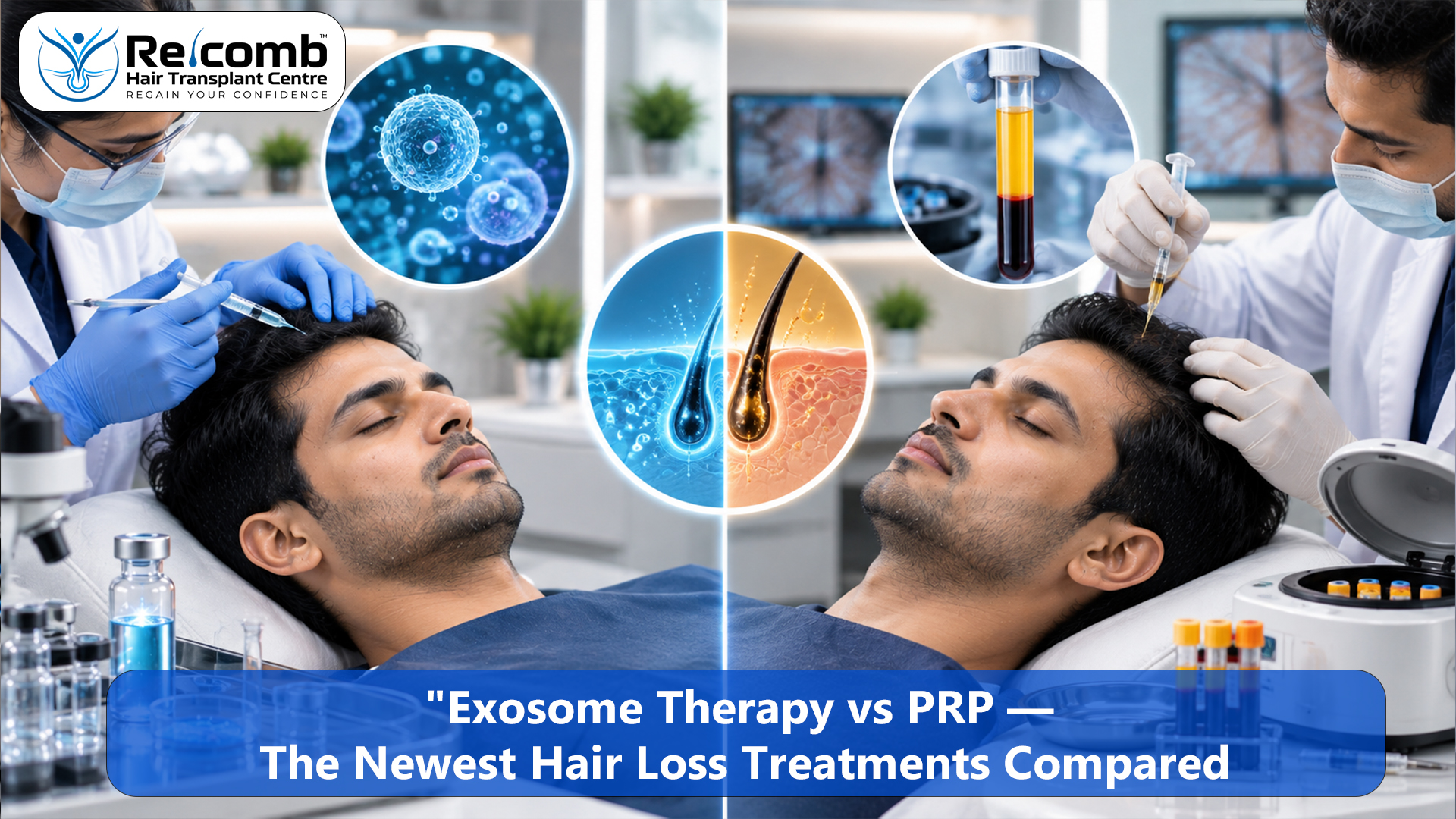
PRP concentrates the patient's own platelets, which release growth factors when activated. The growth factors in PRP, platelet-derived growth factor, vascular endothelial growth factor, and epidermal growth factor among others, signal follicles to support anagen phase maintenance, improve circulation, and reduce perifollicular inflammation.
Exosome therapy delivers a different class of biological signal. Rather than growth factors from activated platelets, it delivers the molecular cargo of stem cell-derived extracellular vesicles. This cargo includes growth factors as well but also microRNA sequences that can regulate gene expression within the recipient follicle cells, anti-inflammatory cytokines that modulate the immune environment around the follicle, and proteins that support cell proliferation and differentiation within the dermal papilla.
The theoretical advantage of exosomes over PRP is that they deliver a more complex and targeted biological signal than platelet-derived growth factors alone. They communicate directly with follicle cells at the genetic regulation level, not just the growth factor stimulation level.
In practice, the distinction between these mechanisms is real but the clinical significance is still being established. PRP works through growth factor stimulation. Exosome therapy works through a broader molecular communication mechanism that includes but extends beyond growth factor signalling. Whether this broader mechanism produces meaningfully better clinical outcomes than well-executed PRP in the typical androgenetic alopecia patient is a question the current evidence is only beginning to address.
What the Current Evidence Says
This is where clinical honesty matters most, because the marketing of exosome therapy in India has outpaced the evidence base considerably.
PRP for hair loss has been evaluated in multiple randomised controlled trials across more than a decade. The evidence supports its use for early to moderate androgenetic alopecia, with consistent findings of reduced shedding, improved hair shaft diameter, and modest density improvement in responding patients. The mechanisms are well characterised, the safety profile is established, and the clinical outcomes are predictable within understood parameters.
Exosome therapy for hair loss has a much shorter evidence history. As of 2026, the published clinical literature on exosome therapy specifically for androgenetic alopecia consists primarily of small pilot studies, case series, and early-phase trials rather than large randomised controlled studies. The results from these early investigations are promising, showing growth factor profiles and follicular response metrics that suggest exosomes have meaningful biological activity at the follicle level.
What the current evidence does not yet provide is the same confidence about predictable clinical outcomes, optimal session protocols, long-term safety data, and comparative superiority over well-executed PRP that the PRP literature offers. Promising early results in small studies do not automatically translate to reliable clinical outcomes across a diverse patient population.
This does not mean exosome therapy is ineffective. It means the evidence base is early-stage and patients should understand that when they receive exosome treatment in 2026, they are receiving a treatment with a promising biological rationale and early supportive evidence, not one with the established track record of PRP.
Safety Considerations
The safety profile of PRP is well established. Because PRP uses the patient's own blood, the risk of immune reaction, disease transmission, or systemic adverse effects is negligible. The procedure risks are limited to localised infection and the normal discomfort of scalp injections.
Exosome therapy involves allogeneic material, meaning it is derived from donor cells rather than the patient's own tissue. This introduces a different safety consideration. The exosomes are processed and purified to remove cellular material, which significantly reduces but does not eliminate the theoretical risk of immune response or contamination. The quality of the manufacturing process, the regulatory oversight of the exosome preparation, and the source cell characterisation are all relevant to the safety of any specific exosome product.
In India, the regulatory framework for exosome therapy as a therapeutic product was still developing in 2025 and 2026. Patients receiving exosome treatment should ask specifically about the source and regulatory status of the preparation being used. A product prepared under validated conditions with appropriate quality control is a different clinical proposition from one prepared under less rigorous conditions.
This is not a reason to categorically avoid exosome therapy. It is a reason to be informed about what specifically is being administered.
Where Exosome Therapy Fits Relative to PRP and GFC
For patients trying to decide between PRP, GFC, and exosome therapy, a clinical framework is more useful than a ranking.
PRP is the appropriate first-line biological support treatment for early to moderate androgenetic alopecia when non-surgical management is the goal. It has the strongest evidence base, the longest track record, the clearest safety profile, and predictable outcomes in the right patient profile. It is the established standard against which newer treatments are compared.
GFC is appropriate for patients who have not responded adequately to PRP or for whom a higher growth factor concentration is clinically indicated. As discussed in the GFC versus PRP blog, GFC delivers a more concentrated growth factor preparation than standard PRP by extracting only the active proteins rather than the full platelet-rich plasma.
Exosome therapy occupies a position at the frontier of the evidence base. For patients with early to moderate androgenetic alopecia who have not achieved satisfying results with PRP or GFC, or for patients interested in receiving the most biologically complex preparation currently available in the non-surgical space, exosome therapy is a reasonable clinical consideration with the understanding that its evidence base is earlier-stage than PRP or GFC.
Exosome therapy is not a replacement for finasteride and minoxidil in patients with androgenetic alopecia. No biological injection treatment, however promising, addresses the DHT mechanism that drives ongoing follicle miniaturisation. Medical management remains the foundation on which all biological treatments are layered.
Practical Considerations for Indian Patients
Cost is a relevant practical consideration. Exosome therapy is significantly more expensive than PRP per session in India, with costs ranging from Rs 15,000 to Rs 40,000 per session depending on the preparation used and the clinic, compared to Rs 4,000 to Rs 8,000 per PRP session. For a treatment with an earlier-stage evidence base, patients should evaluate whether the cost premium is justified by their specific clinical situation and what the alternative use of those resources would be within their overall treatment plan.
Product standardisation is another consideration specific to the Indian market. The quality and composition of exosome preparations vary significantly between suppliers. Unlike PRP, which is prepared from the patient's own blood and therefore has inherent consistency, exosome products depend on the manufacturing process and source cell characterisation. Patients should ask specifically about the product being used and its regulatory and manufacturing status.
RECOMB's Approach (2026)
At RECOMB Hair Transplant Centre, Surat, biological treatments including PRP, GFC, and exosome therapy are recommended based on the individual patient's clinical profile, the evidence base supporting each treatment, and an honest discussion of what each can and cannot achieve.
Dr. Krishna Bhalala's background as a DNB Dermatologist and his engagement with emerging clinical literature means that new treatments including exosome therapy are evaluated against the existing evidence rather than adopted on the basis of marketing claims or early enthusiasm. Exosome therapy is discussed with patients who are appropriate candidates for it, with a clear explanation of the current evidence, the cost implications, and how it compares to established alternatives.
For the majority of patients presenting with early to moderate androgenetic alopecia who have not previously received biological treatment, PRP or GFC remains the clinically supported starting point. Exosome therapy is considered as a next step for patients who have not responded adequately to these treatments or who have specific clinical reasons that make stem cell-derived exosome signalling a rational therapeutic choice.
Know Which Biological Treatment Is Right for Your Stage at RECOMB →
WhatsApp: +91 7624008000 | www.recombhair.com
Final Takeaway
Exosome therapy represents a genuinely interesting biological advance in the non-surgical management of hair loss. Its mechanism is distinct from PRP and theoretically more complex, its early clinical evidence is promising, and its application in hair restoration is a legitimate area of active development.
What it is not, in 2026, is a treatment with the established evidence base, safety profile, and predictable clinical outcomes of PRP. Patients who choose exosome therapy should do so with accurate understanding of where the evidence currently stands, what specifically is being administered, and how it fits within a complete treatment plan that addresses the underlying mechanism of their hair loss.
The patients who benefit most from any biological treatment, whether PRP, GFC, or exosome therapy, are those who choose it as part of a clinically grounded plan rather than because it is the newest or most expensive option available.
Dr. Krishna Bhalala and Dr. Nilesh Kachhadiya conduct a limited number of personal consultations each week at RECOMB, Surat. If you want a clinical assessment of which biological treatment is appropriate for your specific stage of hair loss, this is where that determination is made with honesty and specificity.
Get a Clinical Answer on Which Treatment Is Right for You at RECOMB →
WhatsApp: +91 7624008000
We respond within 24 hours, 6 days a week.
www.recombhair.com
Contact RECOMB Hair Transplant Centre
RECOMB Hair Transplant Centre
19, Ground Floor, Zenon Building, Opp. Unique Hospital, near Kiran Motors, Khatodara Wadi, Surat, Gujarat 395001
Phone: +91 7624008000
Website: www.recombhair.com