
Scalp micropigmentation and hair transplant are frequently compared as if they are two versions of the same solution. They are not. They solve different problems, produce different results, suit different patients, and in many cases are complementary rather than competing. Choosing between them without understanding this distinction produces outcomes that disappoint patients who expected the wrong thing from whichever they chose.
This blog gives a direct, honest comparison of both, what each can deliver and what each cannot, so patients can make a genuinely informed decision.
What Scalp Micropigmentation Actually Is
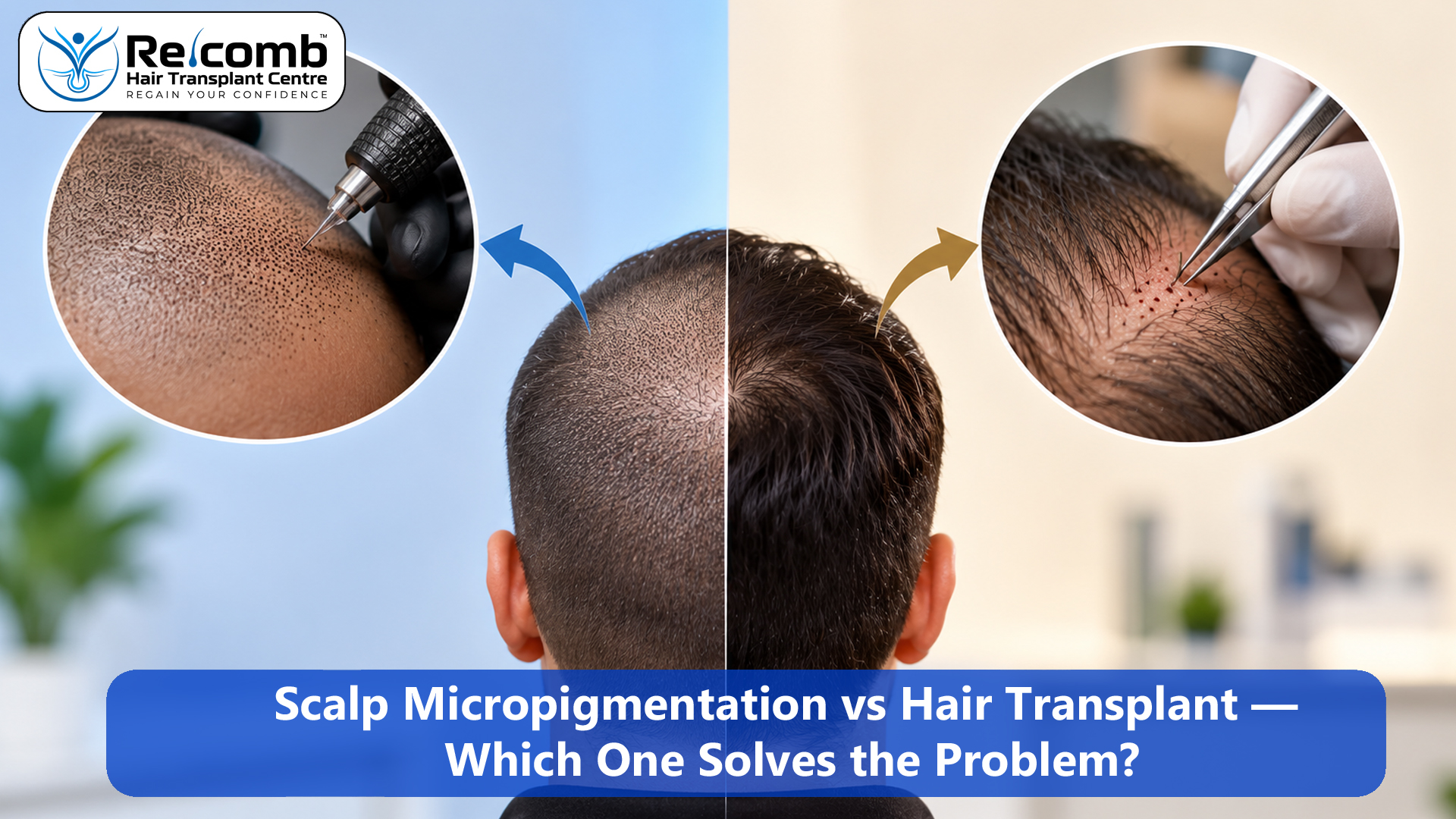
Scalp micropigmentation, commonly called SMP, is a specialised tattooing technique that deposits pigment into the upper dermis of the scalp to simulate the appearance of hair follicles at a shaved or very short hair length. It does not create hair. It creates the visual impression of hair density by replicating the dot-like appearance of closely cropped follicle openings.
The result, when performed well, is a scalp that appears to have a full head of shaved hair rather than a bald scalp. The illusion is effective under most lighting conditions and at normal social distances.
What SMP does not do is produce any actual hair growth. The scalp remains bald beneath the pigment. The dots fade over years and require periodic refreshing. The appearance is permanently limited to a very short, shaved-head aesthetic. A patient who wants to grow their hair beyond a short buzz cut will not achieve that appearance with SMP regardless of how well it is executed.
What Hair Transplant Actually Does
A hair transplant relocates living, DHT-resistant follicles from the donor zone to the recipient area. Those follicles produce real, growing hair that can be cut, styled, and worn at any length. The result is not an illusion of hair. It is actual hair.
The limitation of hair transplant is that it requires adequate donor supply, carries a 12 to 18 month growth timeline, and cannot achieve natural density across very large bald areas in a single session. It is a surgical procedure with recovery requirements. It produces a result that looks like hair and behaves like hair because it is hair.
Who Is Right for SMP
SMP serves a specific patient profile well.
Patients who prefer a shaved-head aesthetic and want to eliminate the visible contrast between the bald scalp and the remaining hair ring are strong SMP candidates. The procedure creates visual uniformity across the scalp that makes the shaved appearance look intentional rather than forced by hair loss.
Patients with insufficient donor supply for a satisfying hair transplant result, including those with extensive Grade 6 or 7 loss and limited donor density, benefit from SMP as an alternative to surgery that cannot deliver adequate coverage.
Patients who have had a hair transplant and want to improve the appearance of the donor area by camouflaging extraction sites or who want to add the appearance of density between existing transplanted grafts are good candidates for SMP as a complement to surgery rather than an alternative.
Patients who want a non-surgical, low-maintenance approach to the appearance of hair loss and are comfortable with a permanently short hair aesthetic are appropriate SMP candidates.
Who Is Right for Hair Transplant
Hair transplant serves patients who want actual hair growth rather than the simulation of it.
Patients at Norwood Grade 2 to 5 with adequate donor density and realistic expectations about the timeline and density achievable are appropriate surgical candidates. The result produces real hair that can be styled, which is not possible with SMP.
Patients who have already had SMP and want to add actual hair density on top of the pigment background are candidates for hair transplant, since the two can be combined effectively.
Patients who want flexibility in hairstyle and length require a hair transplant. SMP locks the patient into a very short hair aesthetic permanently.
Where the Decision Is Genuinely Difficult
The decision is most complex for patients at Grade 5 or 6 where hair transplant can achieve meaningful but not complete coverage and SMP can achieve a clean, finished appearance across the entire scalp. In this scenario, the question is whether the patient values actual hair growth at moderate density more than they value the complete visual uniformity of a well-executed SMP.
There is no universally correct answer. Some patients in this range prefer the result of a transplant that covers the frontal zone with real hair even if the crown remains thin. Others prefer the clean consistency of SMP across the full scalp.
Both are clinically valid choices at this grade. The honest consultation helps the patient understand specifically what each would look like for their individual parameters and make the decision based on accurate information rather than assumption about which is better in general.
At RECOMB, patients presenting with extensive loss are given an honest assessment of what surgical coverage can realistically achieve versus what SMP would deliver, so the decision is genuinely informed.
Book a Consultation to Understand Both Options for Your Case at RECOMB →
WhatsApp: +91 7624008000 | www.recombhair.com
Combining Both
SMP and hair transplant are complementary in several specific clinical scenarios.
Post-transplant SMP in the donor area camouflages extraction sites that are visible at short hair lengths, improving the donor appearance in patients who prefer to wear their hair very short.
SMP between transplanted grafts adds visual density in zones where graft coverage is adequate but not as dense as the patient would like, creating the impression of fuller density without requiring additional donor grafts.
SMP in the crown alongside a frontal transplant addresses the practical reality that many Grade 5 patients have enough donor supply for excellent frontal coverage but insufficient reserve for full crown coverage. The transplant addresses the frontal zone with real hair. SMP addresses the crown with pigment. Together they produce a complete-looking result from a limited donor budget.
RECOMB’s Approach (2026)
At RECOMB Hair Transplant Centre, Surat, patients asking about SMP are given an honest clinical assessment of whether their case is better served by surgery, SMP, or a combination. Dr. Krishna Bhalala and Dr. Nilesh Kachhadiya do not position hair transplant as the answer for every patient because for some patients it is not.
The goal is a result the patient is satisfied with for decades. Sometimes that is a hair transplant. Sometimes it is SMP. Sometimes it is both in sequence. The right answer follows from the individual clinical picture and the patient’s priorities, not from the clinic’s preferred revenue stream.
Final Takeaway
SMP creates the appearance of hair. Hair transplant creates actual hair. They are not competing solutions but different tools for different problems and different patient priorities.
The patient who chooses between them based on accurate information about what each delivers is the patient who is satisfied with the result. The one who chooses based on marketing claims or assumptions about which is more advanced will be disappointed when the result does not match the expectation.
Dr. Krishna Bhalala and Dr. Nilesh Kachhadiya conduct a limited number of personal consultations each week at RECOMB, Surat. If you are trying to decide between SMP and a hair transplant, or whether a combination approach serves your case, this is where that decision gets a clinical foundation.
Find Out Which Option Is Right for Your Case at RECOMB →
WhatsApp: +91 7624008000
We respond within 24 hours, 6 days a week.
www.recombhair.com
Contact RECOMB Hair Transplant Centre
RECOMB Hair Transplant Centre
19, Ground Floor, Zenon Building, Opp. Unique Hospital, near Kiran Motors, Khatodara Wadi, Surat, Gujarat 395001
Phone: +91 7624008000
Website: www.recombhair.com