
The procedure day is the part patients prepare for. The recovery is the part that surprises them.
Most patients arrive at their FUE hair transplant with a general understanding that there will be a healing period and that results take time. What very few have is a specific, week by week picture of what normal looks like, what is expected versus what warrants attention, and what is happening biologically at each stage of the first twelve weeks.
This blog provides that picture specifically. Not a vague reassurance that things will look better with time, but a clinical explanation of what is happening at each stage of the FUE recovery timeline and what patients should and should not be doing at each point.
Understanding this timeline before the procedure changes how patients experience recovery. Patients who know that their hair will shed at week three, that their scalp will look largely unchanged at month two, and that visible growth begins at month three to four navigate each stage with accurate expectations rather than alarm. Those who do not know this frequently interpret normal events as complications.
Day 1 to 3: The Immediate Post-Operative Period
The first 72 hours are the most clinically critical for graft survival. Newly placed grafts are not yet anchored by new blood vessel connections and remain vulnerable to dislodgement by direct mechanical force, high water pressure, or physical exertion that significantly increases scalp blood flow.
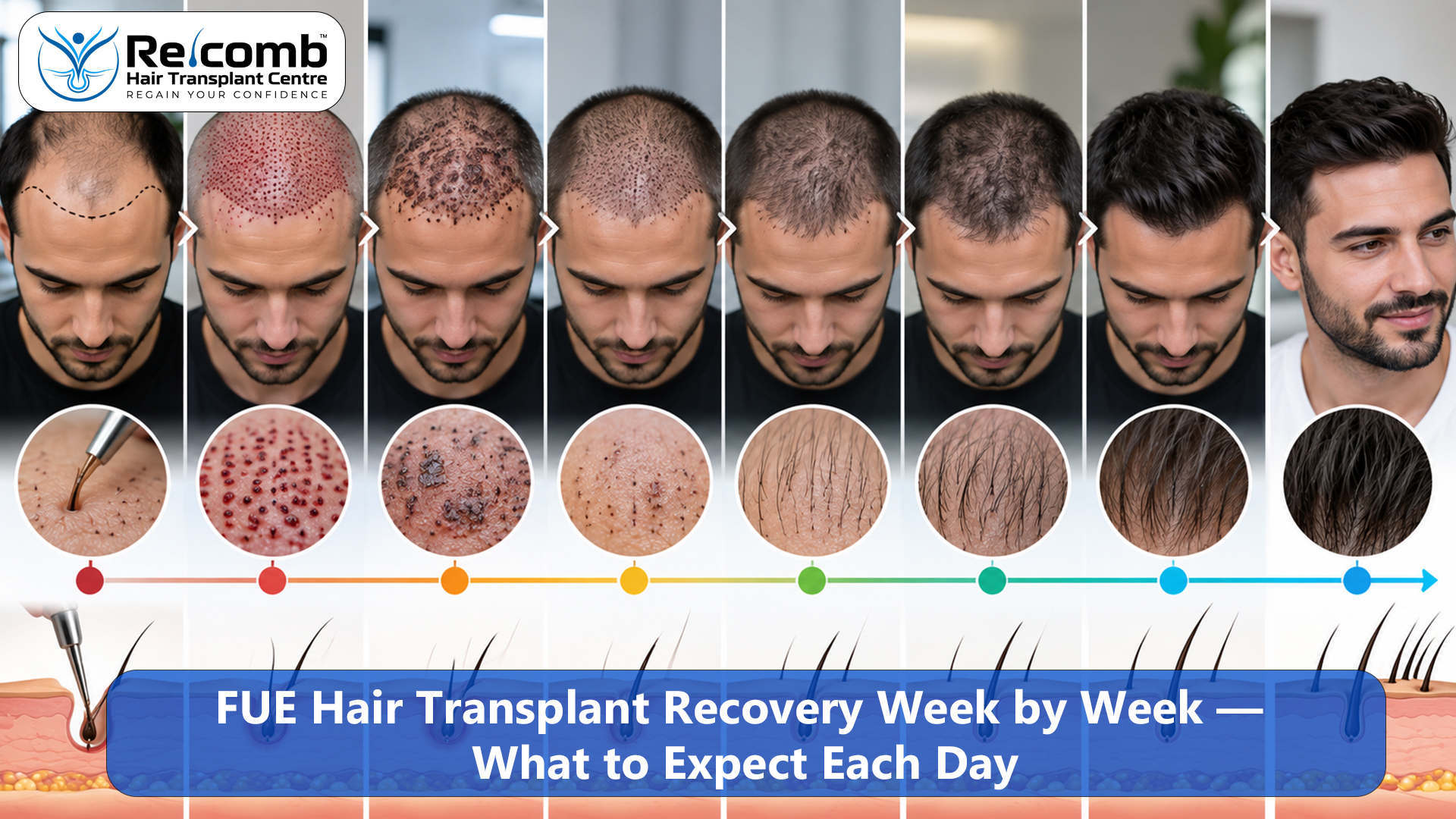
On day one, the recipient area looks dense with small implanted grafts, each capped with a tiny dried blood clot. The donor area has multiple small circular extraction sites that look like fine red dots across the back and sides of the scalp. Both zones look more intense than patients expect.
Swelling is expected and normal. It typically develops more prominently on day two and three, sometimes extending to the forehead and around the eyes. This is the natural inflammatory response to the surgical procedure and is not a sign of infection or complication. It resolves without intervention in most patients by day four to five. Patients are instructed to sleep with the head elevated at approximately 45 degrees using extra pillows to reduce fluid pooling toward the face.
Physical activity is restricted to walking only during this period. Anything that significantly elevates heart rate or blood pressure to the scalp, including exercise, strenuous work, bending from the waist, or heavy lifting, is avoided. Sun exposure to the treated areas is avoided because UV light affects healing tissue and is a source of heat that can affect graft viability.
The clinical team at RECOMB provides direct contact details for this period specifically, because this is when patients have the most questions and when any genuine concerns require prompt guidance.
Day 4 to 7: First Wash and Scab Formation
From day four, the first wash begins. This is not a return to normal hair washing. It is a specific, gentle protocol that softens and gradually removes the scabs forming around each graft without dislodging the grafts themselves.
The first wash technique involves applying a saline or prescribed lotion to the recipient area and allowing it to soak for fifteen to twenty minutes before any contact. This softening step is essential because attempting to remove dry scabs with direct friction at this stage can pull grafts out with them. After soaking, the scabs are gently patted rather than rubbed, using the fingertips in a soft, dabbing motion only.
This process is repeated daily from day four through to approximately day ten to fourteen, with each wash progressively removing more of the scabbing as it softens and loosens naturally. Patients are instructed not to attempt to remove all scabs in one session. The process is gradual by design.
The donor area heals faster than the recipient area. By the end of the first week, the extraction sites in the donor zone are typically well-scabbed and beginning to close. These small scabs fall off naturally within the first one to two weeks without intervention.
Mild itching in both the recipient and donor zones during this period is normal as the healing process progresses. Patients are instructed not to scratch. Itching that is severe or accompanied by significant pain, increased redness beyond the immediate post-operative baseline, or discharge warrants contact with the clinical team.
Week 2: External Healing Largely Complete
By the end of week two, the scalp looks remarkably different from the immediate post-operative appearance. Most of the scabbing in both the recipient and donor zones has resolved. The redness in the recipient area has typically faded to a mild pinkness. The donor extraction sites are healed externally and not visible under normal hair length.
Most patients can return to office-based work or normal social activity from day seven onward without significant visible evidence of surgery. Close observation may reveal the mild pinkness of the recipient area or the very fine stubble of transplanted hair shafts that have not yet shed, but these are subtle and not noticeable to casual observers.
Patients returning to work in environments where they cannot control the visibility of any residual pinkness sometimes prefer to wait until the end of week two. For patients who wear their hair short enough to expose the donor area, this period may require a cap if the extraction sites are still visible, which typically resolves within the first ten days.
Sun exposure remains limited. Physical activity restrictions ease slightly but vigorous exercise, swimming, and any activity producing significant scalp sweating remains restricted through week two.
Weeks 3 to 5: Shedding Phase
This is the phase that alarms patients who were not adequately prepared for it. The transplanted hairs shed. The grafts that were placed so carefully two to four weeks ago lose their hair shafts. The hairline and transplanted zones begin to look thin, sometimes thinner than they did before the surgery.
This is normal, expected, and does not indicate failure. The transplanted hair shaft is shed as the follicle transitions from its disrupted state into a resting phase before beginning a new anagen cycle. The follicle itself, the living root structure beneath the scalp surface, remains intact. The hair will regrow from the same follicle in the coming months.
Understanding this before surgery prevents the distress that this phase causes for patients who were not told about it. At RECOMB, this phase is discussed in detail during the pre-surgical consultation and again at the one-month follow-up, ensuring that patients have accurate context when it begins.
Shock loss of native hairs, where existing hairs in and around the recipient zone also shed due to the surgical disruption of their follicular environment, typically occurs during this same period. This adds to the visible reduction in density and can be alarming. Like the transplanted hair shedding, shocked native hairs recover and regrow in the coming months in the vast majority of patients.
Weeks 6 to 10: The Quiet Phase
After the shedding phase, the scalp enters a period of apparent inactivity. The transplanted follicles are resting beneath the surface, completing their telogen phase and preparing to re-enter anagen. Visible new growth has not yet begun for most patients. The scalp looks largely as it did at the pre-surgical baseline.
This is the hardest phase for most patients psychologically. The result feels absent. The procedure seems to have left no visible improvement. The timeline that was explained pre-surgically is real but feels abstract when applied to an unchanged-looking scalp.
At RECOMB, proactive contact with every patient occurs around the six-week and ten-week marks specifically to address this phase. Patients are reminded that the visible quiet corresponds to significant biological activity beneath the scalp surface as follicles complete their transition back to the growth phase. This contact is not reactive. It is a scheduled part of the follow-up protocol because this phase produces predictable anxiety that accurate, timely communication prevents.
Months 3 to 4: Early Growth Begins
From approximately month three, the first signs of new growth become visible in most patients. The initial hairs are fine and thin, without the shaft diameter that the mature hair will eventually develop, but their presence is visible to the patient and marks the end of the quiet phase.
Growth at this stage is uneven. Some zones begin producing visible hairs earlier than others. The frontal hairline, where the vascularity tends to be most responsive, often shows earlier growth than the midscalp or crown. Patients should not interpret uneven early growth as uneven final density. The distribution evens as growth progresses through month four and five.
The three-month follow-up assessment at RECOMB includes trichoscopy to evaluate early growth pattern and confirm that follicles are re-entering anagen as expected. This is also the point at which post-operative GFC or PRP therapy is introduced for patients where it was planned, providing biological growth factor support during the active early growth phase.
Months 5 to 6: Increasing Density and Visible Improvement
By month five to six, the improvement from the procedure is clearly visible in most patients. Density continues to increase as more follicles complete their transition and produce progressively thicker hair shafts. The first meaningful comparison photographs with the pre-surgical baseline can be taken at this stage.
At six months, most patients have achieved 50 to 65 percent of their final density. The improvement is satisfying and noticeable in face-to-face interactions, though the result continues to develop through the following months.
The six-month follow-up assessment at RECOMB documents this progress with standardised photography and trichoscopy, provides a density measurement compared to the pre-surgical baseline, and assesses the recovery of shocked native hairs alongside the transplanted growth.
Months 7 to 12: Maturation and Final Result
The final six months of the first year are the maturation phase. Growth continues and density increases, but the most dramatic visible changes have already occurred. The hair shafts thicken progressively as each successive cycle produces a more fully developed hair. By month nine to ten, 80 to 90 percent of the final density is visible for most patients.
The final result, including full shaft diameter and maximum density, is assessable at twelve to fifteen months. The twelve-month assessment at RECOMB is the most comprehensive follow-up appointment, providing the definitive evaluation of the result against the original surgical plan and forming the basis for any long-term management decisions including the timing of a second session if planned.
RECOMB's Approach (2026)
At RECOMB Hair Transplant Centre, Surat, recovery management is a structured process rather than an afterthought. Dr. Krishna Bhalala and Dr. Nilesh Kachhadiya provide specific recovery guidance tailored to each patient's procedure details, scalp characteristics, and any clinical factors that influence the expected recovery course.
Every patient leaves RECOMB on surgery day with written recovery instructions, direct contact information for the clinical team during the critical first 72 hours, and a clear understanding of the week by week timeline described in this blog. The follow-up schedule ensures that every clinically important phase of the recovery is monitored and that patients are never left navigating an unexpected development without clinical guidance.
Know Every Stage of Your Recovery Before You Have the Procedure at RECOMB →
WhatsApp: +91 7624008000 | www.recombhair.com
Final Takeaway
FUE recovery is a twelve-month process that proceeds through predictable phases. The immediate post-operative period requires specific care for graft protection. The shedding phase at weeks three to five is normal and expected. The quiet phase at weeks six to ten requires patience and accurate expectations. Growth begins at months three to four, becomes clearly satisfying at six months, and reaches its full expression at twelve to fifteen months.
Patients who understand each phase before the procedure experience recovery with accurate expectations and confidence. Those who encounter it without preparation frequently interpret normal events as complications. The difference between these two experiences is entirely in the quality of pre-operative counselling and the structure of post-operative follow-up.
Dr. Krishna Bhalala and Dr. Nilesh Kachhadiya conduct a limited number of personal consultations each week at RECOMB, Surat. If you are considering a procedure and want to understand in detail what your recovery would look like, this is where that conversation starts.
Understand Your Full Recovery Before You Commit to Your Procedure →
WhatsApp: +91 7624008000
We respond within 24 hours, 6 days a week.
www.recombhair.com
Contact RECOMB Hair Transplant Centre
RECOMB Hair Transplant Centre
19, Ground Floor, Zenon Building, Opp. Unique Hospital, near Kiran Motors, Khatodara Wadi, Surat, Gujarat 395001
Phone: +91 7624008000
Website: www.recombhair.com