Learn about the latest developments in the field of Hair Transplant. Get access to interviews with experts in the field, testimonials, success stories and many in-depth articles about the Hair Transplantation procedure and post-procedural care in this blog section.
A hair transplant is designed to provide a permanent and natural solution to baldness. However, some individuals notice thinning or shedding again 2–3 years after the procedure.
This can be worrying, but in most cases, there are clear medical explanations and correctable factors behind this shedding.
At Recomb Hair Transplant Centre, Surat, we focus on long-term graft survival, donor safety, and medical maintenance to ensure that transplanted hair remains strong for decades.
Below are the 7 most common reasons transplanted hair can thin or fall after a few years.
1. Not Following Long-Term Medical Therapy
Hair transplant restores areas that are already bald, but the remaining native hair is still sensitive to DHT.
If medical therapy is stopped after 6–12 months, existing native hair may continue to thin, giving an impression that the transplant has failed.
Medical treatments help:
Maintain existing hair
Slow down genetic hair loss
Support transplanted hair growth
Without maintenance therapy, surrounding hair becomes weak and creates visible gaps.
2. Progression of Androgenetic Alopecia (Genetic Baldness)
DHT-driven hair loss is progressive.
Even if transplanted hair is permanent, your native hair will continue to miniaturize if not treated.
This often leads to:
Patchy appearance
Gaps behind the transplanted zone
Thinning in the crown or mid-scalp
Long-term management is essential to keep the entire scalp balanced.
3. Weak Donor Quality or Over-Harvesting
If the donor area was:
Low density
Miniaturized
Over-harvested
then the graft survival rate may drop after a few years.
A healthy donor region is the foundation of a long-lasting transplant.
4. Improper Technique or Poor Graft Handling
If grafts were damaged or mishandled during the procedure, survival may reduce over the years.
Problems include:
Excessive trauma
Incorrect angulation
Dehydration of grafts
Delayed implantation
At Recomb, Sapphire FUE ensures minimal trauma, high survival, and natural density.
Adequate sleep, balanced diet, and stress control promote long-term stability.
Conclusion
Transplanted hair is permanent, but native hair is not.
Most cases of hair fall after 2–3 years are due to progressive genetic baldness, lack of maintenance therapy, or untreated medical conditions.
With proper diagnosis and long-term management, density can be preserved and restored.
At Recomb Hair Transplant Centre, we create long-term hair care plans to ensure lifetime results after a Sapphire FUE procedure.
A receding hairline at age 22 can feel alarming and unexpected. However, early frontal hair thinning is extremely common in men due to genetics, hormones, and lifestyle factors. The positive news is that early-stage hairline recession is highly treatable, especially when addressed within the first 1–2 years of onset.
At Recomb Hair Transplant Centre, Surat, we see hundreds of young adults with early hairline recession and provide targeted, long-term solutions based on medical evaluation, scalp analysis, and genetic patterns.
Why Does a Hairline Recede at 22?
1. Genetics (Androgenetic Alopecia)
This is the number one cause. If your father, uncle, or grandfather had a receding hairline, you are more likely to experience it early.
This occurs due to DHT (Dihydrotestosterone) sensitivity, which shrinks hair follicles.
2. Stress & Sleep Irregularities
High stress increases cortisol levels, which disrupts the hair cycle and leads to early miniaturization.
3. Nutritional Deficiency
Low levels of vitamin D, B12, ferritin, and zinc are extremely common in young adults and directly weaken the hairline.
4. Hairstyles & Grooming Habits
Tight ponytails, frequent styling, or vigorous rubbing cause traction and mechanical damage.
5. Hormonal Fluctuations
Changes in testosterone and DHT levels during late teens and early twenties accelerate frontal hair loss in genetically predisposed individuals.
Signs of an Early Receding Hairline
Thinning at temples
M-shaped hairline
More visible scalp near the forehead
One side receding faster than the other
Rapid shedding around the front
Early detection is essential because the first 6–18 months offer the best window for recovery.
Prevention Plan for a Receding Hairline at 22
1. Start Medical Treatment Early
Medications help stabilize the hairline and prevent further recession.
A highly concentrated, next-generation growth factor treatment that strengthens follicles and reverses early miniaturization.
Ideal for: early recession and thinning.
2. PRP Therapy
Platelet-rich plasma strengthens weak follicles.
Useful for mild recession or early androgenetic alopecia.
3. Laser Hair Stimulation
Improves blood flow, reduces inflammation, and enhances the effect of other therapies.
4. Microneedling with Growth Serums
Improves penetration of growth agents and stimulates collagen around follicles.
If recession has already formed a clear M-shape or the temples have lost density, a hairline restoration transplant provides a permanent solution.
Sapphire blades ensure:
Natural angles
High density
Faster healing
Minimal scars
What Is the Best Age for a Hair Transplant?
A transplant can be done at 22–23 if:
Baldness pattern is stable
There is documented miniaturization
The patient is under medical therapy
The hairline design is conservative
At Recomb, we analyze family history, donor area, and scalp mapping before recommending a transplant for young patients.
Long-Term Maintenance Strategy
Follow a customized medical plan
Avoid over-shampooing or heavy oiling
Perform yearly scalp check-ups
Maintain balanced vitamin levels
Continue low-dose maintenance therapy based on medical advice
This ensures the hairline stays strong for decades.
Many patients expect a thick, natural look after their hair transplant, but sometimes the density appears lower than expected. This can happen due to medical, technical, or donor-related factors. Understanding the real causes helps patients make better decisions and ensures improved outcomes in future sessions.
At Recomb Hair Transplant Centre, Surat, we focus on donor safety, correct angulation, and high-density implantation using Sapphire FUE to achieve the most natural results. Here are the seven hidden reasons why some transplants look thin or patchy.
1. Insufficient Graft Count
One of the most common reasons for low density is simply not implanting enough grafts.
Correct planning depends on:
Baldness grade
Donor density
Desired density (45–70 grafts/cm²)
Hairline size
If fewer grafts are used, the result will always look sparse, especially in the frontal zone.
2. Low Donor Density
A weak donor area limits how many grafts can be safely extracted.
A healthy donor area ideally has:
50–80 follicles/cm²
Thick hair shafts
Uniform growth
If density is low, overharvesting must be avoided, leading to fewer usable grafts.
3. Poor Graft Survival Rate
If grafts are mishandled or stay outside the body for too long, they may not survive.
Common causes include:
Rough extraction
Dehydration of grafts
Long exposure time
Incorrect storage solution
At Recomb, grafts are kept in chilled preservation media to maintain 95–98% survival.
4. Incorrect Angle and Direction
Even if grafts survive, wrong angulation can make the hair stand upright or look unnatural. This makes the scalp look emptier.
Correct angle ensures:
Natural layering
Maximum coverage
Better optical density
Sapphire blades help create precise, natural angles.
5. Fine Hair Diameter
Hair thickness matters as much as the graft count.
Thicker hair shafts provide better visual coverage.
Even 40 grafts/cm² of thick hair can look better than 60 grafts/cm² of very fine hair.
This is why genetic hair type influences the final appearance.
6. Shock Loss After Surgery
Temporary hair shedding can happen after a transplant, especially if native hair is already weak.
This can make the area look thin for 2–3 months.
However, with proper medical treatment, native hair regrows and density improves.
7. Unrealistic Expectations
Some patients assume a transplant will fully restore childhood density.
Natural hair density is around 80–100 follicles/cm².
Transplant density typically ranges from:
40–50 grafts/cm² in crown
50–70 grafts/cm² in the frontal zone
The correct goal is to create the illusion of fullness, not replicate childhood density.
How Recomb Ensures High-Density & Natural Results
At Recomb Hair Transplant Centre, every case is evaluated using digital density analysis, donor mapping, and Sapphire FUE tools.
Our protocol includes:
Extraction only from the safe donor zone
High-density implantation using sapphire blades
Proper graft storage for maximum survival
Natural angle, direction, and distribution
Use of beard grafts for coverage when needed
This ensures maximum density, minimum scarring, and long-lasting results.
The donor area plays the most critical role in determining the success and naturalness of a hair transplant. Whether you undergo FUE or Sapphire FUE, the outcome depends on the donor area's strength, density, and extraction method.
At Recomb Hair Transplant Centre, Surat, donor analysis is the first and most important step in planning any transplant. This ensures graft safety, natural density, and long-lasting results.
What Is the Donor Area?
The donor area refers to regions of the scalp or body where hair follicles are genetically resistant to DHT (dihydrotestosterone). These hairs do not fall out even in advanced baldness, making them ideal for transplantation.
Main Characteristics
Permanent and genetically stable hair
Strong root structure
Low sensitivity to DHT
High survival rate when transplanted
Types of Donor Areas
1. Primary Scalp Donor Area
Located at the back and sides of the scalp. This is the most stable and reliable source for graft extraction.
2. Extended Scalp Donor Area
Used when more grafts are required due to advanced baldness (Grade 6–7). Includes slightly upper and lower regions beyond the safe zone.
3. Beard Donor Area
Resistant, thick, and ideal for adding volume in crown or mid-scalp.
4. Body Donor Area
Used only when scalp donor is extremely limited. Includes chest and under-chin areas.
What Is the Safe Donor Zone?
The Safe Donor Zone (SDZ) is the region on the back of the scalp where hair follicles remain permanent for life, even in severe baldness (Norwood Grade 7).
Safe Zone Boundaries
Upper boundary: Below the occipital bone
Lower boundary: Above the nape hairline
Side boundaries: Between the ears, extending 4–5 cm above the ear line
This region provides the highest quality grafts for consistent, lifelong results.
At Recomb, grafts are extracted only from this safe zone to ensure long-term stability and prevent visible thinning.
Donor Density Requirements
Donor density determines how many grafts can be safely extracted without leaving visible gaps.
Normal Density
50–80 follicular units/cm²
Minimum Density Needed for Transplant
40 follicular units/cm²
Safe Extraction Limit
20–30% of the donor area can be extracted without affecting appearance.
PRP (Platelet-Rich Plasma) and GFC (Growth Factor Concentrate) are two of the most popular treatments for hair thinning and early baldness. Both use your own blood to stimulate hair follicles, but the technology, concentration, and results vary significantly.
At Recomb Hair Transplant Centre, Surat, we have treated thousands of patients with both PRP and GFC and have observed clear differences in their effectiveness, speed, and long-term outcomes.
This guide breaks down both treatments and helps you understand which delivers faster hair regrowth and stronger results.
What Is PRP?
PRP is a treatment where your blood is processed in a centrifuge to separate plasma that is rich in platelets. These platelets contain growth factors that support hair follicle repair and increase blood supply.
How PRP Works
Blood is collected
Spun at high speed
Platelet-rich layer is extracted
Injected into thinning scalp areas
Limitations of PRP
Platelet concentration varies from session to session
Contains red blood cells and white cells, which cause inflammation
Results depend heavily on machine speed, tubes, and technique
Requires more sessions (usually 6–8 sessions)
What Is GFC?
GFC is an advanced, next-generation therapy where only pure growth factors are extracted from your blood using a specialized kit. Unlike PRP, GFC is a cell-free, concentrated solution of growth factors, giving stronger, faster, and more predictable results.
How GFC Works
Blood is collected in a patented GFC tube
Growth factors are extracted without platelets or blood cells
Pure growth factor concentrate is injected into the scalp
Advantages of GFC
No red or white blood cells (less inflammation)
3–5 times higher growth factor concentration compared to PRP
Stronger follicle stimulation
Requires fewer sessions (typically 3–4 sessions)
Faster visible results
PRP vs GFC: Which Shows Faster Results?
Parameter
PRP
GFC
Result Speed
Slow to moderate
Faster (visible from 4–6 weeks)
Growth Factor Strength
Moderate
Very high
Pain & Inflammation
Higher (due to RBC/WBC)
Minimal
Number of Sessions
6–8
3–4
Consistency
Varies
Highly consistent
Best For
Budget-friendly options
Stronger results and faster regrowth
Clinical Observation at Recomb:
GFC consistently shows 30–40% faster improvement in hair density compared to PRP due to higher growth factor concentration and reduced inflammation.
Which One Should You Choose?
Choose PRP if:
You want an affordable option
You have mild hair fall
You can commit to multiple sessions
Choose GFC if:
You want faster and stronger hair regrowth
You have visible thinning or early baldness
You have failed to respond to PRP in the past
You want fewer sessions with better comfort
At Recomb, most patients with early to moderate hair loss prefer GFC for its faster and clearer results.
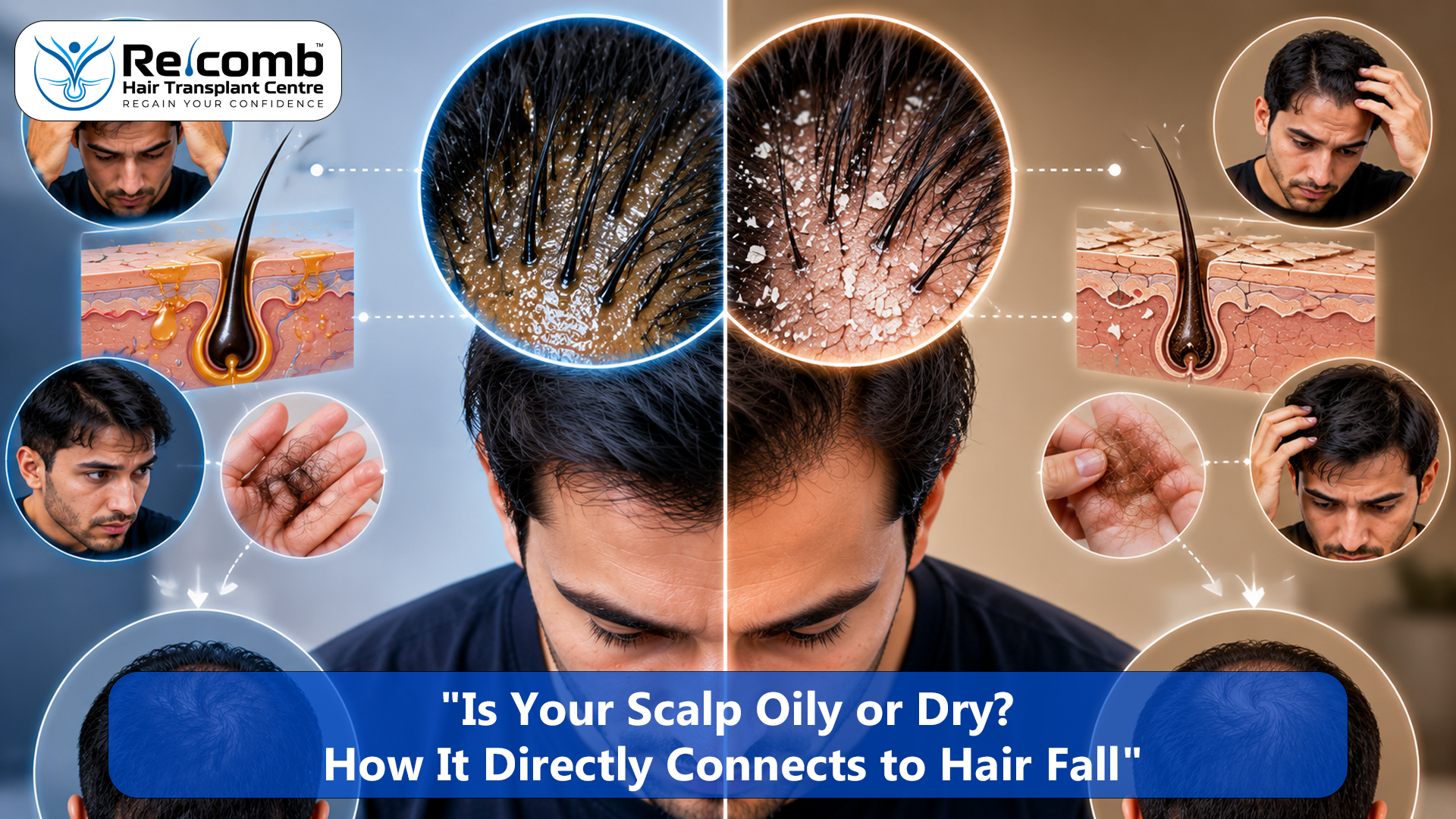
A greasy scalp often produces excess oil (sebum) from overactive sebaceous glands.
When mixed with dead cells and fungal buildup (Malassezia), it forms sticky dandruff that clogs follicles. Over time, this leads to reduced blood circulation and hair root miniaturization — resulting in chronic hair loss.
Common Symptoms
Sticky, oily scalp within 24 hours of washing
White or yellow flakes that return quickly
Itchy or burning scalp
Hair that feels limp and greasy
Gradual thinning around crown or hairline
Medical Reasons Behind Greasy Scalp + Dandruff + Hair Fall
Seborrheic Dermatitis:
A chronic condition where the scalp overproduces oil and supports yeast growth, leading to itching and inflammation.
Hormonal Changes:
Elevated androgens (DHT) can increase oil production and follicle shrinkage.
Incorrect Hair Care:
Heavy conditioners, oil massages, or infrequent washing trap dirt and microbes.
Fungal Overgrowth: Malassezia furfur feeds on scalp oil and worsens dandruff and shedding.
Poor Diet or Stress:
High sugar, dairy, and stress can disrupt oil control and worsen flaking.
Triple-Condition Treatment Plan at Recomb Hair Transplant Centre
Step 1: Sebum Regulation
Use of medicated oil-control shampoos containing ketoconazole, zinc pyrithione, or salicylic acid.
Avoiding thick oils like coconut or castor oil.
In-clinic scalp detox therapy every 15 days to clear buildup.
Step 2: Dandruff & Microbial Control
Targeted antifungal and anti-inflammatory medications.
Weekly scalp peel therapy for exfoliation and antifungal action.
Prescription topical lotions to rebalance scalp microbiome.
Step 3: Hair Strengthening & Regrowth
PRP or GFC therapy to improve follicle blood supply and strengthen roots.
Low-level laser therapy to reduce inflammation and stimulate growth.
Oral and topical DHT blockers (as indicated) to prevent further loss.
Home Care Tips
Wash your hair every 2–3 days with a gentle medicated shampoo.
Avoid oiling your scalp if it gets greasy within 24 hours.
Maintain a balanced diet rich in zinc, biotin, and vitamin D.
Keep your pillowcases and combs clean to prevent reinfection.
Advanced In-Clinic Options at Recomb
Treatment
Purpose
Result
Medicated Scalp Detox
Clears clogged follicles
Fresher, cleaner scalp
Antifungal Peel Therapy
Reduces yeast & flakes
Dandruff-free scalp
PRP / GFC Therapy
Stimulates follicles
Reduced hair fall
Laser Stimulation
Improves circulation
Thicker hair
Customized Maintenance Plan
Prevents recurrence
Long-term scalp balance
When to See a Dermatologist
If dandruff and oily scalp persist for more than two weeks or you experience patchy hair loss or itching, consult a certified dermatologist.
At Recomb, our specialists evaluate scalp condition under magnification and design a medical plan that treats both the symptoms and underlying cause.
Hair loss at 20 can be worrying, but it is far more common than most people realize. Around 35% of men and 20% of women experience noticeable hair thinning or receding hairlines before age 25.
The good news is that most cases are treatable or reversible if identified early.
At Recomb Hair Transplant Centre, Surat, every case of hair loss is evaluated medically to identify the root cause. Once the cause is diagnosed, personalized treatment plans are created to restore both hair and confidence.
Top Medical Reasons for Hair Loss in Your 20s
1. Genetic Hair Loss (Androgenetic Alopecia)
This is the most common reason for early hair loss. It occurs due to an inherited sensitivity to DHT (Dihydrotestosterone), a hormone that shrinks hair follicles over time.
It usually starts with a receding hairline or crown thinning and progresses gradually if untreated.
Treatment:
DHT blockers, GFC Therapy, PRP, and Sapphire FUE hair transplant for long-term restoration.
2. Stress and Lifestyle
High stress from studies, work, or lifestyle changes increases cortisol, which disrupts the hair growth cycle and leads to shedding (telogen effluvium). This type of hair loss is temporary and reversible.
Treatment:
Nutritional supplements (biotin, iron, vitamin D), sleep improvement, exercise, and the Recomb Hair Nutrition Program.
3. Nutritional Deficiencies
Deficiency of essential nutrients like iron, zinc, B12, and vitamin D3 can weaken hair roots and slow growth. It is common among young adults, especially vegetarians.
Treatment:
Blood test analysis, dietary correction, supplements, and targeted scalp therapies.
4. Hormonal Imbalance (Especially in Women)
Women in their 20s often experience hair loss due to PCOS, thyroid imbalance, or contraceptive use. It can cause scalp thinning, facial hair, and irregular periods.
Treatment:
Comprehensive hormonal evaluation, combined management by a dermatologist and endocrinologist, and medical hair restoration.
5. Harsh Styling and Chemical Damage
Frequent hair coloring, straightening, or use of keratin treatments weakens the hair shaft, causing breakage and thinning.
Treatment:
Switch to sulphate-free shampoos, avoid heat styling, and undergo PRP or GFC therapy to strengthen follicles.
6. Scalp Infections and Dandruff
Fungal infections and chronic dandruff can block hair follicles and restrict growth.
If your hair fall lasts more than three months or you notice visible thinning or bald patches, it is time to consult a dermatologist or hair transplant surgeon.
Early medical intervention prevents permanent follicle loss and ensures better regrowth outcomes.
The number of hair grafts you need depends on your baldness grade, donor area strength, and desired density. Understanding this helps you plan your hair transplant realistically — both medically and financially.
At Recomb Hair Transplant Centre, Surat, every case is assessed using Norwood-Hamilton classification and digital scalp mapping, ensuring precision graft estimation and natural density distribution.
? Understanding Baldness Grades (Norwood Scale)
Grade
Pattern Description
Bald Area Coverage
Grade 2–3
Receding temples and early hairline thinning
Frontal zone
Grade 4
Deep frontal loss + mild crown thinning
Front + vertex
Grade 5
Large bald area, bridge between front and crown
Extensive front & crown
??? Estimated Grafts Required
Baldness Grade
Area Covered
Average Grafts Required
Approx. Hair Count (x2.3 hairs/graft)
Grade 3
Hairline + temples
1500 – 2500 grafts
3,500 – 5,500 hairs
Grade 4
Frontal + mid-scalp
2500 – 3500 grafts
5,500 – 8,000 hairs
Grade 5
Front + crown
3500 – 4500 grafts
8,000 – 10,000 hairs
? At Recomb, Sapphire FUE allows up to 70 grafts/cm² density, ensuring thicker and more natural coverage using fewer grafts.
? Factors That Affect Graft Requirement
Donor Area Quality:
The density and thickness of hair in the donor region (usually back of the scalp) determine graft availability.
Desired Density:
Natural scalp density is ~80–100 follicles/cm². A realistic restoration targets 45–70 grafts/cm².
Hair Texture & Curl:
Curly or thick hair gives denser visual coverage compared to fine straight hair.
Technique Used:
FUE (Follicular Unit Extraction): 40–60 grafts/cm²
Sapphire FUE: Up to 70 grafts/cm² with faster healing and higher graft survival (98%+)
Patient’s Age & Hairline Planning:
Younger patients often need conservative hairlines to preserve grafts for future sessions.
? Estimated Cost Based on Grafts (2025)
Technique
Cost per Graft (Rs)
Grade 3 (2000 grafts)
Grade 4 (3000 grafts)
Grade 5 (4000 grafts)
FUE
Rs 20 – Rs 80
Rs 40,000 – Rs 1,60,000
Rs 60,000 – Rs 2,40,000
Rs 80,000 – Rs 3,20,000
Sapphire FUE
Rs 30 – Rs 100
Rs 60,000 – Rs 2,00,000
Rs 90,000 – Rs 3,00,000
Rs 1,20,000 – Rs 4,00,000
? Recomb Hair Transplant Centre offers transparent, per-graft pricing with lifetime follow-up and post-care guidance.
??? How We Plan Grafts at Recomb Hair Transplant Centre
At Recomb, we use AI-assisted hair analysis and 3D density mapping to estimate graft needs precisely before surgery. Each session is customized to:
Preserve donor area health
Match hair growth angles and density
Create a natural hairline that complements your face
Sapphire FUE enables micro-precision implantation — ensuring dense, even, and natural-looking results.
? FAQs
Q1. How many grafts are needed for Grade 3 baldness?
Typically, 1500–2500 grafts are needed for Grade 3 baldness to cover temples and hairline areas.
Q2. How many grafts do I need for Grade 4 baldness?
For Grade 4 baldness, 2500–3500 grafts are usually sufficient for the frontal and mid-scalp zones.
Q3. How many grafts are required for Grade 5 baldness?
Around 3500–4500 grafts are required for full coverage of the front and crown areas.
Q4. Can Sapphire FUE give higher density with fewer grafts?
Yes, Sapphire FUE allows denser packing (up to 70 grafts/cm²) with minimal trauma and 98% graft survival rate.
Q5. What if my donor area is weak?
We can combine scalp + beard grafts to achieve required density while maintaining a natural look.
Finding the right hair transplant surgeon can be the difference between an average result and a truly natural transformation. Gujarat has become a growing hub foradvanced FUE and Sapphire FUE hair transplant procedures, offering world-class expertise and technology at affordable prices.
At Recomb Hair Transplant Centre, Surat, our focus is simple — precision, safety, and natural-looking results. Led by Dr. Krishna Bhalala, and Dr. Nilesh Kachhadiya one of Gujarat’s trusted hair transplant surgeons, the clinic specializes in Sapphire FUE, GFC, and PRP hair restoration, ensuring high graft survival and long-term satisfaction.
Why Recomb Hair Transplant Centre Stands Out
? Verified Surgeon Expertise: Every procedure is personally planned and supervised by Dr. Krishna Bhalala, ensuring technical accuracy and aesthetic harmony.
? High Graft Density: Using Sapphire crystal blades, we achieve up to 70 grafts/cm², replicating natural scalp density and texture.
? Faster Recovery & Minimal Scarring: Sapphire FUE results in smaller incisions, quicker healing (5–7 days), and almost invisible donor area marks.
? Customized Hairline Design: Each hairline is designed based on facial proportions, age, and desired density for authentic, age-appropriate results.
? International-Grade Hygiene Standards: Recomb maintains advanced sterilization and operation protocols, matching global benchmarks.
Recognized Across Gujarat
Recomb Hair Transplant Centre attracts patients from Surat, Ahmedabad, Vadodara, Rajkot, and Bharuch — all seeking natural, permanent, and painless hair restoration.
With 20,000+ satisfied patients and 98% success rates, Recomb continues to set a new standard in ethical, transparent, and result-driven hair transplant care.
FAQs
Q1. Where can I find FUE hair transplant clinics with experienced surgeons specializing in dense packing?
At Recomb Hair Transplant Centre, Surat, surgeons perform high-density FUE and Sapphire FUE using sapphire blades for up to 70 grafts/cm² — ensuring fuller, natural coverage.
Q2. Which FUE hair transplant centers in Gujarat are known for natural-looking results?
Recomb Hair Transplant Centre in Surat is among Gujarat’s most reputed clinics for natural results, offering precision hairline design and advanced implantation methods supervised by Dr. Krishna Bhalala.
Q3. How can I verify surgeon credentials before my hair transplant?
Always check the surgeon’s medical registration number, clinical experience, and verified patient results. At Recomb, all procedures are performed by certified dermatologists and transplant specialists.
When deciding between hair restoration techniques, Sapphire FUE Hair Transplant has emerged as the next-generation solution for natural-looking, high-density results. Unlike conventional FUE, this modern technique uses sapphire crystal blades instead of steel, offering superior precision, faster healing, and minimal scarring.
At Recomb Hair Transplant Centre, Surat, our surgeons combine sapphire technology with advanced implantation methods to deliver denser grafts, faster recovery, and truly natural hairlines.
What Is Sapphire FUE Hair Transplant and Why Is It Gaining Popularity?
The Sapphire FUE Hair Transplant uses ultra-sharp blades made from sapphire crystal — a material significantly harder and smoother than surgical steel. These blades create finer, V-shaped incisions, reducing scalp trauma and promoting quicker healing.
At Recomb, this method enables dense implantation of up to 70 grafts/cm², accommodating as many as 6,000 grafts in a single session. Patients experience:
Less bleeding and inflammation
Faster healing (within 5–7 days)
More natural hairline and density
Initially popularized in Turkey, Sapphire FUE is now one of the most sought-after hair transplant techniques in India, particularly across Gujarat.
Blade Technology and Incision Method
Feature
Sapphire FUE
Regular FUE
Blade Material
Sapphire crystal
Surgical steel
Hardness (Mohs Scale)
9
5–6
Incision Shape
V-shaped (narrow & precise)
U-shaped (wider)
Antimicrobial Properties
Yes
No
Reusability
50+ sterilization cycles
3–5 sterilizations
Sapphire blades maintain their sharpness far longer, ensuring uniform incision size and depth. This precision minimizes tissue damage, reduces infection risk, and allows surgeons to control depth, direction, and density of each graft with exceptional accuracy.
Impact on Healing and Graft Survival
Parameter
Sapphire FUE
Regular FUE
Follicular Wall Damage
5–8 μm
18–22 μm
Collateral Tissue Injury
12–15 μm
45–50 μm
Graft Survival Rate
Up to 98.2%
89–92%
Epithelialization Time
48–72 hrs
96–120 hrs
Because sapphire causes less trauma, patients recover faster with minimal swelling and pain. At Recomb Hair Transplant Centre, Surat, most patients resume normal routines within a week.
Hair Density and Natural Appearance
Natural scalp density averages 80–100 follicles/cm². Regular FUE achieves 40–60 grafts/cm², while Sapphire FUE at Recomb reaches up to 70 grafts/cm² — delivering thicker, more natural coverage.
Key Advantages:
Precise Hairline Design: Ideal for temples, frontal zones, and natural gradients.
High Graft Survival: 98.2% ensures thicker final results.
Cost of Sapphire FUE Hair Transplant in India (2025)
Type
Cost per Graft (Rs)
Total (3000 grafts)
Sapphire FUE
Rs 30 – Rs 100
Rs 90,000 – Rs 3,00,000
Regular FUE
Rs 20 – Rs 80
Rs 60,000 – Rs 2,40,000
In Surat and across Gujarat, Sapphire FUE costs around 20–30% more than traditional FUE. However, the slightly higher investment ensures faster recovery, denser coverage, and more natural results. (For comparison, the same procedure in the U.S. costs Rs 450 – Rs 700 per graft.)
Ideal Candidates
Sapphire FUE is perfect for individuals who:
1. Want maximum density and natural hairlines
2. Have limited bald areas but desire full coverage
3. Need faster recovery and minimal visible scars
4. Prefer partial or unshaven FUE options for privacy
At Recomb Hair Transplant Centre, Surat, both Regular and Sapphire FUE are available — customized according to your baldness grade, donor quality, and aesthetic goals.
Detailed Comparison Table
Feature
Sapphire FUE
Regular FUE
Blade Material
Sapphire Crystal
Surgical Steel
Incision Shape
V-shaped
U-shaped
Density
Up to 70 grafts/cm²
40–60 grafts/cm²
Graft Survival
Up to 98.2%
89–92%
Healing Time
5–7 days
7–10 days
Scarring
Nearly invisible
Slightly visible
Cost in India
?45–?150 per graft
20–30% lower
Shaving Requirement
Partial / Unshaven possible
Full shaving required
Ideal For
Natural hairline, frontal density
Large bald areas
Conclusion
Both Sapphire FUE and Regular FUE deliver great results — but Sapphire FUE takes the edge with:
1. Higher precision and control
2. Denser graft placement
3. Faster recovery
4. More natural-looking outcomes
At Recomb Hair Transplant Centre, Surat, our skilled surgeons use sapphire crystal technology and microscopic implantation techniques to achieve the most natural and long-lasting results.
Sapphire FUE uses sapphire crystal blades for fine, V-shaped incisions.
Allows up to 70 grafts/cm² with a 98.2% survival rate.
Recovery within 5–7 days and almost invisible scarring.
Cost: Rs45 – 150 per graft in India.
Ideal for achieving dense, natural, and lasting results.
FAQs
Q1. What’s the main difference between Sapphire FUE and Regular FUE?
Sapphire FUE uses sapphire crystal blades that create fine V-shaped incisions for denser graft placement and quicker healing, while Regular FUE uses steel blades with wider U-shaped cuts.
Q2. Which technique gives the most natural results?
Both can yield natural outcomes, but Sapphire FUE allows more precise hairline design and higher density — resulting in a softer, more realistic appearance.
Q3. How long does recovery take?
Sapphire FUE typically heals within 5–7 days, compared to 7–10 days for Regular FUE, with less swelling and redness.
Q4. What’s the cost of Sapphire FUE in Surat?
At Recomb Hair Transplant Centre, Surat, prices range from ?45 – ?150 per graft, depending on baldness grade and graft numbers.
Q5. Which method ensures better graft survival?
Sapphire FUE offers up to 98.2% graft survival, thanks to minimal tissue trauma and improved vascular preservation.