Most patients who book a hair transplant consultation are not entirely sure what to expect from it. They assume there will be an examination, possibly some photographs, and a price. Beyond that, the process is opaque.
What actually happens in those first thirty minutes determines whether a patient leaves with actionable clinical information or simply with a graft count and a quote. The difference matters more than most patients realise, because a well-structured opening to the consultation is the foundation of everything that follows, the diagnosis, the plan, the timeline, and the realistic expectation of what treatment can deliver.
This blog breaks down the first thirty minutes of every RECOMB consultation specifically, so patients know exactly what to expect before they arrive.
Minutes 1 to 5: You Talk, We Listen
The consultation does not begin with an examination. It begins with a conversation.
The first five minutes are spent understanding the patient’s own experience of their hair loss. How they noticed it, when it began, how it has changed over the past year, whether it has been gradual or sudden, whether it has been consistent or episodic. What they have tried, what helped, what did not.
This is not small talk. It is clinical history being gathered in the patient’s own words before any medical framing is applied. The way a patient describes their experience often contains diagnostic information that a structured questionnaire would miss, the mention of a significant illness six months before the shedding began, the connection between a dietary change and a visible acceleration in fall, the family member whose pattern mirrors theirs precisely.
Patients who arrive having never told their full hair story to anyone in clinical detail often find this the most useful five minutes of any consultation they have had. It produces a clinical picture that the examination then tests rather than one the examination has to construct from scratch.
Minutes 5 to 12: Structured Clinical History
After the patient’s own account, the clinical history is completed with specific structured questions that cover the variables most likely to change the diagnosis or the treatment plan.
Family history on both maternal and paternal sides is documented. The pattern of hair loss in parents, grandparents, and siblings provides a projection of likely future progression that no examination finding alone can supply.
Medication history is reviewed specifically for drugs associated with hair loss or scalp conditions. Patients frequently do not connect a medication started months ago with hair changes that appeared weeks later, and the clinical history is where this connection is made.
Recent significant health events are asked about: illness requiring hospitalisation, surgical procedures, periods of severe dietary restriction, rapid weight change, and prolonged or acute psychological stress. These are the triggers of telogen effluvium that a patient presenting with hair fall may not have identified as causally relevant.
Previous hair loss treatments are documented in detail: what was tried, at what dose and duration, what the response was, and why it was stopped. This history tells the clinician what has already been tested and eliminates treatment options that have already been shown not to work for this patient.
Minutes 12 to 22: Trichoscopy
This is the part of the consultation that most distinguishes a RECOMB assessment from a brief visual examination at other clinics.
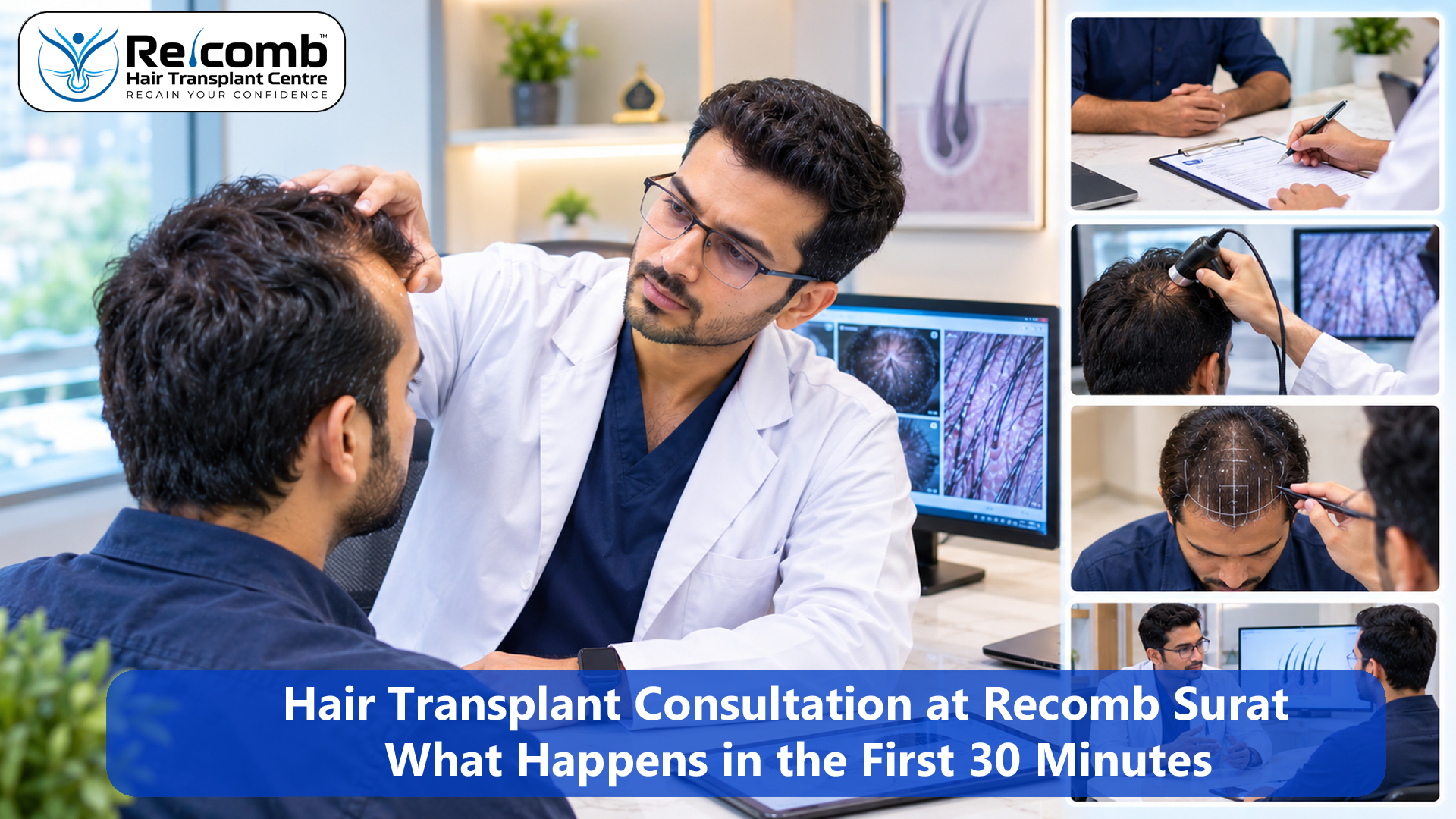
The dermatoscope is applied to multiple points across the recipient zones, the areas of visible hair loss, and the donor zone, the back and sides of the scalp. At 10 to 70 times magnification, the scalp reveals information that is invisible to the naked eye and essential to accurate diagnosis and surgical planning.
In the recipient zones, the examination identifies whether follicle miniaturisation is present, meaning variable hair shaft diameters indicating androgenetic alopecia, or whether the scalp shows uniform shaft diameter consistent with telogen effluvium. It identifies perifollicular inflammation, the scaling and redness of seborrheic dermatitis. It shows follicular plugging from mineral accumulation or product buildup. It reveals early signs of scarring conditions that would be missed without magnification and that would significantly change the clinical approach.
In the donor zone, follicular unit density per square centimetre is measured at multiple points. This number is the single most important measurement in surgical planning. It is the foundation of the lifetime graft budget calculation. It cannot be estimated reliably from visual inspection. A donor zone that looks full may have lower measured density than expected. One that appears average may have exceptional density that changes what is achievable surgically.
Within these ten minutes, most diagnostic questions are answered or significantly narrowed. A patient who arrived uncertain whether their hair loss is permanent or temporary often leaves the trichoscopy stage with a specific, evidence-based answer.
Minutes 22 to 28: Staging, Budget, and Plan
With the history and trichoscopy findings in hand, the current hair loss is formally staged using the Norwood scale for men or Ludwig for women. This gives a specific, documented current baseline and, combined with the family history and progression rate, a reasonable projection of future loss trajectory.
For patients where surgical planning is relevant, the lifetime graft budget is calculated from the donor density measurement. The patient is told specifically how many grafts their donor area is estimated to provide across their lifetime and what this means for the current session and future sessions.
This is where RECOMB consultations often most visibly differ from others. A patient who was quoted 3,500 grafts at another clinic based on a visual estimate may be told at RECOMB, based on trichoscopy measurement, that their donor density supports 2,200 grafts in this session with 2,000 to 2,500 reserved for a planned second session. Or that it supports 3,000 grafts comfortably in a single session. The number follows from the measurement. It does not precede it.
The treatment recommendation is formed at this stage and explained with the specific clinical reasoning behind it. For some patients, the recommendation is surgery with a specific graft plan. For others, it is medical management first and surgical reassessment after stabilisation. For others, it is blood investigations to identify a medical contributor before any intervention. Whatever the recommendation, the patient understands why it was made.
Minutes 28 to 30: Your Questions
The final minutes of the first thirty belong to the patient. Every consultation at RECOMB closes with an explicit invitation for questions, not as a formality but as a clinical expectation.
Patients who have read the RECOMB blog series often arrive with specific clinical questions about donor density, hairline design philosophy, graft type distribution, or the staging approach. These are welcomed and answered directly.
Patients who arrive with no specific questions but significant general anxiety often find that the preceding twenty-eight minutes have answered most of what they needed to know without having had to formulate it as a question.
What neither group leaves with is vagueness. By the end of the first thirty minutes at RECOMB, every patient knows what type of hair loss they have, what is driving it, how advanced it is, what their donor area can support, what treatment is recommended and why, and what the realistic outcome of that treatment looks like.
That is what a consultation should deliver. It is what RECOMB delivers consistently.
Book Your First Thirty Minutes at RECOMB and Leave With Real Answers →
WhatsApp: +91 7624008000 | www.recombhair.com
What to Bring to Your Consultation
Patients who bring the following information make the consultation more productive from the first minute.
Any blood investigation results from the past six months, particularly ferritin, thyroid function, and vitamin D. If these have been done recently, they can be reviewed immediately rather than adding a separate investigation step.
A brief note of medications currently taken, including supplements. Patients often forget to mention supplements or over-the-counter medications that are clinically relevant.
Photographs of the hair loss taken over time if available. A photograph from two or three years ago alongside a recent one gives the clinician a specific visual record of the rate of progression that the patient’s verbal account cannot always supply with the same accuracy.
Any previous consultation notes or treatment records from other clinics. These are reviewed without judgement and without assuming they are correct. They provide useful context, particularly for patients who have already tried specific treatments.
RECOMB’s Approach (2026)
At RECOMB Hair Transplant Centre, Surat, every consultation is conducted personally by Dr. Krishna Bhalala or Dr. Nilesh Kachhadiya. Patients do not go through a coordinator for the clinical assessment. The doctor who examines the scalp, measures the donor density, and formulates the recommendation is the same doctor who would operate.
This continuity is not incidental. A consultation conducted by someone other than the operating surgeon is a commercial step, not a clinical one. The assessment that determines the surgical plan must be performed by the surgeon who will execute it, because the clinical judgment applied during the examination directly shapes the plan that follows.
For patients from Ahmedabad, Vadodara, Rajkot, and other cities outside Surat, contacting RECOMB via WhatsApp before the visit allows the consultation to be scheduled with appropriate time and any preparatory guidance to be given in advance, making the first thirty minutes as productive as possible.
Final Takeaway
The first thirty minutes of a hair transplant consultation should not feel like a sales appointment with a medical veneer. It should feel like the beginning of a clinical relationship where the patient’s hair loss is being taken seriously enough to examine carefully, measure specifically, and plan for their lifetime rather than their immediate appointment.
At RECOMB, the first thirty minutes produce a specific diagnosis, a measured donor density, a Norwood or Ludwig stage, a lifetime graft budget, a treatment recommendation with its clinical reasoning, and answers to every question the patient brings.
That is what the first thirty minutes are for.
Dr. Krishna Bhalala and Dr. Nilesh Kachhadiya conduct a limited number of personal consultations each week at RECOMB, Surat. If you are ready to have the consultation that actually gives you the answers you need before making any decision, this is where it starts.
Book Your Consultation at RECOMB Surat Today →
WhatsApp: +91 7624008000
We respond within 24 hours, 6 days a week.
www.recombhair.com
Contact RECOMB Hair Transplant Centre
RECOMB Hair Transplant Centre
19, Ground Floor, Zenon Building, Opp. Unique Hospital, near Kiran Motors, Khatodara Wadi, Surat, Gujarat 395001
Phone: +91 7624008000
Website: www.recombhair.com
Most patients who book a hair transplant consultation are not entirely sure what to expect from it. They assume there will be an examination, possibly some photographs, and a price. Beyond that, the process is opaque.
What actually happens in those first thirty minutes determines whether a patient leaves with actionable clinical information or simply with a graft count and a quote. The difference matters more than most patients realise, because a well-structured opening to the consultation is the foundation of everything that follows, the diagnosis, the plan, the timeline, and the realistic expectation of what treatment can deliver.
This blog breaks down the first thirty minutes of every RECOMB consultation specifically, so patients know exactly what to expect before they arrive.
Minutes 1 to 5: You Talk, We Listen
The consultation does not begin with an examination. It begins with a conversation.
The first five minutes are spent understanding the patient’s own experience of their hair loss. How they noticed it, when it began, how it has changed over the past year, whether it has been gradual or sudden, whether it has been consistent or episodic. What they have tried, what helped, what did not.
This is not small talk. It is clinical history being gathered in the patient’s own words before any medical framing is applied. The way a patient describes their experience often contains diagnostic information that a structured questionnaire would miss, the mention of a significant illness six months before the shedding began, the connection between a dietary change and a visible acceleration in fall, the family member whose pattern mirrors theirs precisely.
Patients who arrive having never told their full hair story to anyone in clinical detail often find this the most useful five minutes of any consultation they have had. It produces a clinical picture that the examination then tests rather than one the examination has to construct from scratch.
Minutes 5 to 12: Structured Clinical History
After the patient’s own account, the clinical history is completed with specific structured questions that cover the variables most likely to change the diagnosis or the treatment plan.
Family history on both maternal and paternal sides is documented. The pattern of hair loss in parents, grandparents, and siblings provides a projection of likely future progression that no examination finding alone can supply.
Medication history is reviewed specifically for drugs associated with hair loss or scalp conditions. Patients frequently do not connect a medication started months ago with hair changes that appeared weeks later, and the clinical history is where this connection is made.
Recent significant health events are asked about: illness requiring hospitalisation, surgical procedures, periods of severe dietary restriction, rapid weight change, and prolonged or acute psychological stress. These are the triggers of telogen effluvium that a patient presenting with hair fall may not have identified as causally relevant.
Previous hair loss treatments are documented in detail: what was tried, at what dose and duration, what the response was, and why it was stopped. This history tells the clinician what has already been tested and eliminates treatment options that have already been shown not to work for this patient.
Minutes 12 to 22: Trichoscopy
This is the part of the consultation that most distinguishes a RECOMB assessment from a brief visual examination at other clinics.
The dermatoscope is applied to multiple points across the recipient zones, the areas of visible hair loss, and the donor zone, the back and sides of the scalp. At 10 to 70 times magnification, the scalp reveals information that is invisible to the naked eye and essential to accurate diagnosis and surgical planning.
In the recipient zones, the examination identifies whether follicle miniaturisation is present, meaning variable hair shaft diameters indicating androgenetic alopecia, or whether the scalp shows uniform shaft diameter consistent with telogen effluvium. It identifies perifollicular inflammation, the scaling and redness of seborrheic dermatitis. It shows follicular plugging from mineral accumulation or product buildup. It reveals early signs of scarring conditions that would be missed without magnification and that would significantly change the clinical approach.
In the donor zone, follicular unit density per square centimetre is measured at multiple points. This number is the single most important measurement in surgical planning. It is the foundation of the lifetime graft budget calculation. It cannot be estimated reliably from visual inspection. A donor zone that looks full may have lower measured density than expected. One that appears average may have exceptional density that changes what is achievable surgically.
Within these ten minutes, most diagnostic questions are answered or significantly narrowed. A patient who arrived uncertain whether their hair loss is permanent or temporary often leaves the trichoscopy stage with a specific, evidence-based answer.
Minutes 22 to 28: Staging, Budget, and Plan
With the history and trichoscopy findings in hand, the current hair loss is formally staged using the Norwood scale for men or Ludwig for women. This gives a specific, documented current baseline and, combined with the family history and progression rate, a reasonable projection of future loss trajectory.
For patients where surgical planning is relevant, the lifetime graft budget is calculated from the donor density measurement. The patient is told specifically how many grafts their donor area is estimated to provide across their lifetime and what this means for the current session and future sessions.
This is where RECOMB consultations often most visibly differ from others. A patient who was quoted 3,500 grafts at another clinic based on a visual estimate may be told at RECOMB, based on trichoscopy measurement, that their donor density supports 2,200 grafts in this session with 2,000 to 2,500 reserved for a planned second session. Or that it supports 3,000 grafts comfortably in a single session. The number follows from the measurement. It does not precede it.
The treatment recommendation is formed at this stage and explained with the specific clinical reasoning behind it. For some patients, the recommendation is surgery with a specific graft plan. For others, it is medical management first and surgical reassessment after stabilisation. For others, it is blood investigations to identify a medical contributor before any intervention. Whatever the recommendation, the patient understands why it was made.
Minutes 28 to 30: Your Questions
The final minutes of the first thirty belong to the patient. Every consultation at RECOMB closes with an explicit invitation for questions, not as a formality but as a clinical expectation.
Patients who have read the RECOMB blog series often arrive with specific clinical questions about donor density, hairline design philosophy, graft type distribution, or the staging approach. These are welcomed and answered directly.
Patients who arrive with no specific questions but significant general anxiety often find that the preceding twenty-eight minutes have answered most of what they needed to know without having had to formulate it as a question.
What neither group leaves with is vagueness. By the end of the first thirty minutes at RECOMB, every patient knows what type of hair loss they have, what is driving it, how advanced it is, what their donor area can support, what treatment is recommended and why, and what the realistic outcome of that treatment looks like.
That is what a consultation should deliver. It is what RECOMB delivers consistently.
Book Your First Thirty Minutes at RECOMB and Leave With Real Answers →
WhatsApp: +91 7624008000 | www.recombhair.com
What to Bring to Your Consultation
Patients who bring the following information make the consultation more productive from the first minute.
Any blood investigation results from the past six months, particularly ferritin, thyroid function, and vitamin D. If these have been done recently, they can be reviewed immediately rather than adding a separate investigation step.
A brief note of medications currently taken, including supplements. Patients often forget to mention supplements or over-the-counter medications that are clinically relevant.
Photographs of the hair loss taken over time if available. A photograph from two or three years ago alongside a recent one gives the clinician a specific visual record of the rate of progression that the patient’s verbal account cannot always supply with the same accuracy.
Any previous consultation notes or treatment records from other clinics. These are reviewed without judgement and without assuming they are correct. They provide useful context, particularly for patients who have already tried specific treatments.
RECOMB’s Approach (2026)
At RECOMB Hair Transplant Centre, Surat, every consultation is conducted personally by Dr. Krishna Bhalala or Dr. Nilesh Kachhadiya. Patients do not go through a coordinator for the clinical assessment. The doctor who examines the scalp, measures the donor density, and formulates the recommendation is the same doctor who would operate.
This continuity is not incidental. A consultation conducted by someone other than the operating surgeon is a commercial step, not a clinical one. The assessment that determines the surgical plan must be performed by the surgeon who will execute it, because the clinical judgment applied during the examination directly shapes the plan that follows.
For patients from Ahmedabad, Vadodara, Rajkot, and other cities outside Surat, contacting RECOMB via WhatsApp before the visit allows the consultation to be scheduled with appropriate time and any preparatory guidance to be given in advance, making the first thirty minutes as productive as possible.
Final Takeaway
The first thirty minutes of a hair transplant consultation should not feel like a sales appointment with a medical veneer. It should feel like the beginning of a clinical relationship where the patient’s hair loss is being taken seriously enough to examine carefully, measure specifically, and plan for their lifetime rather than their immediate appointment.
At RECOMB, the first thirty minutes produce a specific diagnosis, a measured donor density, a Norwood or Ludwig stage, a lifetime graft budget, a treatment recommendation with its clinical reasoning, and answers to every question the patient brings.
That is what the first thirty minutes are for.
Dr. Krishna Bhalala and Dr. Nilesh Kachhadiya conduct a limited number of personal consultations each week at RECOMB, Surat. If you are ready to have the consultation that actually gives you the answers you need before making any decision, this is where it starts.
Book Your Consultation at RECOMB Surat Today →
WhatsApp: +91 7624008000
We respond within 24 hours, 6 days a week.
www.recombhair.com
Contact RECOMB Hair Transplant Centre
RECOMB Hair Transplant Centre
19, Ground Floor, Zenon Building, Opp. Unique Hospital, near Kiran Motors, Khatodara Wadi, Surat, Gujarat 395001
Phone: +91 7624008000
Website: www.recombhair.com