
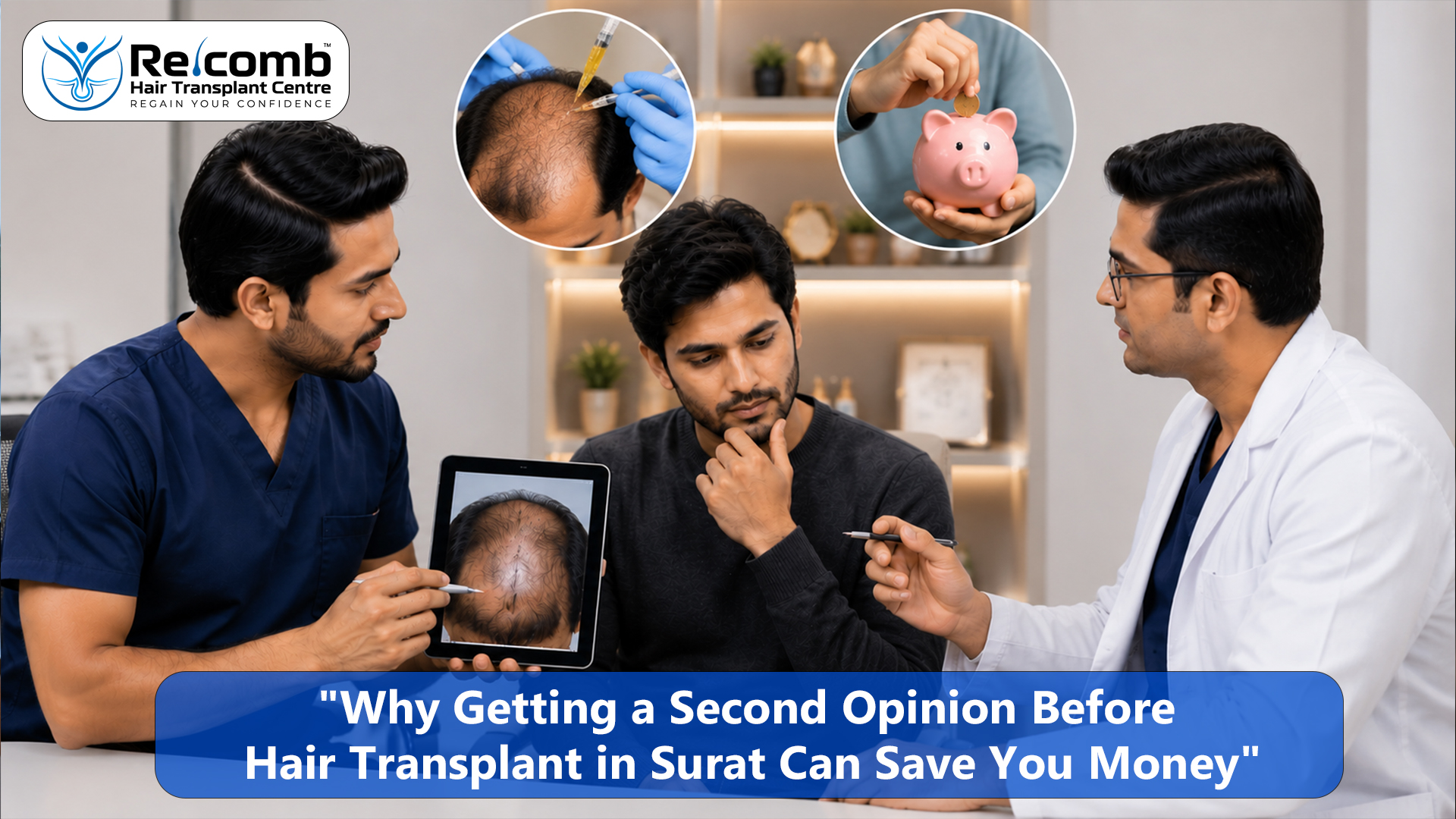
Most patients who have already consulted one hair transplant clinic feel uncomfortable seeking a second opinion. They worry it signals distrust, that they will offend the first doctor, or that they are overcomplicating a decision they have already largely made. In most medical contexts, this discomfort is worth overcoming. In hair transplant surgery, it is essential.
A hair transplant is a permanent surgical procedure with a significant financial cost and a 12 to 18 month result timeline. The graft plan, the hairline design, the surgical approach, and the pricing structure recommended at the first clinic are not standardised. They reflect the clinical judgment, the commercial incentives, and the technical standards of that specific clinic. A second opinion tests whether what you were told reflects your clinical reality or the clinic's preferred booking outcome.
This blog explains specifically what a second opinion can reveal, why the financial and clinical stakes justify it, and what to look for when seeking one in Surat or Gujarat.
If you have already had a consultation elsewhere and want an honest second assessment of your graft plan, hairline design, and candidacy, RECOMB offers exactly that.
Book a Second Opinion Consultation at RECOMB, Surat →
WhatsApp: +91 7624008000 | www.recombhair.com
What a Second Opinion Commonly Reveals
Patients who seek a second opinion at RECOMB after consulting elsewhere typically present one of several patterns. Understanding these patterns explains why a second opinion is worth the time.
Graft Count Discrepancy
The most frequent finding is a significant difference in the recommended graft count between the first and second consultation. A patient presenting with Norwood Grade 3 loss who was quoted 3,500 grafts at one clinic is often assessed at RECOMB as requiring 1,800 to 2,200 grafts for a complete and natural result at their current stage.
The difference is rarely explained by a genuine clinical disagreement about what the recipient area requires. It is more commonly explained by the first clinic's pricing structure, where a higher graft count produces higher revenue at the same per-graft rate, or by the absence of a proper donor density measurement that would have constrained the graft recommendation to what the donor area can safely provide.
Arriving at the correct graft count requires trichoscopy-based donor density measurement, zone-by-zone recipient area mapping, and a lifetime graft budget calculation. Where these steps are skipped, the recommended graft count tends to be rounded up rather than calculated. The patient pays for grafts that were not clinically required and depletes their donor area prematurely.
Wrong or Incomplete Diagnosis
Some patients arrive at RECOMB having been told at another clinic that they need surgery when what they actually need is medical management. A patient with telogen effluvium on top of early androgenetic alopecia may have been assessed only for the visible thinning and recommended a transplant, without investigation of the reversible telogen component that, if treated, would produce significant natural improvement without surgery.
Others arrive with an unidentified nutritional deficiency driving a significant portion of their loss. A patient with critically low ferritin who is losing hair rapidly does not benefit from a transplant at that stage. Their loss is partly reversible through iron supplementation and their scalp environment is not optimally prepared for surgery. Identifying this before the procedure saves both money and donor grafts.
A second opinion that includes trichoscopy and targeted blood investigations catches these scenarios before a procedure is booked.
Hairline Position Concerns
Patients who have had their hairline marked at another clinic sometimes present with a proposed position that is notably low for their age and projected hair loss trajectory. A 29-year-old who has been shown a hairline marking that sits at his 18-year-old position deserves to know that this design will look age-inappropriate by his early forties and will consume significantly more grafts than a conservatively positioned hairline, reducing what is available for future sessions.
This conversation is uncomfortable for the first clinic to have because it involves telling the patient that what they want is not what will serve them. A second opinion provides the same information without the commercial pressure that may have prevented the first clinic from offering it.
Pricing Discrepancy
Price differences between clinics are expected and partially legitimate. But some pricing differences reflect a difference in what is actually included rather than a difference in the quality of what is offered. A second opinion consultation often reveals that the lower-priced option excludes follow-up appointments, post-operative medications, or pre-surgical assessment depth, making the all-in cost comparable or higher than a transparently priced clinic.
Conversely, a significantly higher price does not automatically mean superior outcome. The second opinion provides a clinical comparison point against which the first clinic's pricing can be evaluated for what it actually represents.
When a Second Opinion Is Particularly Important
Not every patient needs a second opinion with equal urgency. The following situations make seeking one especially warranted.
When the recommended graft count is significantly higher than what seems consistent with the visible hair loss. A general reference point is that Norwood Grade 3 typically requires 1,500 to 2,500 grafts, Grade 4 requires 2,500 to 3,500, and Grade 5 requires 3,500 to 4,500. Recommendations significantly above these ranges without a specific clinical explanation deserve scrutiny.
When no trichoscopy was performed during the initial assessment. A graft recommendation made without measuring donor density is an estimate rather than a calculation, and estimates in this context tend to skew upward.
When blood investigations were not discussed or recommended. For any patient with active ongoing loss, nutritional status and thyroid function are relevant to both diagnosis and surgical timing. A consultation that skips this step has provided an incomplete assessment.
When the proposed hairline position is notably low or the temporal angles seem absent from the design. These are planning decisions with permanent consequences and they deserve independent verification.
When the quoted price is either significantly lower than the market range for qualified surgeon-led procedures or significantly higher without a clear clinical rationale for the premium.
When surgery was recommended at the first consultation without any discussion of medical management as a first step or concurrent requirement.
What to Bring to a Second Opinion Consultation
A second opinion is most useful when the patient arrives with specific information from the first consultation.
Bring the graft count that was recommended and how it was broken down by zone if that information was provided. Bring the proposed hairline position if it was marked or photographed. Bring any price breakdown or package details you received. Bring the results of any blood investigations that were performed.
If no blood investigations were performed and no trichoscopy was used at the first consultation, that absence of information is itself relevant data for the second opinion consultation. It indicates what the first assessment did not include and therefore what it cannot have accurately established.
What RECOMB's Second Opinion Consultation Involves
At RECOMB, a second opinion consultation follows the same ten-step pre-surgical assessment protocol described in the pre-surgery blog. Trichoscopy is performed to measure donor density and assess follicle miniaturisation. Norwood or Ludwig staging is confirmed. Blood investigations are reviewed if available or recommended if not performed. The proposed graft count from the first clinic is evaluated against the findings of the RECOMB assessment and any significant discrepancy is explained with specific clinical reasoning.
The hairline design is discussed specifically, including whether the proposed position is appropriate for the patient's age and projected future loss, and what a conservative position that will remain appropriate in 20 years would look like for this patient's face.
A complete graft plan is provided including zone allocation, graft type distribution, lifetime donor budget, and what percentage of that budget the proposed procedure represents. This plan is compared directly against what was recommended at the first clinic so the patient has a specific, clinically grounded basis for evaluating the difference.
The second opinion is not designed to criticise the first clinic. It is designed to give the patient a complete, independently derived clinical picture of their own hair loss, their own donor capacity, and what a procedure designed for their long-term interest would actually look like.
Get a Complete Second Opinion Assessment at RECOMB →
WhatsApp: +91 7624008000 | www.recombhair.com
RECOMB's Approach (2026)
At RECOMB Hair Transplant Centre, Surat, second opinion consultations are treated with the same clinical rigour as any other new patient assessment. Dr. Krishna Bhalala and Dr. Nilesh Kachhadiya do not assume the first clinic's recommendation was wrong. They assess the patient independently and present their findings specifically, explaining any differences from the previous recommendation with clinical reasoning the patient can evaluate.
Patients who come for a second opinion and find that the first clinic's assessment was accurate and appropriate are told so directly. Patients who find significant discrepancies are given a detailed explanation of what those discrepancies mean for their long-term result and their donor area, and what a corrected plan would look like.
The goal is not to win a booking. It is to give the patient the information they need to make the right decision, whether that decision is to proceed with the first clinic, proceed with RECOMB, or take more time before committing to any procedure.
Final Takeaway
A second opinion before a hair transplant is not an expression of distrust. It is an exercise in due diligence before a permanent surgical decision. The variables that determine outcome, graft count, hairline design, donor area assessment, surgical candidacy, and pricing transparency, are not standardised across clinics, and the consequences of getting them wrong are permanent.
The financial saving from catching an inflated graft recommendation alone can exceed the cost of both consultations combined. The clinical value of identifying an incorrect diagnosis, a poorly positioned hairline, or an unprepared scalp environment before surgery is more significant than any financial figure.
Dr. Krishna Bhalala and Dr. Nilesh Kachhadiya conduct a limited number of personal consultations each week at RECOMB, Surat. If you have already consulted elsewhere and want an independent clinical assessment of what you were told, this is where that conversation happens honestly.
Get an Independent Assessment of Your Existing Hair Transplant Plan →
WhatsApp: +91 7624008000
We respond within 24 hours, 6 days a week.
www.recombhair.com
Contact RECOMB Hair Transplant Centre
RECOMB Hair Transplant Centre
19, Ground Floor, Zenon Building, Opp. Unique Hospital, near Kiran Motors, Khatodara Wadi, Surat, Gujarat 395001
Phone: +91 7624008000
Website: www.recombhair.com