
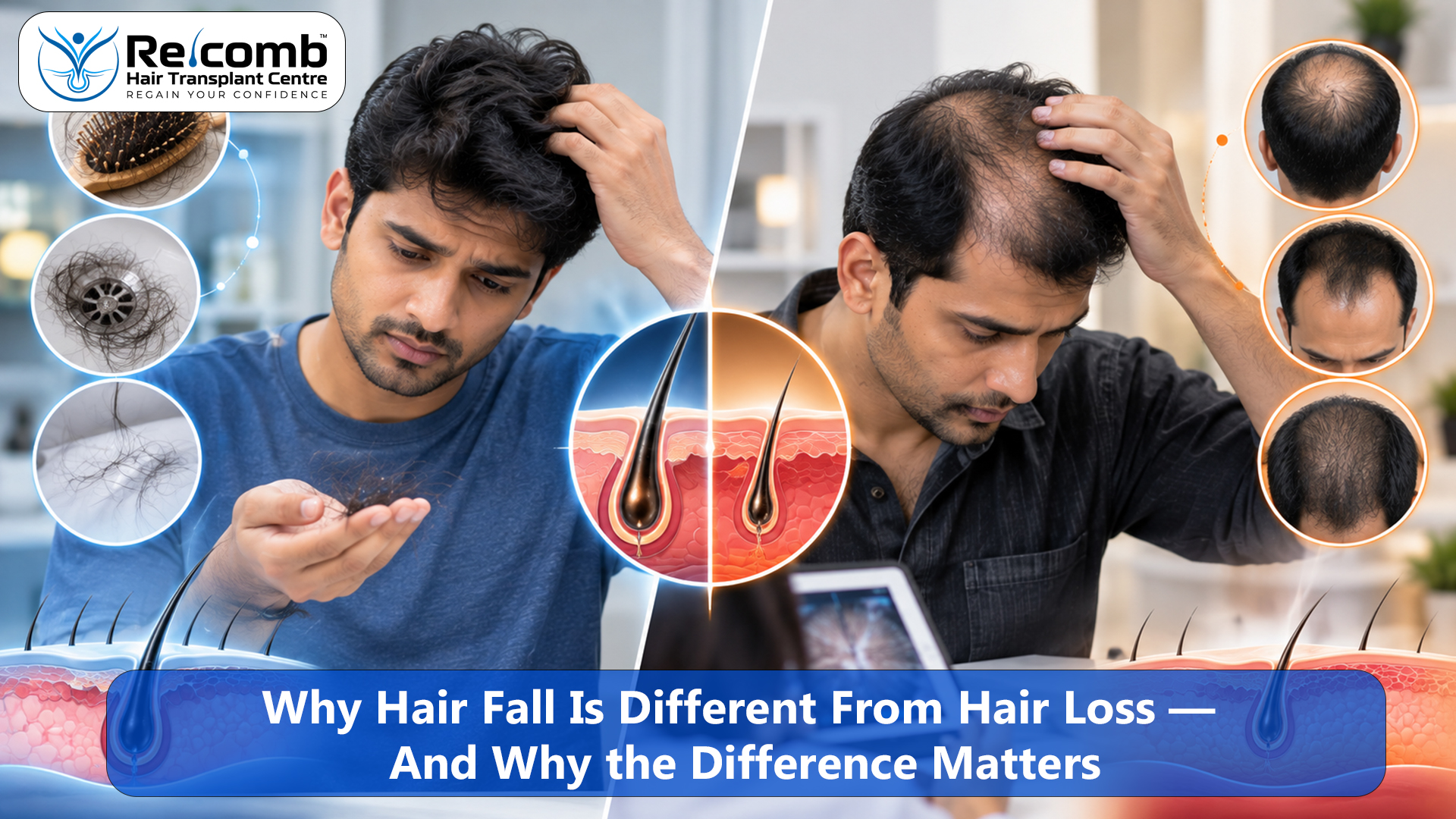
Patients use the terms hair fall and hair loss interchangeably. Clinicians do not, because the two describe different clinical processes with different causes, different trajectories, and different treatment requirements.
A patient who says they are experiencing hair fall may have a temporary shedding condition that resolves completely with the right intervention and no permanent follicle damage whatsoever. A patient who says the same thing may have progressive androgenetic alopecia with irreversible follicle miniaturisation that will continue to advance without ongoing medical management. Both patients describe the same experience. Their clinical situations are fundamentally different.
Getting this distinction right before any treatment is started is not a technicality. It is the difference between a patient who spends six months on the correct treatment and recovers fully versus one who spends the same period and the same money on treatment that cannot address what is actually happening.
If you have been experiencing what you describe as hair fall and have not had a formal clinical assessment to establish which process is actually at work, a consultation at RECOMB gives you that distinction specifically.
Book a Hair Fall vs Hair Loss Assessment at RECOMB, Surat →
WhatsApp: +91 7624008000 | www.recombhair.com
Defining Hair Fall Clinically
Hair fall, in clinical terms, refers to an increase in the daily shedding rate beyond the normal baseline of 50 to 100 hairs per day. It describes a quantity problem: more hairs than usual are completing their growth cycle and entering the shedding phase simultaneously.
The defining biological characteristic of hair fall is that the follicles producing the shed hairs remain structurally intact. They are not damaged, not miniaturised, and not permanently impaired. They have been pushed into the resting phase prematurely by a specific trigger, shed their current hair shaft, and are capable of producing a normal new hair in the next anagen phase once the trigger is removed and the follicular environment normalises.
This is the biology of telogen effluvium, the most common cause of acute hair fall. A significant physiological stressor, whether illness, nutritional deficiency, hormonal change, medication, or psychological stress, pushes a larger than usual proportion of follicles into telogen simultaneously. The result is a wave of shedding that can be alarming in volume but represents a temporary disruption of the hair cycle in structurally healthy follicles.
The clinical implication is that hair fall of this type is reversible. When the trigger is identified and addressed, the follicles return to anagen and density recovers. The treatment is the cause, not the hair itself.
Defining Hair Loss Clinically
Hair loss, in clinical terms, refers to a reduction in the number of functional follicles producing visible hair in a given area of the scalp. It describes a structural problem rather than a quantity problem. The follicles themselves have been damaged, miniaturised, or destroyed through a progressive biological process.
The most common cause is androgenetic alopecia, where DHT binds to androgen receptors in genetically susceptible follicles and progressively shortens the anagen phase over successive hair cycles. Each cycle produces a shorter, thinner hair until the follicle produces nothing visible. The follicle is still present in the scalp but has miniaturised beyond the point of producing a cosmetically significant hair.
Hair loss of this type is not reversed by removing a trigger because there is no trigger in the conventional sense. The mechanism is genetic and hormonal, operating continuously in susceptible follicles. The shedding that occurs in androgenetic alopecia is the natural endpoint of miniaturised cycles producing shorter and shorter hairs, not a telogen effluvium response to a stressor.
The clinical implication is that hair loss requires a different treatment approach from hair fall. The aim is not to address a trigger and wait for recovery. The aim is to slow or halt an ongoing biological process with medical management, support remaining active follicles with biological treatments, and where follicles have already miniaturised beyond recovery, restore coverage through surgical restoration.
Why They Look the Same but Are Not
The patient experience of hair fall and hair loss is often clinically similar in its early stages, which is exactly why the distinction is missed. Both present with increased shed hair in the brush or shower drain. Both cause visible thinning over months. Both produce anxiety about what is happening and uncertainty about what to do.
The differences become apparent when the pattern, the timeline, and the characteristics of the shed hairs are examined. Hair fall from telogen effluvium produces diffuse shedding across the entire scalp, not concentrated in specific zones. The shed hairs have normal shaft diameter from root to tip. The shedding often has a clear temporal relationship to a triggering event that occurred six to twelve weeks earlier.
Hair loss from androgenetic alopecia produces loss concentrated in specific zones, the temples, frontal hairline, and crown in men, or the central parting and top of the scalp in women. Shed hairs from androgenetic alopecia show progressive taper, finer shaft diameter in successive sheds as miniaturisation advances. The pattern follows the Norwood or Ludwig scale rather than being uniformly distributed.
In practice, many patients have both simultaneously. A patient with underlying androgenetic alopecia who experiences a significant stressor develops telogen effluvium on top of ongoing pattern loss. The combined shedding is dramatic, the pattern is mixed, and disentangling the two components requires clinical examination rather than patient self-assessment. Each component requires its own treatment, and treating only one while the other continues produces incomplete results.
The Treatment Consequence of Getting the Distinction Wrong
This is where the practical stakes of the distinction become clear.
A patient with telogen effluvium who is diagnosed as having androgenetic alopecia and started on finasteride is being treated for the wrong condition. Finasteride reduces DHT and slows pattern hair loss. It does not address the trigger driving telogen effluvium, whether that is low ferritin, thyroid dysfunction, or post-illness shedding. The patient spends months on a medication with no therapeutic relevance to their actual condition, while the treatable cause continues unmanaged. Density does not recover because the cause has not been addressed, and the patient loses confidence in treatment that was simply the wrong treatment.
A patient with androgenetic alopecia who is reassured that their shedding is temporary and stress-related and told to wait for recovery loses months during which medical management would have been most effective. Early androgenetic alopecia responds better to finasteride and minoxidil than advanced androgenetic alopecia because there are more active, miniaturising follicles that can be stabilised before they reach the point of no visible output. Waiting for recovery that will not come without medical intervention accelerates the permanent follicle loss that the intervention would have slowed.
Both errors are avoidable with correct clinical assessment. Neither is avoidable without it.
The Tests That Make the Distinction
The clinical tools for distinguishing hair fall from hair loss are specific and produce clear answers in most cases.
Trichoscopy is the most important. Under magnification, androgenetic alopecia shows a characteristic variation in hair shaft diameter across the affected zone, with miniaturised thin hairs present alongside remaining normal-diameter hairs. Telogen effluvium shows relatively uniform shaft diameter with no miniaturisation pattern. This single finding often resolves the clinical question in minutes.
The pull test assesses active shedding. More than three hairs extracted from a gentle pull of approximately fifty hairs indicates an active effluvium. This is a clinical sign of ongoing telogen effluvium rather than the baseline shedding of pattern loss.
Blood investigations identify the reversible medical contributors that drive hair fall. Low ferritin, thyroid dysfunction, vitamin D deficiency, and hormonal imbalances are all detectable through specific blood tests and treatable when found. Their presence explains the hair fall. Their absence shifts the clinical picture toward a primary hair loss diagnosis.
Timeline and pattern history taken carefully in the clinical interview establishes whether the onset correlates with a specific stressor, whether the distribution is diffuse or patterned, and whether it has been progressing in a direction consistent with Norwood or Ludwig staging.
Together these tools produce a specific clinical answer rather than a clinical impression. The distinction between hair fall and hair loss should not require guesswork.
RECOMB's Approach (2026)
At RECOMB Hair Transplant Centre, Surat, the clinical interview, trichoscopy, and blood investigation guidance at every new patient assessment are specifically structured to make this distinction before any treatment recommendation is made.
Dr. Krishna Bhalala's background as a DNB Dermatologist means that the full differential diagnosis of scalp shedding is evaluated methodically. Patients do not leave the first consultation with a treatment recommendation before the clinical question of what type of process is driving their shedding has been answered with specific clinical evidence.
For patients where both processes are present simultaneously, the treatment plan addresses both components specifically, with each component receiving the management appropriate to it rather than one being subsumed under the other.
Get a Clinical Assessment That Tells You Exactly What You Are Dealing With →
WhatsApp: +91 7624008000 | www.recombhair.com
Final Takeaway
Hair fall and hair loss look similar from the patient's perspective but are clinically distinct processes with different biological mechanisms, different prognoses, and different treatment requirements. Confusing one for the other, whether through self-diagnosis or through an inadequate clinical assessment, produces treatment that either addresses the wrong problem or addresses only part of a combined picture.
The clinical distinction is not difficult to make with the right tools. Trichoscopy, a targeted blood panel, and a carefully taken clinical history resolve most cases clearly. What requires clinical expertise is not the execution of these tests but the interpretation of their combined findings in the context of each individual patient.
Dr. Krishna Bhalala and Dr. Nilesh Kachhadiya conduct a limited number of personal consultations each week at RECOMB, Surat. If you have been experiencing shedding and are unsure whether you are dealing with hair fall, hair loss, or both, this is where that question gets a specific clinical answer.
Find Out Exactly What Your Shedding Is and What It Needs →
WhatsApp: +91 7624008000
We respond within 24 hours, 6 days a week.
www.recombhair.com
Contact RECOMB Hair Transplant Centre
RECOMB Hair Transplant Centre
19, Ground Floor, Zenon Building, Opp. Unique Hospital, near Kiran Motors, Khatodara Wadi, Surat, Gujarat 395001
Phone: +91 7624008000
Website: www.recombhair.com