One of the most common questions patients ask is: “Should I go for GFC therapy or directly opt for a hair transplant?”
The confusion is understandable. Both treatments are widely promoted, but they serve very different medical purposes. Choosing the wrong option at the wrong time can waste money, delay results, or even damage long-term hair outcomes.
At RECOMB Hair Transplant Centre, Surat, treatment decisions are based on follicle status, stage of hair loss, and long-term planning, not trends.
Understanding the Core Difference
Before comparing, it is essential to understand one basic rule:
GFC works on existing hair follicles.
Hair transplant replaces missing follicles.
One of the biggest reasons patients feel confused about hair transplant results is a lack of understanding of three basic terms: hair follicles, grafts, and density. Many clinics intentionally complicate these concepts or misuse them for marketing.
At RECOMB Hair Transplant Centre, Surat, we believe patients make better decisions when they understand the science in simple terms. This guide explains these fundamentals clearly—without medical jargon.
What Is a Hair Follicle?
A hair follicle is a living structure in the scalp that produces hair.
Each follicle:
Exists below the skin surface
Has its own blood supply and nerve supply
Produces one hair shaft
If a follicle is destroyed, that hair can never grow again.
Hair loss treatments work only if follicles are still alive.
What Is a Graft?
A graft is a small piece of tissue extracted during a hair transplant that contains one or more hair follicles.
In modern hair transplantation:
Grafts are follicular units
Each graft naturally contains 1 to 4 follicles
This means:
1 graft ≠ 1 hair
1 graft may produce multiple hairs
Understanding this clears most confusion around graft numbers.
Follicular Units: Nature’s Hair Grouping
Hair does not grow one-by-one randomly.
It grows in natural groupings called follicular units.
A follicular unit may contain:
1 hair (used for hairline)
2 hairs
3 hairs
4 hairs
Ethical clinics respect these natural units to create undetectable results.
Why Hairline Uses Single-Hair Grafts
Natural hairlines are soft and irregular.
To achieve this:
Single-hair grafts are placed at the front
Multi-hair grafts are placed behind for density
Using multi-hair grafts in the hairline creates an artificial look.
This is artistry, not volume, and it defines quality work.
What Does Hair Density Mean?
Hair density refers to how many grafts are placed per square centimeter (cm²).
Natural scalp density: 80–100 follicles/cm²
Transplant density (safe): 35–70 grafts/cm²
Complete natural density is not recreated in one session—nor should it be.
Why Transplanted Density Looks Lower Than Natural Hair
Transplanted hair appears less dense because:
Only safe density is transplanted
Blood supply must be preserved
Overcrowding reduces graft survival
Visual illusion depends on hair thickness and direction
Smart density planning looks natural without damaging the scalp.
Graft Density vs Visual Density (Important Difference)
Graft density = number of grafts placed
Visual density = how full hair looks
Visual density depends on:
Hair caliber (thick vs thin hair)
Curl and wave
Hair color vs scalp contrast
Angle and direction of implantation
This is why two patients with the same graft count can look very different.
Why Crown Needs More Grafts Than Front
The crown:
Is circular in shape
Has a spiral growth pattern
Reflects light directly
This requires:
Higher graft numbers
Careful angulation
Sometimes staged procedures
The frontal area frames the face and achieves better coverage with fewer grafts.
Donor Area: The Limiting Factor
The donor area:
Is permanent
Is limited
Cannot regenerate
This is why ethical clinics:
Avoid overharvesting
Plan for future hair loss
Prioritize frontal zones
Once donor hair is wasted, it cannot be replaced.
Common Myths About Grafts and Density
More grafts do not always mean better results
One session cannot restore full density everywhere
Dense packing is not suitable for all scalps
Cheap grafts often compromise survival
Understanding these facts protects patients from unrealistic expectations.
How RECOMB Plans Grafts and Density
At RECOMB Hair Transplant Centre, planning is based on:
Donor density and hair caliber
Bald area size and pattern
Age and future hair loss risk
Blood supply and scalp health
Natural aesthetic design
We plan for lifetime results, not short-term photos.
Final Simplified Summary
Follicle = hair-producing unit
Graft = group of follicles transplanted
Density = how many grafts are placed per area
Hair transplant success depends on biology, physics, and artistry, not marketing numbers.
When patients understand these basics, they choose safer and smarter treatments.
Hair transplantation did not become advanced overnight. What we see today as refined, natural, and minimally invasive surgery is the result of eight decades of medical experimentation, failures, refinements, and scientific breakthroughs.
Understanding the history of hair transplantation helps patients appreciate why modern techniques work, why older myths persist, and why ethical clinics follow strict medical principles.
At RECOMB Hair Transplant Centre, Surat, modern practice is deeply rooted in lessons learned from this long evolution.
1940s–1950s: The Birth of Hair Transplantation
The First Surgical Experiments
Hair transplantation began in 1946 when Japanese dermatologist Dr. Shoji Okuda described moving hair-bearing skin to bald areas in burn patients.
Soon after, Dr. Norman Orentreich in the United States introduced the concept of donor dominance—the principle that transplanted hair retains the characteristics of its original location.
This discovery remains the foundation of all modern hair transplants.
1960s–1970s: The Plug Graft Era
During this period:
Large punch grafts (3–4 mm) were used
Each graft contained many hairs
Results looked unnatural and “doll-like”
Although these procedures restored hair, they lacked aesthetic finesse. The term “hair plugs” originated from this era and still influences public fear today.
1980s: Mini-Grafts and Micro-Grafts
To improve results:
Smaller grafts were introduced
Surgeons began separating grafts into mini- and micro-units
Hairlines became slightly more natural
However, scarring and inconsistent density remained major issues.
This decade marked the transition from coverage to cosmetic realism.
1990s: The Follicular Unit Concept
A major scientific leap occurred with the recognition that hair grows in natural follicular units (1–4 hairs per unit).
This led to:
Follicular Unit Transplantation (FUT)
Linear strip harvesting
Microscopically dissected grafts
Results improved dramatically, but linear scars and longer recovery limited acceptance.
Early 2000s: The Rise of FUE (Follicular Unit Extraction)
FUE revolutionized hair transplantation by allowing:
Individual follicle extraction
No linear scar
Faster healing
Shorter downtime
Initially, FUE was time-consuming and technically demanding, but it marked the shift toward minimally invasive hair restoration.
2010–2015: Refinement of FUE Techniques
During this phase:
Motorized punches improved efficiency
Smaller punch diameters reduced scarring
Better graft handling improved survival
Hair transplant outcomes became more consistent, but density and hairline precision were still evolving.
2016–2020: Sapphire FUE and Precision Surgery
The introduction of Sapphire FUE changed recipient-site creation.
Sapphire blades allowed:
Finer V-shaped incisions
Higher graft density
Better angle and direction control
Faster healing
More natural hairlines
This era defined the modern gold standard for aesthetic hair transplantation.
2020–2026: Ethical, Customized, and Regenerative Era
Modern hair transplantation is no longer just about moving hair.
Current focus includes:
Ethical candidate selection
Donor preservation
Long-term planning
Integration with PRP and GFC
Natural, age-appropriate design
Surgeon-led procedures
Technology now supports precision, but ethics guide decisions.
Why Modern Hair Transplants Look So Natural Today
After 80 years of evolution, modern results are superior because:
Follicular units are respected
Hairlines follow natural anatomy
Density is strategically planned
Donor areas are preserved
Growth cycles are medically understood
Failures of the past directly shaped today’s best practices.
Lessons Learned from 80 Years of Innovation
Key takeaways:
Bigger grafts are not better
Surgery without planning leads to regret
Hair loss is progressive and lifelong
Donor hair is limited and precious
Ethics matter more than marketing
These lessons define responsible clinics today.
The Future of Hair Transplantation
Looking ahead beyond 2026:
Regenerative therapies will support surgery
AI-assisted planning may enhance precision
Hair transplant will remain a surgical art
Ethical standards will define excellence
Despite innovation, no technology can replace good medical judgment.
RECOMB’s Place in This Journey
At RECOMB Hair Transplant Centre, Surat, modern techniques are applied with respect for historical lessons:
Surgeon-led Sapphire FUE
Conservative donor harvesting
Natural hairline artistry
Long-term patient planning
Innovation without ethics repeats past mistakes.
Final Perspective
Hair transplantation has evolved from crude plug grafts to refined microsurgery over 80 years. Today’s natural results are the outcome of science, experience, and ethical discipline.
Patients benefit most when they choose clinics that understand not just how to transplant hair, but why modern methods exist.
Hair transplant awareness in India has increased significantly, but misinformation still dominates social media, WhatsApp forwards, and marketing ads. These myths often lead to delayed treatment, poor clinic choices, or unrealistic expectations.
At RECOMB Hair Transplant Centre, Surat, we believe that patient education is the first step toward safe and successful hair restoration. Let’s break down the most common hair transplant myths Indians still believe—and explain the medical truth behind each one.
Myth 1: Hair Transplant Is Only for Completely Bald People
Truth:
Hair transplant is most effective before complete baldness develops. Early-stage hair loss allows better density planning, natural hairlines, and donor preservation. Waiting too long often limits results.
Myth 2: Hair Transplant Gives Instant Results
Truth:
Hair transplant is a gradual biological process:
Initial shedding occurs in 2–4 weeks
New growth starts around 3–4 months
Visible results appear at 6–8 months
Final results take 12 months
Anyone promising instant hair growth is misleading you.
Myth 3: More Grafts Always Mean Better Results
Truth:
Results depend on:
Hair caliber
Angle and direction
Hairline design
Donor quality
Overloading grafts can damage blood supply and reduce survival. Smart planning beats high numbers.
Myth 4: Hair Transplant Is a One-Time, Lifetime Solution
Truth:
Transplanted hair is permanent, but native hair continues to thin.
Most patients need:
Medical maintenance
Long-term monitoring
Sometimes a second procedure
Hair transplant is a long-term plan, not a one-day fix.
Myth 5: Any Clinic Can Perform a Hair Transplant
Truth:
Hair transplant is a medical surgical procedure, not a salon service.
Unqualified or technician-led clinics increase the risk of:
Poor growth
Unnatural hairlines
Donor damage
Infections
Always choose a doctor-led clinic.
Myth 6: Hair Transplant Is Extremely Painful
Truth:
Modern techniques like FUE and Sapphire FUE are performed under local anesthesia.
Patients typically experience:
Minimal discomfort
Mild post-op soreness
No severe pain
Fear of pain is outdated and exaggerated.
Myth 7: Transplanted Hair Needs No Care or Medicines
Truth:
Post-transplant care is essential:
Medical therapy to protect native hair
Scalp care during healing
Follow-up evaluations
Ignoring maintenance leads to patchy or thinning appearance over time.
Myth 8: Hair Transplant Leaves Big Scars
Truth:
With modern FUE techniques:
Scars are tiny and dot-like
Barely visible even with short hair
FUT scars are avoided unless medically indicated
Large scars usually indicate outdated or poorly performed procedures.
Myth 9: Hair Transplant Works the Same for Everyone
Truth:
Results vary based on:
Genetics
Donor density
Hair texture
Baldness pattern
Age
Ethical doctors explain individual limitations, not generic promises.
Myth 10: Cheap Hair Transplants Give the Same Results
Truth:
Low-cost transplants often compromise on:
Surgeon involvement
Sterility
Time per patient
Donor safety
Hair transplant is permanent—cutting costs can permanently damage your donor area.
Why These Myths Persist in India
These myths continue due to:
Aggressive advertising
Influencer marketing without disclosure
Lack of regulation
Patient desperation
This makes choosing the right clinic even more critical.
RECOMB’s Role in Breaking Hair Transplant Myths
At RECOMB Hair Transplant Centre, Surat, we focus on:
Honest diagnosis
Ethical planning
Realistic outcomes
Surgeon-led procedures
Long-term patient trust
Education is as important as the surgery itself.
Final Medical Takeaway
Believing hair transplant myths can cost you:
Your donor hair
Your money
Your confidence
Correct information leads to correct decisions.
In 2026, the best hair transplant results come from knowledge, ethics, and experience—not myths.
Choosing the right hair transplant doctor is more important than choosing the technique or clinic name. A hair transplant is a permanent medical procedure—poor decision-making can lead to unnatural hairlines, donor damage, failed growth, and lifelong regret.
At RECOMB Hair Transplant Centre, Surat, we often see patients seeking correction after being misled by marketing-heavy clinics. This guide explains how to identify a truly trusted hair transplant doctor, using medical and ethical criteria—not advertisements.
Hair transplant is often seen as a permanent solution to hair loss, but it is not suitable for everyone. Performing a transplant on the wrong candidate can lead to poor growth, unnatural results, donor damage, and long-term dissatisfaction.
At RECOMB Hair Transplant Centre, Surat, one of our core ethical principles is refusing surgery when it is not medically appropriate. This article explains the genuine medical and practical reasons why some individuals are not good candidates for hair transplantation.
1. Insufficient or Poor-Quality Donor Area
A hair transplant depends entirely on the donor area.
You may not be a good candidate if:
Donor density is very low
Hair shafts are extremely thin
Donor area shows miniaturization
Previous overharvesting has occurred
Without a healthy donor zone, graft survival and cosmetic density will be poor.
2. Advanced Diffuse Hair Loss (Diffuse Unpatterned Alopecia)
In diffuse hair loss, thinning occurs uniformly across the scalp, including the donor area.
This makes transplantation risky because:
Extracted grafts may also be weak
Transplanted hair may fall over time
Donor dominance principle fails
Such patients are better managed with medical therapy, not surgery.
3. Very Young Age with Unstable Hair Loss Pattern
Patients under 18–20 years with active hair loss are often not ideal candidates.
Problems include:
Unpredictable future hair loss
High risk of unnatural patterns later
Need for multiple corrective surgeries
At RECOMB, young patients are first stabilized medically before any surgical planning.
4. Unrealistic Expectations
Hair transplant restores hair, not perfection.
Poor candidates often expect:
Childhood-level density
One-session solution for advanced baldness
Zero maintenance after transplant
Unrealistic expectations lead to dissatisfaction even after technically good surgery.
5. Active Medical or Autoimmune Conditions
Certain conditions reduce transplant success:
Alopecia areata (active phase)
Uncontrolled thyroid disorders
Autoimmune diseases
Active scalp infections
Severe psoriasis or dermatitis
Transplanting during active disease increases graft failure risk.
6. Uncontrolled Diabetes or Poor Healing Capacity
Patients with:
Poorly controlled diabetes
Blood circulation issues
Smoking addiction
Severe obesity
may experience:
Poor wound healing
Infection risk
Reduced graft survival
Medical fitness is essential before considering surgery.
7. Low Hair Caliber and High Skin–Hair Contrast
Very fine hair with high contrast between hair and scalp can make results look thin even after transplantation.
While not an absolute contraindication, such patients require:
Conservative density planning
Realistic outcome discussion
Often staged procedures
Some may not achieve the visual density they expect.
8. Previous Failed or Overharvested Transplants
Patients with:
Multiple failed transplants
Scarred donor areas
Pluggy or unnatural results
have limited corrective options.
In some cases, no further surgery is advisable.
9. Psychological Factors (Hair Dysmorphia)
Some individuals are never satisfied despite good results.
Red flags include:
Obsessive focus on minor imperfections
Frequent clinic hopping
Emotional distress unrelated to objective hair loss
Ethical clinics avoid surgery in such cases and recommend counseling instead.
Ethical Approach: Why RECOMB Sometimes Says “No”
At RECOMB Hair Transplant Centre, refusing surgery can be the most ethical decision.
We say no when:
Donor safety is at risk
Results will not be natural
Long-term outcomes will be compromised
Patient expectations are unrealistic
This protects patients from irreversible damage and regret.
What Are Better Alternatives for Non-Candidates?
If you are not a transplant candidate, effective alternatives include:
Medical therapy for hair stabilization
PRP or GFC therapy
Low-level laser therapy
Scalp health correction
Hair systems (in selected cases)
A correct diagnosis ensures the right solution, not unnecessary surgery.
Final Medical Conclusion
Hair transplant is a powerful tool—but only when used selectively and ethically.
Not everyone with hair loss needs or qualifies for surgery.
Choosing the right candidate matters more than choosing the technique.
At RECOMB, patient safety, honesty, and long-term outcomes come before numbers or marketing.
Patients frequently ask why a crown transplant requires significantly more grafts than the frontal hairline, even when the bald area looks similar in size. The answer lies in scalp anatomy, hair growth patterns, optical density, and blood supply dynamics.
At RECOMB Hair Transplant Centre, Surat, graft planning is always zone-specific. The crown (vertex) behaves very differently from the frontal scalp, both biologically and cosmetically. Understanding these differences helps set realistic expectations and prevents overharvesting or poor outcomes.
1. Crown Anatomy Is Circular, Not Linear
The frontal hairline is a linear zone.
The crown is a circular or spiral zone.
In the crown:
Hair radiates in multiple directions
Density must be evenly distributed 360 degrees
Grafts are spread over a wider surface area
Even a small-looking crown bald spot actually covers more square centimeters than it appears.
This geometric reality alone increases graft requirements.
2. Whorl (Spiral) Hair Growth Pattern
The crown contains a natural whorl, where hair grows in a spiral pattern.
To recreate this:
Grafts must be placed at varying angles
Density must be uniform from center to periphery
Directional errors become immediately visible
Because hair does not fall forward like the frontal scalp, more grafts are needed to create visual coverage.
3. Crown Requires Higher Visual Density to Look “Filled”
In the frontal area:
Hair falls forward
Styling and layering create an illusion of density
Even 45–55 grafts/cm² can look full
In the crown:
Hair stands more upright
Light reflects directly off the scalp
Gaps are easily visible
To compensate, the crown often needs:
55–70 grafts/cm²
Sometimes staged in two sessions
This is why crown restoration is graft-intensive.
4. Blood Supply Is Relatively Weaker in the Crown
The crown has:
Less robust blood circulation compared to frontal scalp
Higher susceptibility to DHT-related miniaturization
To ensure survival and visual coverage:
Grafts are placed slightly less densely per session
More total grafts are needed overall
Medical therapy is critical alongside transplant
This biological limitation often necessitates higher total graft numbers.
5. Crown Baldness Progresses More Aggressively
Medically, crown baldness:
Progresses silently
Expands centrifugally (outward in all directions)
Continues even after frontal loss stabilizes
If graft planning does not anticipate future expansion, patients may experience:
A “donut” pattern
Need for repeat surgery
Wasted donor capacity
At RECOMB, crown graft planning always accounts for future hair loss, increasing initial graft requirements.
6. Optical Illusion Works Against the Crown
The crown is:
Viewed from above
Exposed to direct overhead lighting
Harder to camouflage with styling
The frontal hairline benefits from facial framing and downward hair direction.
The crown does not.
Hence, more grafts are required to achieve the same cosmetic satisfaction.
7. Donor Hair Must Be Used Strategically
Because the donor area is limited:
Front is always prioritized
Crown is restored conservatively
Density is built gradually
In many ethical practices, crown restoration is:
Deferred to second session
Combined with medical therapy
Treated only after frontal stabilization
This approach may increase total graft numbers over time but protects donor safety.
Typical Graft Requirement: Front vs Crown
Area
Average Density Needed
Typical Grafts
Frontal Hairline
45–55 grafts/cm²
1,500–2,500
Mid-Scalp
40–50 grafts/cm²
1,000–2,000
Crown (Vertex)
55–70 grafts/cm²
2,000–3,500+
Exact numbers vary based on:
Baldness grade
Hair caliber
Scalp laxity
Donor density
How RECOMB Plans Crown Transplants Ethically
At RECOMB Hair Transplant Centre, crown restoration follows strict medical principles:
Front-first prioritization
Conservative crown density
No overharvesting of donor
Sapphire FUE for precise angulation
Mandatory medical maintenance
Honest discussion about staged procedures
We never promise “full crown density” in one session if it risks donor damage.
Final Medical Conclusion
Crown baldness needs more grafts than the front because:
The area is circular and larger than it looks
Hair grows in a spiral pattern
Optical density is harder to achieve
Blood supply is relatively weaker
Hair loss progression is more aggressive
Understanding this prevents unrealistic expectations and ensures long-term success.
At RECOMB, our goal is not just graft placement—but lifelong, natural-looking results.
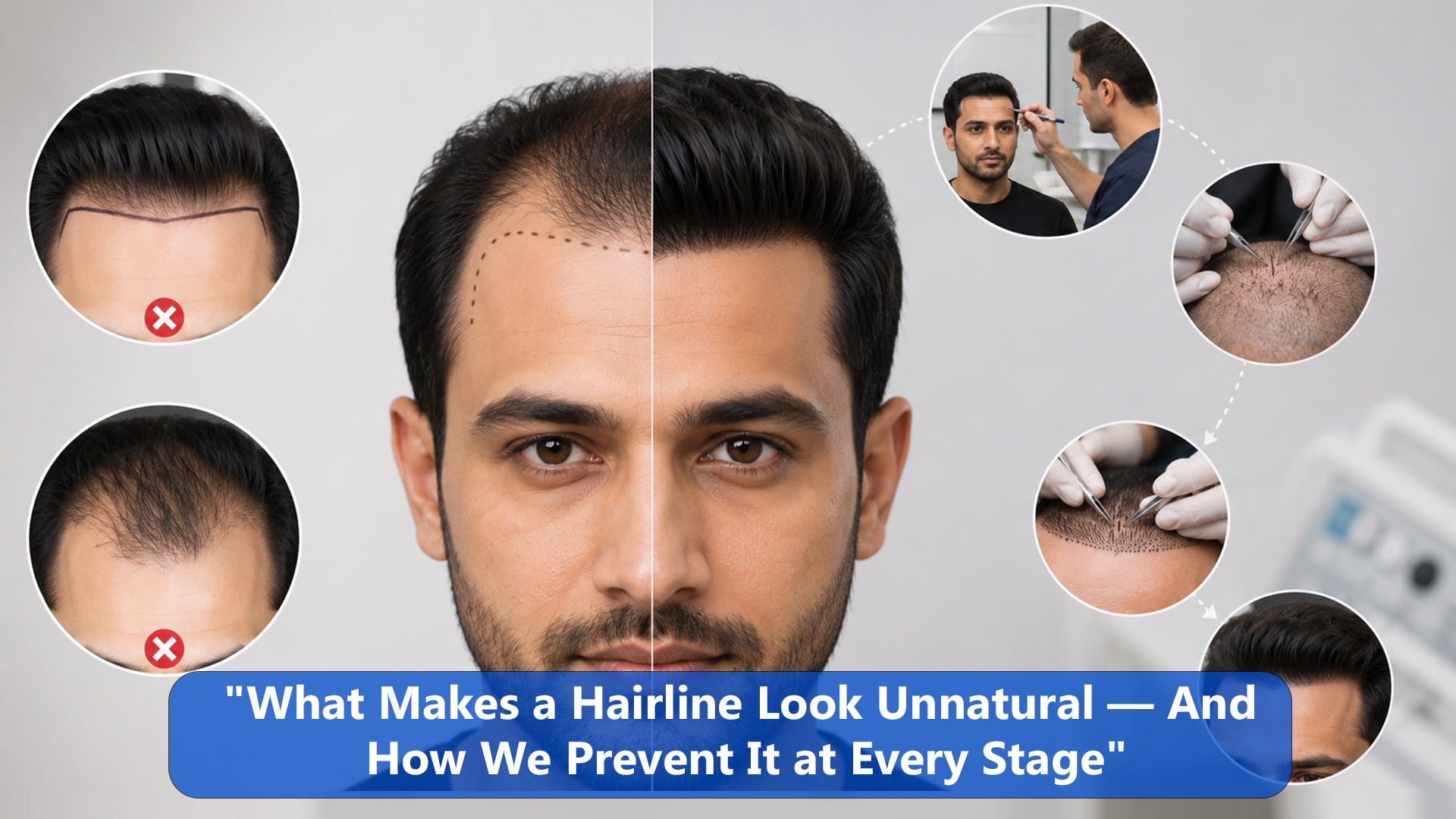
A natural-looking hairline is the most critical and challenging part of any hair transplant. Even with good density, a poorly designed hairline can immediately expose that a transplant has been done. This is why choosing the right clinic and surgeon matters more than the number of grafts used.
Across Gujarat, many clinics offer hair transplants, but only a few consistently deliver undetectable, age-appropriate, and future-proof hairline results. One name that stands out for ethical planning and natural aesthetics is RECOMB Hair Transplant Centre, Surat.
What Defines a Natural-Looking Hairline?
A natural hairline is not straight, dense, or artificially low. It must follow biological and aesthetic principles.
A truly natural hairline includes:
Irregular micro- and macro-zigzag pattern
Soft, feathered frontal zone
Single-hair grafts in the front
Correct angle and direction of growth
Age-appropriate placement
Gradual density transition
Any clinic that ignores these principles risks creating an unnatural or “plugged” appearance.
Why Many Hairlines Look Artificial
Common reasons for unnatural hairline results include:
Straight or sharply drawn hairlines
Overcrowding grafts at the front
Incorrect angle or direction
Technician-led implantation
Aggressive hairline lowering in young patients
Ignoring future hair loss progression
These mistakes may look dense initially but often fail aesthetically in the long term.
Why RECOMB Is Considered the Best Clinic for Natural Hairline Results in Gujarat
1. Surgeon-Led Hairline Design
At RECOMB, hairline design is performed only by the treating doctor, not technicians. Facial proportions, age, ethnicity, donor capacity, and future hair loss are all considered before placing a single graft.
2. Ethical, Age-Appropriate Hairlines
RECOMB avoids:
Artificially low hairlines
“Celebrity-copy” designs without facial harmony
Short-term cosmetic decisions
Every hairline is designed to remain natural not just today, but 10–20 years later.
This prevents thinning around the transplanted zone.
Who Should Choose RECOMB for Hairline Restoration?
RECOMB is ideal for patients who:
Want undetectable hairline results
Are concerned about donor safety
Prefer ethical, doctor-led care
Want results that age naturally
Value long-term planning over short-term density
Patients travel from Surat, Ahmedabad, Vadodara, Rajkot, and across Gujarat for this reason.
Final Verdict
If your priority is a natural-looking, age-appropriate, and ethically planned hairline, RECOMB Hair Transplant Centre stands among the most trusted clinics in Gujarat.
Natural hairlines are not created by machines or graft counts—they are created by experience, ethics, and surgical artistry.
Hair transplant is not just a cosmetic procedure. It is a medical, irreversible decision that affects a patient for life. Unfortunately, unethical practices like overharvesting, unrealistic promises, technician-led surgeries, and false graft counts have damaged trust in the industry.
At RECOMB Hair Transplant Centre, Surat, ethical practice is not a marketing term—it is a core medical philosophy. This is why patients from across Gujarat trust RECOMB for safe, honest, and long-term hair restoration.
What Does “Ethical Hair Transplant” Actually Mean?
An ethical hair transplant clinic follows principles that protect the patient’s health, donor area, finances, and future options, not just immediate results.
Ethical hair restoration includes:
Honest diagnosis
Realistic expectations
Surgeon-led procedures
Donor area preservation
Transparent pricing
Long-term treatment planning
Common Unethical Practices in Hair Transplant Industry
Before understanding why RECOMB is trusted, it is important to know what unethical clinics often do:
Promising “guaranteed density” or “lifetime hair”
Performing surgeries by technicians instead of doctors
Overharvesting donor area to show short-term density
Misleading graft counts
Recommending transplant when medicines are sufficient
Ignoring long-term hair loss progression
These practices may give temporary cosmetic results but often lead to permanent donor damage and unnatural appearance.
Why RECOMB Surat Is Trusted for Ethical Hair Transplants
1. Doctor-Led Procedures Only
At RECOMB, every hair transplant is planned, performed, and supervised by a qualified hair transplant surgeon.
No technician-only surgeries. No shortcuts.
2. Honest Diagnosis Before Recommending Transplant
Not every patient needs a hair transplant.
At RECOMB:
Early hair loss is treated with medicines, PRP, or GFC
Transplant is advised only when follicles are permanently lost
Young patients receive conservative, future-proof planning
If a transplant is not needed, it is clearly explained.
3. Donor Area Preservation Is Priority
The donor area is limited and non-renewable.
RECOMB follows:
Safe donor zone extraction
Maximum 20–30% harvest rule
No overharvesting for marketing photos
Long-term donor safety planning
This ensures patients remain eligible for future procedures if required.
4. Transparent Graft Planning and Pricing
At RECOMB:
Grafts are calculated based on scalp area and density
No inflated or fake graft numbers
Clear discussion of achievable density
No hidden costs
Patients know exactly what they are paying for and why.
5. Ethical Hairline Design
RECOMB avoids:
Artificially low hairlines
Straight or “painted” hairlines
Overcrowding grafts beyond safe density
Instead, hairlines are designed to be:
Age-appropriate
Natural in angle and direction
Sustainable for future hair loss
6. Long-Term Hair Loss Management
Hair transplant is not a one-day solution.
RECOMB provides:
Post-transplant medical maintenance
PRP / GFC support
Annual scalp evaluations
Education about future hair loss
This prevents shock loss, thinning, and dissatisfaction years later.
7. No False Promises
At RECOMB:
Results are explained honestly
Limitations are clearly discussed
No “100% density” or “guaranteed regrowth” claims
Patient expectations are aligned with medical reality
Ethical medicine values truth over marketing.
Ethical Practices Lead to Better Long-Term Results
Patients treated ethically experience:
Natural-looking hairlines
Healthy donor areas
Stable results over years
Lower need for corrective surgeries
Higher satisfaction and confidence
This is why RECOMB grows primarily through word-of-mouth trust, not aggressive advertising.
Who Should Choose an Ethical Hair Transplant Clinic?
Hardik Pandya, one of India’s most stylish and dynamic cricketers, has often been in the spotlight not just for his performances but also for his appearance. Over the years, fans and media have noticed a visible improvement in his hairline density, leading to widespread speculation about a possible hair transplant.
So, did Hardik Pandya actually undergo a hair transplant?
While there is no official confirmation, a medical and visual analysis strongly suggests that advanced hair restoration treatment was likely involved.
Observed Hairline Changes Over the Years
Early in his career, Hardik Pandya showed signs of:
Receding temples
Mild frontal thinning
Reduced density around the hairline
In recent appearances, his hair shows:
Improved frontal density
Sharper and more structured hairline
Uniform thickness without visible thinning
Natural growth angles
Such changes are unlikely to occur naturally, especially in genetically driven hair loss, pointing toward medical or surgical intervention.
Was It a Hair Transplant or Medicines?
1. Medicines Alone?
Medicines like DHT blockers and topical treatments can slow hair loss but cannot recreate a lost hairline.
In Hardik Pandya’s case, the improvement appears structural rather than just thickness-related.