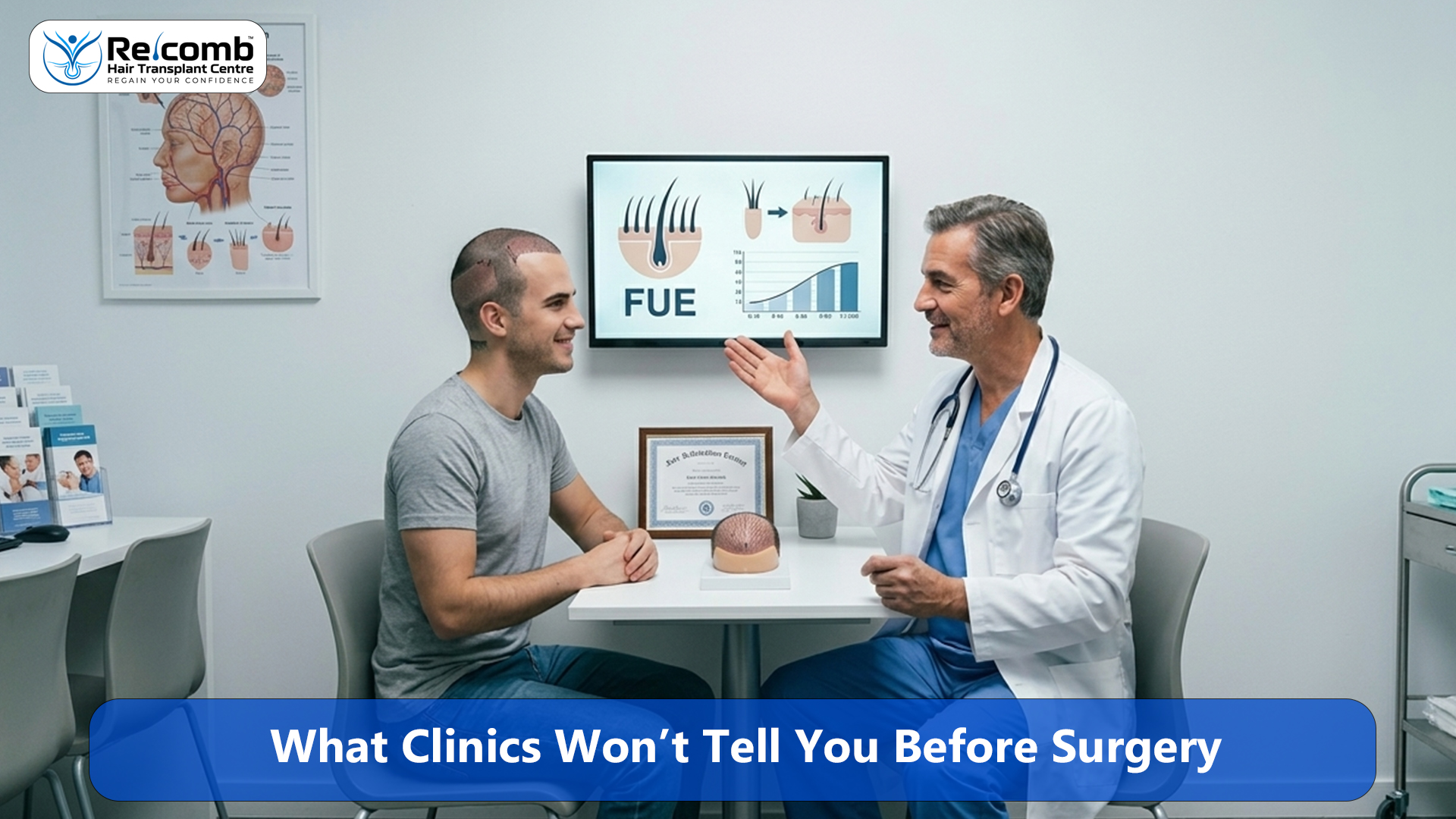
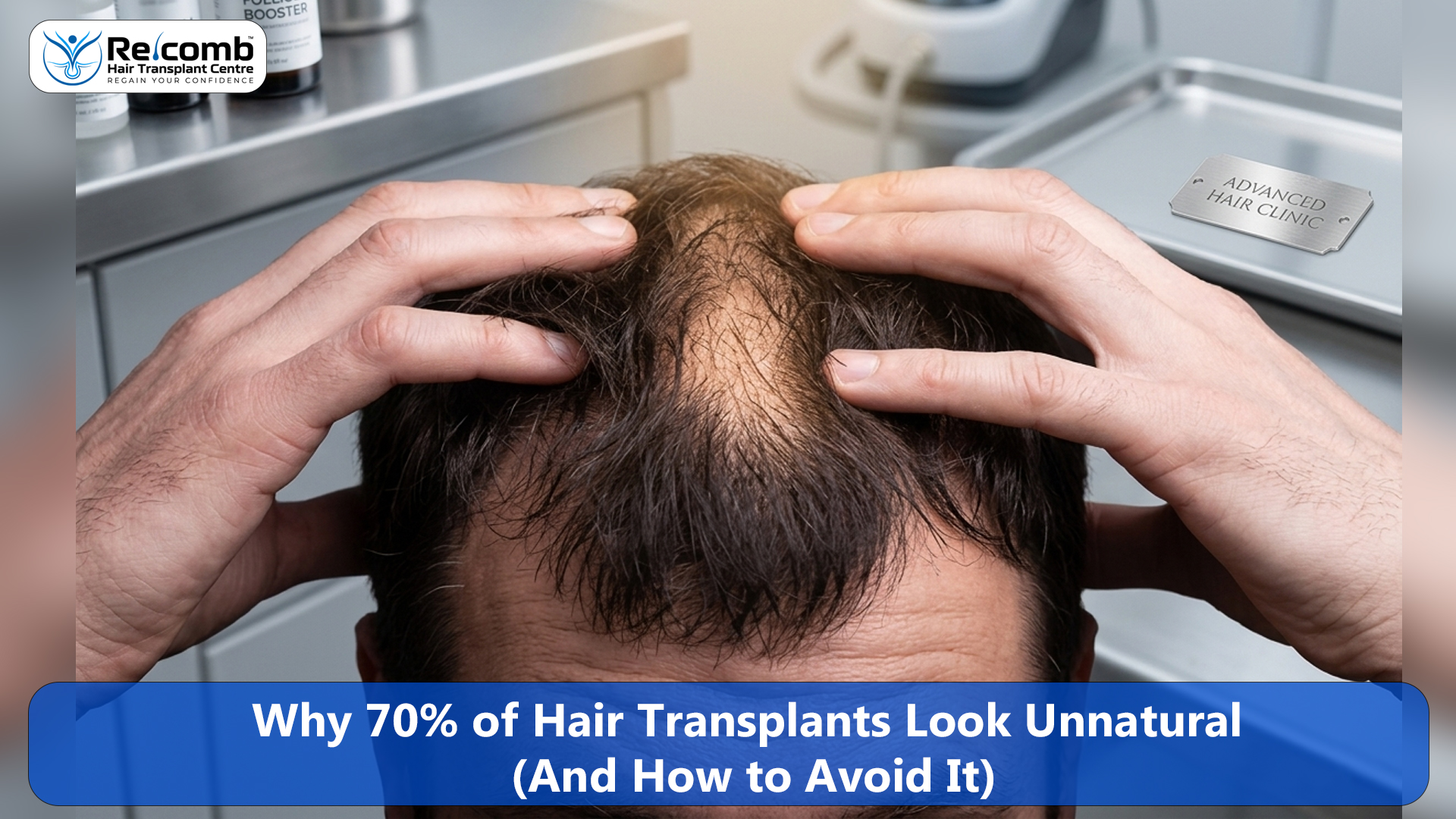
Hair transplant has become widely accessible, but with growing demand comes aggressive marketing. Many clinics highlight only the positives—dense results, permanent hair, and quick transformation.
What often gets ignored are the limitations, trade-offs, and long-term realities.
At RECOMB Hair Transplant Centre, patient education is considered as important as the procedure itself.
Here are key truths patients should know before deciding.
1. Hair Transplant Does NOT Stop Hair Loss
This is one of the most misunderstood points.
A hair transplant:
Moves existing hair from donor to recipient area
Does not stop ongoing hair loss
Your native hair can continue to thin after surgery.
What This Means
Without proper planning:
Transplanted hair remains
Surrounding hair may disappear
Result may look unnatural over time
2. Donor Hair Is Limited Forever
Your donor area is not unlimited.
Once grafts are extracted:
They do not grow back
The donor capacity reduces permanently
Most patients have a lifetime limit of around 4,000–6,000 grafts.
Why It Matters
Poor planning in the first surgery can:
Exhaust donor early
Limit future correction options
3. You Will Not Get Your Teenage Density Back
Many advertisements show extremely dense results.
Reality:
Natural density = 80–100 follicles/cm²
Transplant density = 35–70 grafts/cm²
Hair transplant improves appearance—but does not fully replicate original density.
4. Results Take Time (Not Instant)
Surgery is just the beginning.
Timeline:
First month: shedding phase
3–4 months: initial growth
6–8 months: visible improvement
10–12 months: final result
Many clinics show only final results—not the full journey.
5. More Grafts Is NOT Always Better
Some clinics promote:
“Maximum grafts”
“Unlimited graft packages”
But excessive graft extraction can:
Damage donor area
Reduce survival rate
Compromise long-term results
Quality and planning matter more than numbers.
6. Technician-Led Surgery Is Common
In some clinics:
Technicians perform most of the procedure
Doctor involvement is limited
Hair transplant requires:
Artistic hairline design
Precise angle control
Medical judgment
Lack of proper supervision increases risk of unnatural results.
7. Hairline Design Is Permanent
Hairline placement is one of the most critical decisions.
A poorly designed hairline:
Is difficult to correct
May look unnatural over time
Consumes valuable grafts
Lower is not always better—natural is better.
8. You May Need Future Procedures
Hair loss is progressive.
Even after a successful transplant:
New areas may thin
Additional sessions may be required
Planning for the future is essential.
9. Not Everyone Is a Good Candidate
Some patients should delay or avoid surgery:
Unstable hair loss
Poor donor density
Unrealistic expectations
Active scalp conditions
Ethical clinics will sometimes advise against surgery.
10. Cheapest Option Can Be Most Expensive Later
Low-cost procedures may compromise:
Planning
Technique
Donor safety
Poor results may require correction surgery, which is more complex and costly.
What You SHOULD Expect From a Good Clinic
A responsible clinic will:
Evaluate your condition properly
Explain limitations honestly
Plan for long-term results
Prioritize donor preservation
Set realistic expectations
Transparency is a sign of quality.
RECOMB’s Ethical Approach (2026)
At RECOMB:
Patients are educated before treatment
Surgery is not recommended when unnecessary
Hairline design is conservative and long-term focused
Donor management is prioritized
The goal is not just performing surgery—but achieving natural, sustainable results.
Final Takeaway
Hair transplant is an effective solution—but only when done with proper understanding.
Before surgery, you should know:
It does not stop hair loss
Donor hair is limited
Results take time
Planning matters more than marketing
Making an informed decision today prevents complications tomorrow.
Hair transplant is one of the most effective solutions for baldness—but not everyone is an ideal candidate.
Many patients rush into surgery due to marketing, social pressure, or frustration with hair loss. However, performing a transplant at the wrong time or in the wrong condition can lead to poor results, wasted grafts, and long-term regret.
At RECOMB Hair Transplant Centre, careful patient selection is a key part of achieving natural and sustainable outcomes.
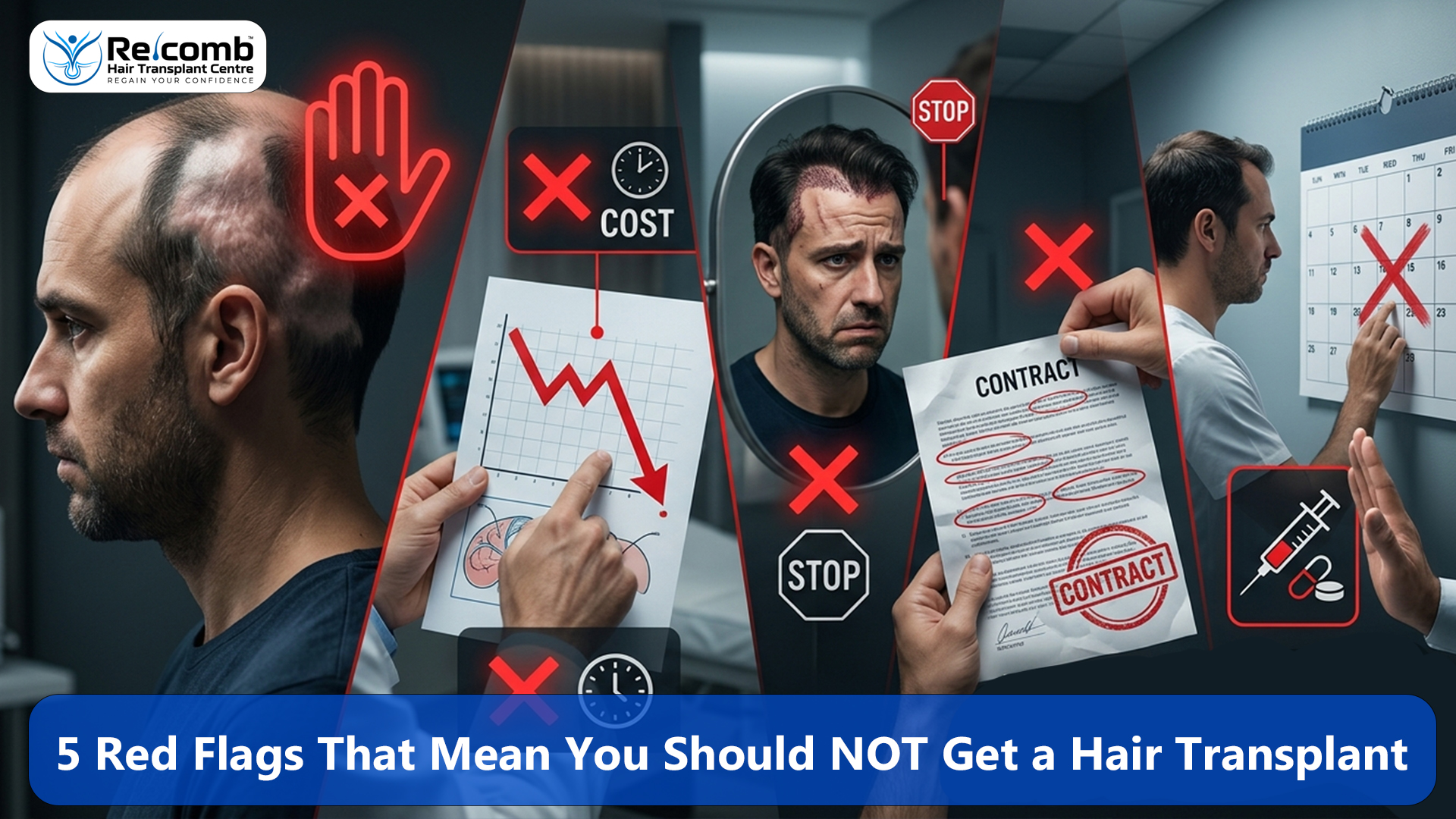
Here are 5 important red flags.
1. You Have Ongoing Rapid Hair Loss
If your hair loss is still actively progressing, especially at a young age:
Hairline continues to recede
Crown keeps expanding
Density reduces quickly
Doing a transplant too early can result in:
Transplanted hair in front
Continued loss behind it
Unnatural “island” appearance
What to Do Instead
Stabilize hair loss first with medical or regenerative treatment before considering surgery.
2. Poor Donor Area Quality
The donor area is your only source of permanent hair.
“If my hair loss continues, how many times can I do a hair transplant?”
The answer is not fixed. It depends on one critical factor:
Your donor area capacity.
At RECOMB Hair Transplant Centre, we plan every procedure keeping long-term donor preservation in mind, because hair transplant is not a one-time cosmetic decision—it’s a lifelong resource management strategy.
Hair transplant technology has improved significantly over the last decade. Modern procedures like FUE and advanced implantation techniques can create extremely natural results.
However, many patients still encounter hair transplants that appear artificial or easily recognizable.
Why does this happen?
Most unnatural results are not caused by the technology itself but by poor planning, incorrect technique, and unrealistic expectations.
At RECOMB Hair Transplant Centre, careful planning and surgical precision are prioritized to ensure results blend naturally with existing hair.
Understanding the common causes of unnatural results helps patients make better decisions.
1. Poor Hairline Design
Hairline design is the most important factor in determining whether a hair transplant looks natural.
Common mistakes include:
Straight hairlines
Hairlines placed too low
Lack of natural irregularity
Natural hairlines have subtle variations and follow facial proportions.
When designed properly, the transplanted hairline becomes almost undetectable.
2. Incorrect Angle and Direction
Hair grows at specific angles depending on the region of the scalp.
For example:
Frontal hair grows forward and slightly downward
Temple hair grows at a sharper angle
Crown hair follows a circular pattern
Incorrect placement angles can make hair stand upright or grow unnaturally.
This mistake immediately reveals the transplant.
3. Improper Graft Distribution
Hair follicles naturally grow in groups of one to four hairs.
Natural hairlines require:
Single-hair grafts in the front
Multi-hair grafts behind the hairline
If multi-hair grafts are placed at the very front, the hairline can appear dense and artificial.
Balanced graft distribution is essential for realism.
4. Overharvesting the Donor Area
Some clinics remove excessive grafts to create high-density results in one session.
This may cause:
Patchy donor area
Visible thinning at the back of the scalp
Long-term donor damage
A natural transplant should look balanced from both the front and back.
5. Aggressive Density Claims
Advertisements often promise extremely high density.
However, excessive graft placement can:
Damage blood supply
Reduce graft survival
Create unnatural hair patterns
A realistic density plan ensures healthy follicle growth.
6. Technician-Led Procedures
In some clinics, technicians perform most of the procedure while doctors supervise multiple surgeries.
Hair transplant requires:
Precise graft extraction
Accurate implantation angles
Artistic hairline design
Insufficient medical supervision can increase the risk of unnatural results.
7. Ignoring Future Hair Loss
Hair loss is progressive.
If transplanted hair is placed without considering future thinning, the result may look unnatural later.
For example:
A dense hairline with bald areas behind it
Uneven distribution as natural hair continues to thin
Long-term planning prevents these issues.
How to Avoid an Unnatural Hair Transplant
Patients can reduce the risk by focusing on several key factors.
Choose an Experienced Surgeon
Experience plays a major role in:
Hairline design
Graft placement
Long-term planning
Evaluate Real Patient Results
Before-and-after photographs should show:
Natural hairline shape
Consistent density
Healthy donor area
Understand Realistic Expectations
Hair transplant aims to improve appearance, not recreate teenage density.
Balanced results look more natural than aggressive designs.
Focus on Donor Preservation
Donor hair is limited.
A responsible clinic plans procedures to protect donor reserves for future needs.
RECOMB’s Approach to Natural Hair Restoration (2026)
At RECOMB, every procedure follows principles designed to maximize natural results.
These include:
Conservative hairline design
Proper graft selection and distribution
Safe donor extraction limits
Long-term hair loss planning
This approach helps ensure that results remain natural not only immediately after surgery but also years later.
Final Takeaway
Unnatural hair transplants usually result from poor planning rather than technological limitations.
The key factors that determine natural results include:
Hairline design
Angle and direction of implantation
Balanced graft distribution
Donor preservation
Long-term treatment planning
Choosing the right clinic and surgeon is the most important step toward achieving natural-looking hair restoration.
One of the most critical decisions in hair transplant surgery is hairline design.
Many patients request a very low and dense hairline to recreate the appearance they had in their early twenties. While this may seem appealing, experienced surgeons often recommend a more conservative hairline design.
Why?
Because hair loss is progressive, and long-term planning is essential for natural and sustainable results.
At RECOMB Hair Transplant Centre, hairline design is carefully planned to ensure the result still looks natural even decades later.
What Is Conservative Hairline Design?
A conservative hairline design means:
Maintaining a slightly higher hairline
Preserving donor grafts for the future
Following natural facial proportions
Avoiding overly straight or artificial lines
The goal is to create a hairline that looks age-appropriate and natural over time.
Why Aggressive Hairlines Can Be Problematic
1. Progressive Hair Loss
Male pattern baldness usually continues with age.
If the hairline is placed too low initially, the surrounding native hair may continue to thin, leaving an unnatural pattern.
This can result in:
Isolated transplanted hairline
Large bald areas behind it
Need for additional procedures
2. Limited Donor Supply
The donor area has a finite number of grafts.
Using too many grafts to create a very low hairline may leave fewer grafts available for treating future hair loss.
Preserving donor hair is essential for long-term planning.
3. Unnatural Appearance With Age
A very low hairline that looks good at age 25 may appear unnatural at age 40 or 50.
Natural hairlines change gradually with age. A conservative design helps maintain a balanced appearance throughout life.
4. Higher Graft Requirement
Lower hairlines require significantly more grafts.
For example:
A natural conservative hairline may need 1,500 grafts
A very low aggressive hairline may require 2,500 grafts or more
Those additional grafts may be needed later for crown or mid-scalp restoration.
Benefits of Conservative Hairline Design
Natural Aging
A conservative hairline follows natural facial proportions and continues to look appropriate as a person ages.
Better Donor Management
By using grafts efficiently, surgeons can preserve donor hair for potential future treatments.
Balanced Density
Instead of concentrating grafts in a small frontal area, conservative planning allows more balanced coverage across the scalp.
Long-Term Satisfaction
Patients who choose conservative hairlines often report better long-term satisfaction because their results remain natural even years later.
Key Principles of Natural Hairline Design
Experienced surgeons consider several factors when designing a hairline:
Facial structure
Age
Donor density
Baldness progression
Hair characteristics (thickness, curl, color)
Hairlines are also designed with slight irregularities to mimic natural patterns.
When a Lower Hairline May Be Appropriate
In certain cases, slightly lower hairlines may still be possible.
These situations include:
Very strong donor density
Stable hair loss pattern
Younger patients with minimal progression risk
However, these decisions require careful evaluation.
RECOMB’s Hairline Planning Philosophy (2026)
At RECOMB, hairline design prioritizes:
Long-term natural aesthetics
Balanced graft distribution
Preservation of donor reserves
Realistic expectations
Every hairline is designed individually based on the patient’s facial proportions and future hair loss risk.
Final Takeaway
Hair transplant success is not just about restoring hair today—it is about creating results that remain natural for decades.
Conservative hairline design protects donor resources, adapts to aging, and reduces the need for corrective procedures later.
Patients who prioritize long-term planning usually achieve the most natural and sustainable results.
Many hair transplant advertisements promise “unlimited grafts” at a fixed price. For patients struggling with baldness, this sounds extremely attractive.
The idea suggests that a clinic will transplant as many grafts as needed without extra cost.
However, in reality, unlimited grafts is not medically possible and can sometimes be a warning sign of poor surgical planning.
At RECOMB Hair Transplant Centre, graft planning is based on donor safety rather than marketing slogans.
In recent years, dieting trends such as intermittent fasting, keto diets, detox diets, and extreme calorie restriction have become extremely popular. Many people adopt these practices to lose weight quickly or improve metabolic health.
However, dermatologists are increasingly observing a side effect that many people do not anticipate:
Severe hair fall after dieting.
At RECOMB Hair Transplant Centre, many patients report sudden hair shedding a few months after significant weight loss.
Understanding why this happens requires understanding how hair growth works.
Why Hair Is Sensitive to Diet
Hair follicles are among the most metabolically active structures in the body.
They require:
Adequate protein
Iron and ferritin
Zinc
Vitamins (especially B-complex and vitamin D)
Stable energy supply
When the body experiences nutritional stress, hair growth is one of the first processes that slows down.
The body prioritizes essential organs like the brain and heart, reducing resources available for hair production.
The Hair Growth Cycle
Hair grows in three phases:
Anagen (growth phase)
Lasts 2–6 years.
Catagen (transition phase)
Short phase where growth stops.
Telogen (resting phase)
Hair eventually sheds.
Severe dieting can push large numbers of hairs into the telogen phase, resulting in excessive shedding.
This condition is known as telogen effluvium.
How Crash Dieting Triggers Hair Loss
1. Sudden Calorie Restriction
Very low-calorie diets shock the body.
When calorie intake drops drastically:
Energy supply to hair follicles decreases
Hair growth slows
Shedding begins within 2–3 months
Rapid weight loss often correlates with severe hair fall.
2. Protein Deficiency
Hair is primarily made of keratin, a protein.
When dieting eliminates protein sources such as:
Eggs
Meat
Dairy
Pulses
Hair follicles cannot produce strong strands.
Low protein intake can trigger diffuse hair thinning.
3. Iron and Ferritin Deficiency
Many restrictive diets reduce intake of iron-rich foods.
Low ferritin levels are strongly linked to hair loss.
Common signs include:
Excessive shedding
Fatigue
Weak nails
Correcting ferritin often improves hair growth.
4. Vitamin Deficiencies
Dieting without nutritional planning can lead to deficiencies such as:
Vitamin D deficiency
B12 deficiency
Zinc deficiency
These nutrients play important roles in follicle health.
5. Hormonal Changes
Extreme dieting can disrupt hormonal balance.
Hormonal fluctuations can trigger:
Hair thinning
Increased shedding
Changes in hair growth cycles
This is particularly common in women undergoing rapid weight loss.
Popular Diet Trends Linked to Hair Loss
Certain dieting patterns have been associated with hair fall when poorly planned: