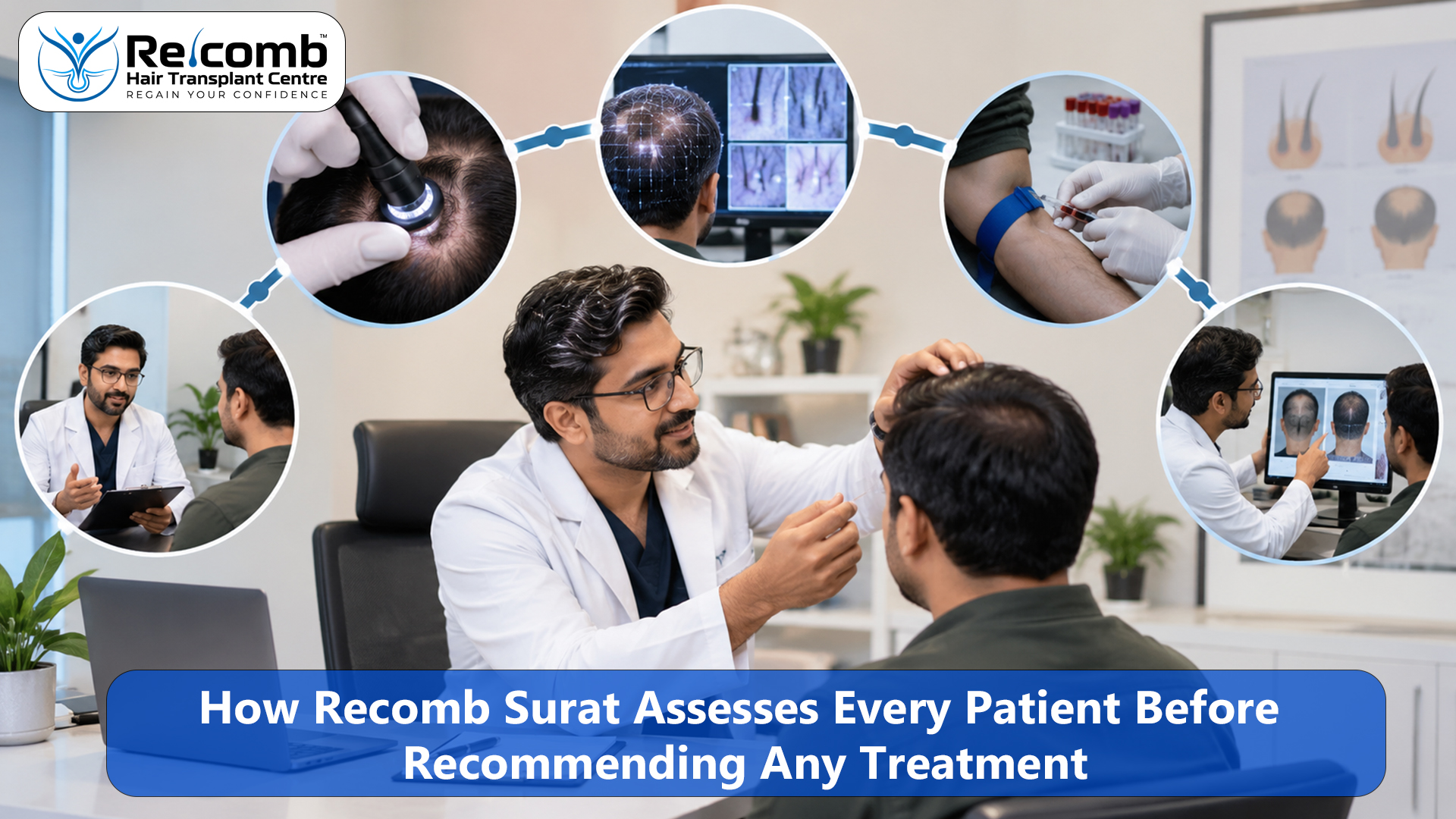
Walk into most hair clinics in India and the consultation follows a predictable sequence. The doctor looks at the scalp, asks how long the hair loss has been happening, quotes a graft count, and presents a treatment option. The entire process takes fifteen to twenty minutes. The patient leaves with a recommendation, a price, and very little understanding of what clinical evidence supports either.
At RECOMB, the consultation follows a different sequence entirely. The recommendation comes last. The assessment comes first, and it takes as long as it takes to produce a specific, clinically grounded picture of what is driving the patient's hair loss and what treatment is actually appropriate for their individual case.
This is not a claim about thoroughness for its own sake. It is a clinical necessity. A treatment recommendation made before a complete assessment is, in most cases, not a clinical recommendation. It is a commercial estimate based on surface-level observations that may or may not reflect what is actually happening at the follicular level.
This blog details exactly what RECOMB's assessment process involves, why each component matters, and what a patient actually knows about their own hair loss by the time they leave the first consultation.
If you want to go through this assessment for your own case before making any treatment decision, a consultation at RECOMB is where that starts.
Book a Complete Hair Loss Assessment at RECOMB, Surat →
WhatsApp: +91 7624008000 | www.recombhair.com
Why Assessment Comes Before Recommendation
The most common errors in hair loss treatment in India, wrong treatment for the diagnosis, incorrect graft count for the donor capacity, poorly timed surgery for the stage of loss, surgery on an unprepared scalp, all share a single root cause: a recommendation was made before the clinical picture was complete.
A patient with telogen effluvium who is recommended a transplant is being offered surgery for a problem that will resolve with the right medical intervention. A patient with androgenetic alopecia who is reassured that their shedding is temporary and told to wait loses the window during which medical management is most effective. A patient whose donor density was never measured proceeds with a procedure that uses an arbitrarily determined graft count that may deplete their lifetime supply faster than a measured plan would have required.
Every one of these errors is downstream of the same problem: the assessment was incomplete or absent. At RECOMB, the assessment protocol exists specifically to prevent these errors by establishing a complete clinical picture before any recommendation is formed.
Component 1: Structured Clinical History
The assessment begins with a structured clinical history that covers more than the obvious questions about when hair loss started and how long it has been progressing.
The timeline and rate of progression are documented specifically. A patient who lost significant ground over six months is in a different clinical situation from one whose loss has progressed gradually over eight years, even if their current Norwood grade is identical.
Family history is documented on both maternal and paternal sides, since androgenetic alopecia is inherited from both lineages. The pattern and extent of hair loss in close relatives, and the age at which it became significant, informs the projection of where the patient's loss is likely to go.
Medication history is reviewed specifically for drugs known to cause or accelerate hair loss, including certain blood pressure medications, statins, retinoids, and some antidepressants. Where a medication is identified as a potential contributor, this changes both the diagnosis and the management approach.
Recent medical events are explored: significant illness, hospitalisation, surgery, rapid weight change, dietary changes, periods of extreme stress. These are the triggers of telogen effluvium that frequently go unconnected to hair fall by patients who do not understand the six to twelve week delay between trigger and shedding.
Previous hair loss treatments are documented, including what was tried, for how long, with what result, and why it was stopped. This history tells the clinician which components of the hair loss have already been tested and what the patient's pattern of response has been.
Component 2: Trichoscopy
Trichoscopy is the magnified examination of the scalp at 10 to 70 times using a dermatoscope. It is the most diagnostically important component of the assessment and the one most commonly absent from hair loss consultations at other clinics.
In the recipient zones, where hair loss is visible, trichoscopy reveals the degree and pattern of follicle miniaturisation. The characteristic finding of androgenetic alopecia, variation in hair shaft diameter with miniaturised thin hairs present alongside normal-diameter hairs, is visible under magnification and absent in telogen effluvium where shaft diameter is relatively uniform. This single finding often resolves the diagnostic question in minutes.
Trichoscopy also identifies perifollicular inflammation, the characteristic scaling and redness of seborrheic dermatitis around follicle openings, follicular plugging from hard water mineral deposits or product buildup, and the early signs of scarring conditions that require urgent dermatological management.
In the donor zone, trichoscopy provides the specific follicular unit density measurement per square centimetre that is the foundation of the graft plan. Without this measurement, any graft count recommendation is an estimate. With it, the lifetime graft budget calculation is grounded in the patient's actual anatomical parameters rather than a visual impression.
Component 3: Norwood or Ludwig Staging
Using the trichoscopy findings and clinical examination, the current extent of hair loss is formally staged using the Norwood scale for men or the Ludwig scale for women. This is not a rough categorisation. It involves mapping the specific boundaries of recession and thinning in each zone to establish a precise current baseline.
Staging serves two purposes. It establishes the current picture against which future change can be measured at follow-up assessments, and it provides the framework for projecting where loss is likely to progress given the patient's age, family history, and rate of change documented in the history.
The combination of current stage and projected trajectory determines whether surgery is appropriate now, whether waiting and preparing the scalp is a better clinical decision, and where within the available donor budget the grafts should be allocated to serve the patient across their lifetime rather than just their current presentation.
Component 4: Scalp Laxity Assessment
Scalp laxity, the looseness or tightness of the scalp skin over the underlying skull, is assessed through physical examination of the donor zone. It is clinically relevant because it affects how grafts can be safely extracted, what extraction density the scalp can support in a single session, and how the donor zone will recover visually after the procedure.
Patients with low scalp laxity require modified extraction technique to maintain accurate follicle tracking during the punch procedure. They may also benefit from staged procedures rather than single large sessions specifically because lower laxity limits the density of extraction achievable without visible donor compromise in one sitting.
This assessment is performed before any surgical plan is confirmed, because the laxity profile across the donor zone changes what is technically achievable in a single session and influences the session design.
Component 5: Hair Characteristics Assessment
The physical characteristics of the patient's hair are documented through trichoscopy and direct examination. These include hair shaft diameter, curl or wave pattern, and the contrast between hair colour and scalp skin tone.
These characteristics directly affect how density translates to visual result. A patient with thick, dark, wavy hair achieves satisfying visual fullness with fewer grafts per square centimetre than a patient with fine, straight, light-coloured hair. Applying the same density target to both patients without accounting for their hair characteristics produces inconsistent outcomes that a properly planned procedure avoids.
Hair characteristics also influence the specific technique adjustments made during extraction. Curly hair requires different extraction motion to prevent follicle twisting during the punch procedure than straight hair. These adjustments are planned before the procedure based on the characteristics documented in the assessment.
Component 6: Blood Investigation Recommendations
Based on the clinical history and trichoscopy findings, targeted blood investigations are recommended where indicated. For patients with active ongoing hair loss, the standard panel at RECOMB covers serum ferritin, thyroid function including TSH and free T3 and T4, vitamin D, and complete blood count.
These investigations identify correctable medical contributors to hair loss that, if untreated, will undermine any treatment applied regardless of how well it is selected. A patient with critically low ferritin who undergoes PRP therapy without addressing the ferritin deficiency will have a suboptimal biological response. A patient with undiagnosed hypothyroidism who undergoes a hair transplant without thyroid management will have reduced graft survival compared to what a thyroid-optimised scalp would achieve.
Where the clinical history suggests hormonal contributors, including symptoms of androgen excess in women, menstrual irregularity, or scalp loss pattern inconsistent with standard androgenetic alopecia, a hormonal panel including prolactin and sex hormones is added to the investigation recommendation.
Patients who bring recent blood investigation results to the consultation have these reviewed as part of the assessment, allowing the medical picture to be addressed immediately rather than requiring a separate step.
Component 7: Lifetime Graft Budget Calculation
For patients where surgical planning is relevant, the trichoscopy-derived donor density measurement is used to calculate the estimated lifetime graft budget. This number, the total grafts the patient can realistically extract across all procedures across their lifetime, is the most important planning parameter in any surgical discussion.
The calculation accounts for the safe extraction rate, typically 40 to 50 percent of follicular units present in the donor zone without visible donor thinning, and the density profile across the full safe donor area. From this, the total available graft estimate is derived and compared to the projected total coverage requirement based on the patient's Norwood stage and projected future loss trajectory.
This comparison tells the patient and the surgeon whether a single session addresses the full anticipated need, whether staging is required to use the budget responsibly across multiple sessions, and what percentage of the lifetime supply the proposed procedure would use. No patient at RECOMB agrees to a procedure without knowing these numbers specifically.
Component 8: The Treatment Recommendation
Only after all of the above components have been completed does the treatment recommendation take shape. At RECOMB, the recommendation is not a predetermined offering presented at the end of a brief consultation. It is a conclusion derived from the specific findings of the assessment applied to the patient's individual case.
For some patients, the recommendation is surgery with a specific graft plan, zone allocation, and timing. For others, it is medical management first with surgical assessment after stabilisation. For others, it is investigation and treatment of a medical contributor before any hair-specific intervention. For some, it is that surgery is not yet appropriate and a specific preparatory plan is required before it becomes appropriate.
Whatever the recommendation, the patient leaves the consultation understanding specifically why it was made, what clinical evidence supports it, what the realistic outcomes are, and what the complete plan looks like across the next 12 to 24 months.
RECOMB's Approach (2026)
At RECOMB Hair Transplant Centre, Surat, this assessment process is not a premium offering available to selected patients. It is the standard first consultation for every new patient regardless of what treatment they arrive expecting.
Dr. Krishna Bhalala and Dr. Nilesh Kachhadiya personally conduct every assessment. Patients do not see a coordinator or a junior team member for the clinical evaluation. The doctors who would operate are the same doctors who examine the scalp, measure the donor density, review the blood results, and make the recommendation. The continuity between assessment and procedure is not incidental. It is essential for the recommendation to be clinically coherent.
For patients from Ahmedabad, Vadodara, Rajkot, and other cities, the assessment is conducted with the same depth and time allocation as for local patients. Patients who contact RECOMB via WhatsApp before travelling are given guidance on what to bring, including any existing blood results, previous procedure records, and specific clinical questions they want addressed, so the consultation time is used as efficiently as possible.
See What a Complete Assessment Looks Like for Your Case at RECOMB →
WhatsApp: +91 7624008000 | www.recombhair.com
Final Takeaway
A treatment recommendation made without a complete assessment is not a clinical decision. It is a commercial estimate that may or may not serve the patient's actual needs. The difference between these two things is visible in the outcomes they produce, in graft survival, in result naturalness, in donor area preservation, and in whether the patient at 45 is satisfied with the decision they made at 35.
The assessment described in this blog is what every hair loss patient deserves before committing to any treatment. It is the standard that every patient should hold any clinic to before agreeing to a procedure.
Dr. Krishna Bhalala and Dr. Nilesh Kachhadiya conduct a limited number of personal consultations each week at RECOMB, Surat. If you want your hair loss assessed properly before any treatment decision is made, this is where that starts.
Start With a Proper Assessment, Not a Package Quote →
WhatsApp: +91 7624008000
We respond within 24 hours, 6 days a week.
www.recombhair.com
Contact RECOMB Hair Transplant Centre
RECOMB Hair Transplant Centre
19, Ground Floor, Zenon Building, Opp. Unique Hospital, near Kiran Motors, Khatodara Wadi, Surat, Gujarat 395001
Phone: +91 7624008000
Website: www.recombhair.com