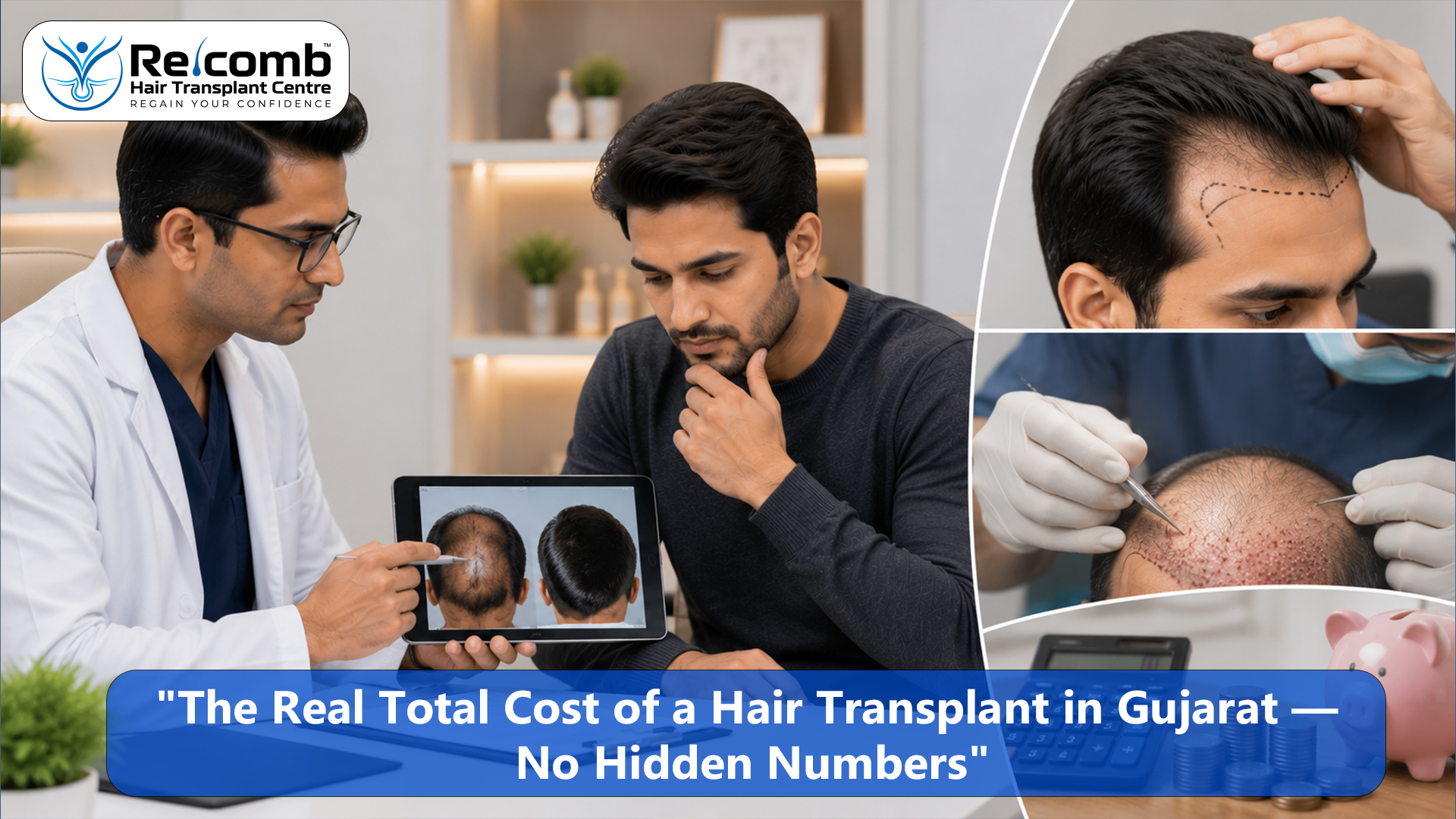
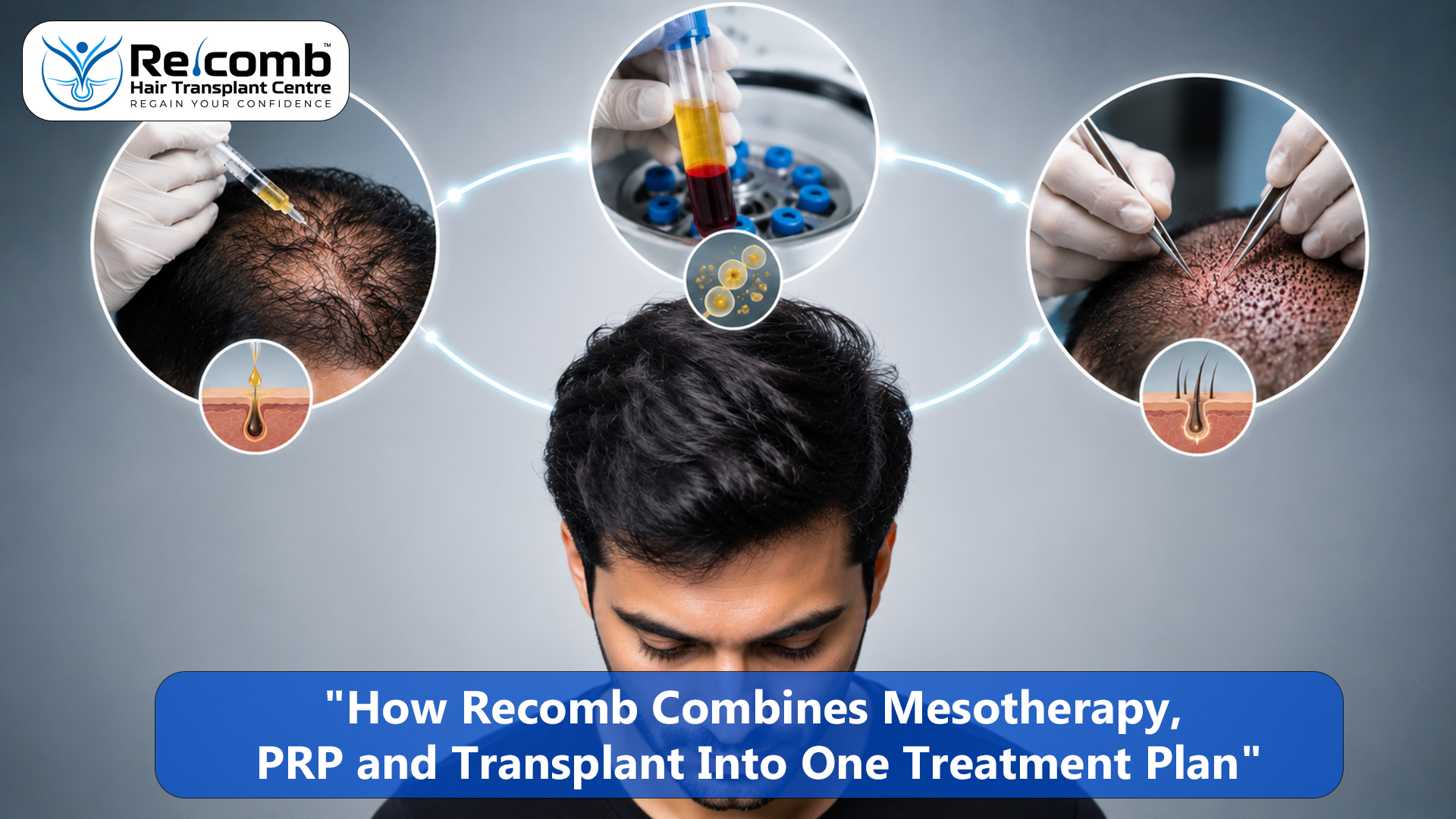
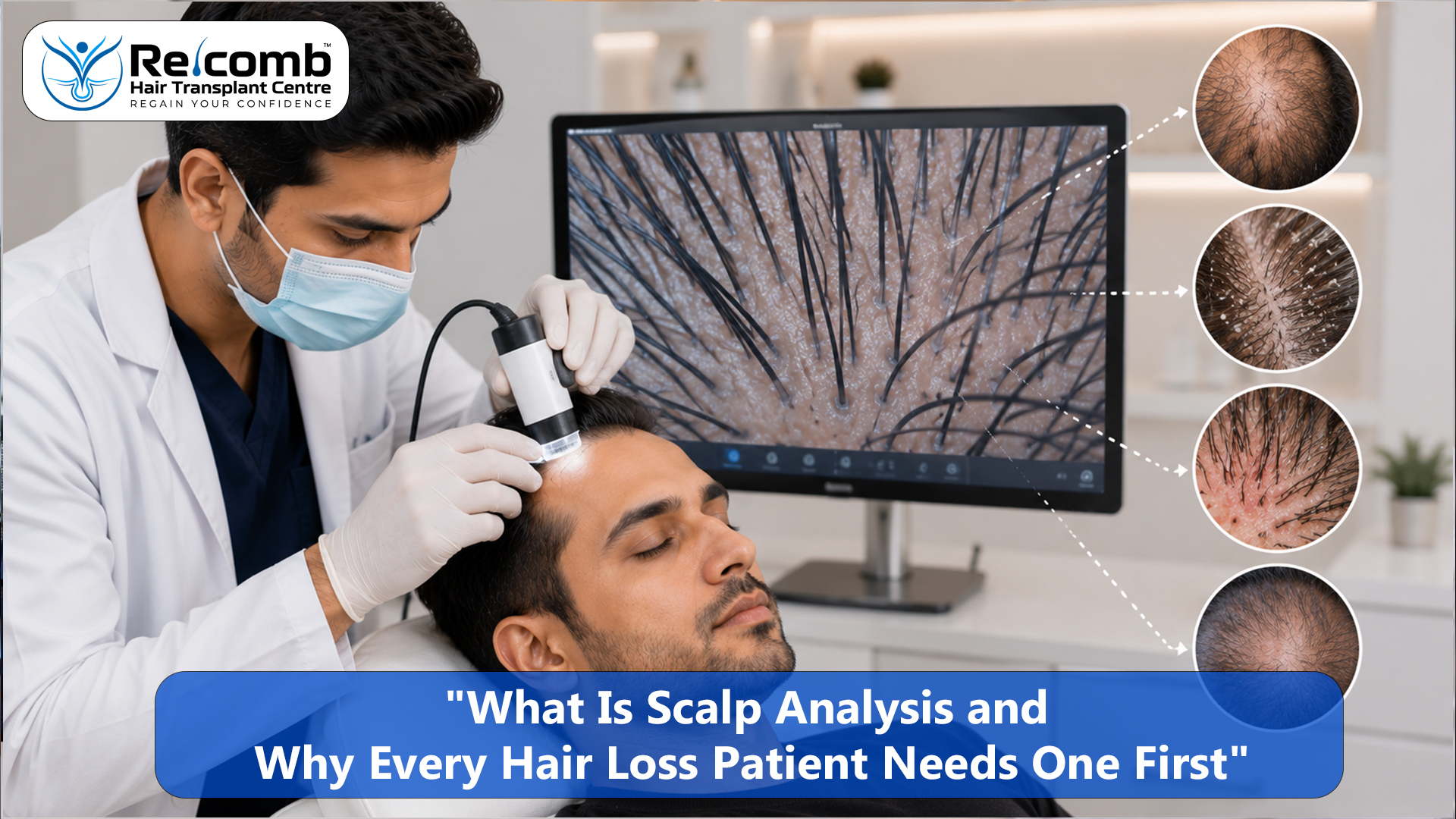
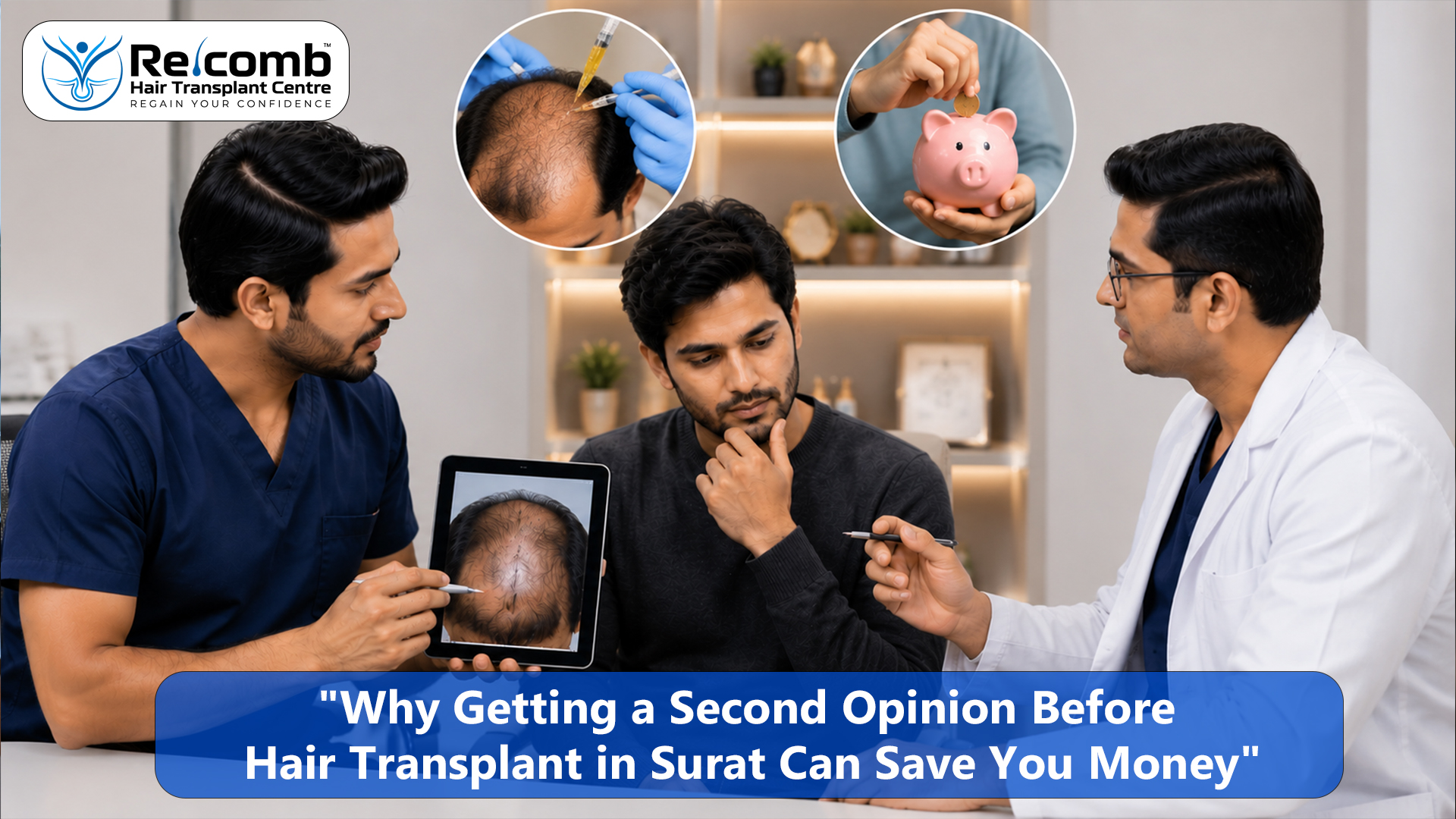
The price quoted for a hair transplant at most clinics in Gujarat is not the price the patient ends up paying. It is the opening number in a cost structure that expands as the patient moves from consultation to procedure to recovery to follow-up. Understanding what the total cost actually looks like before committing to any clinic is not just financially useful. It is clinically important, because what gets left out of the quoted price often reflects what gets left out of the clinical process.
This blog provides the complete cost picture for a hair transplant in Gujarat in 2026, including the procedure cost, the associated costs most patients do not budget for, and the long-term costs that determine whether the investment holds its value over a decade.
If you want a transparent, itemised cost assessment for your specific case at RECOMB, a consultation gives you exactly that.
Book a Transparent Cost Consultation at RECOMB, Surat →
WhatsApp: +91 7624008000 | www.recombhair.com
The Procedure Cost: What the Headline Price Should Include
The headline price quoted for a hair transplant in Gujarat varies widely. At budget-oriented clinics, costs can start from Rs 15,000 to Rs 25,000 for smaller procedures. At qualified surgeon-led clinics with complete assessment and follow-up protocols, costs typically range as follows.
For Norwood Grade 2 to 3 requiring 1,500 to 2,200 grafts, a qualified surgeon-led procedure in Surat typically costs Rs 60,000 to Rs 90,000.
For Norwood Grade 3 to 4 requiring 2,200 to 3,000 grafts, the range is Rs 85,000 to Rs 1,20,000.
For Norwood Grade 4 to 5 requiring 3,000 to 4,000 grafts, the range is Rs 1,10,000 to Rs 1,60,000.
For Norwood Grade 5 to 6 requiring 4,000 to 5,000 grafts, the range is Rs 1,40,000 to Rs 2,00,000 or more depending on complexity.
These figures represent a surgeon-performed FUE procedure with complete pre-surgical assessment, direct surgical team involvement, and basic post-operative care included. They do not represent technician-led budget procedures or the artificially inflated premium pricing of some branded chains.
What a quoted procedure price should include but often does not: the pre-surgical trichoscopy and assessment, local anaesthesia on the day, basic post-operative medications for the first week, and at least one post-operative follow-up consultation. When these are excluded from the headline price, they are billed separately and the total rises.
The Pre-Surgical Investigation Cost
Before any hair transplant, blood investigations are a clinical requirement for most patients. These are almost never included in the headline procedure price and are often not discussed during the initial consultation.
A standard pre-surgical blood panel covering complete blood count, serum ferritin, thyroid function, vitamin D, and basic clotting parameters costs Rs 2,000 to Rs 5,000 at most diagnostic facilities in Surat and Gujarat. For patients with additional clinical indications requiring a hormonal panel, the cost may be Rs 5,000 to Rs 8,000.
If the investigation reveals a deficiency requiring treatment before surgery, such as iron deficiency anaemia or significant vitamin D deficiency, the cost of corrective supplementation for two to three months adds Rs 500 to Rs 2,000 depending on the products prescribed.
These are not optional costs. Proceeding to surgery without establishing blood investigation baseline is poor clinical practice and increases the risk of suboptimal graft survival and healing.
Post-Operative Medication Cost
The immediate post-operative period requires specific medications that are typically not included in procedure package prices unless clearly stated.
Antibiotics prescribed for the first five to seven days to reduce infection risk cost Rs 300 to Rs 600 for a standard course. Anti-inflammatory medication prescribed for the first three to five days to reduce swelling costs Rs 200 to Rs 500. A prescribed shampoo for the first wash and ongoing scalp care during the healing phase costs Rs 300 to Rs 800 depending on the formulation.
Total immediate post-operative medication cost for most patients: Rs 800 to Rs 2,000.
For patients where PRP or GFC is used as a post-operative support treatment in the three to four month growth phase, the cost of a post-operative course of three to four sessions adds Rs 15,000 to Rs 30,000 depending on whether PRP or GFC is used and the clinic's pricing structure for these treatments.
Follow-Up Appointment Cost
A properly managed hair transplant requires scheduled follow-up assessments at one month, three months, six months, and twelve months. These appointments involve trichoscopy, clinical evaluation of growth progress, and medical management review.
At clinics where follow-up is not included in the procedure price, each appointment costs Rs 500 to Rs 2,000 depending on the clinic and whether trichoscopy is performed. Four appointments across the twelve-month period add Rs 2,000 to Rs 8,000 to the total cost.
At RECOMB, follow-up appointments through the growth period are included in the treatment plan and are not billed separately. This is worth confirming explicitly at any clinic before proceeding.
Medical Management Cost: The Ongoing Commitment
Finasteride and minoxidil, the medical management foundation for patients with ongoing androgenetic alopecia, represent a significant long-term cost that is almost never discussed during hair transplant consultations but is clinically mandatory for protecting the result.
Generic finasteride at 1mg daily costs Rs 300 to Rs 600 per month in India depending on the brand and supplier. Topical minoxidil at 5 percent used once or twice daily costs Rs 200 to Rs 500 per month. Combined medical management costs Rs 500 to Rs 1,100 per month or Rs 6,000 to Rs 13,200 per year.
Over five years of maintenance, which is a reasonable minimum expectation for a patient who has undergone surgery and wants to protect the investment, this represents Rs 30,000 to Rs 66,000 in medical management costs, a number that is never mentioned in the headline procedure price but is entirely predictable and should be part of every patient's financial planning.
For patients who add GFC or PRP maintenance sessions every four to six months post-procedure, each maintenance session costs Rs 4,000 to Rs 8,000. Two sessions per year over five years adds Rs 40,000 to Rs 80,000 to the long-term cost picture.
The Cost of a Second Session
Most patients with Norwood Grade 4 or above will require a second surgical session at some point, either because the first session addressed the frontal zone and a second is planned for the crown or midscalp, or because ongoing hair loss has created new areas requiring coverage in the years following the first procedure.
A second session typically costs Rs 50,000 to Rs 1,20,000 depending on the graft count required, which is usually lower than the first session for planned staged procedures. Unplanned second sessions resulting from inadequate first-session planning, including the need for corrective or repair procedures following poor work at another clinic, can cost Rs 80,000 to Rs 1,50,000 or more depending on complexity.
Including the realistic probability of a second session in the total cost picture changes the financial comparison between a well-planned first procedure that preserves donor area for a predictable second session and a poorly planned first procedure that depletes donor area and requires expensive corrective work.
The Cost of a Poor Result: The Most Expensive Scenario
The full cost picture must include what happens when the procedure does not produce an acceptable result, because this is not a rare outcome in a market where technician-led budget procedures are common.
A corrective or repair hair transplant following a poor primary result is technically more complex than the original procedure. Costs typically range from Rs 80,000 to Rs 1,80,000 depending on the extent of correction required. Corrective procedures are also constrained by the donor area damage or depletion caused by the original procedure, meaning the correction achievable may be incomplete regardless of cost.
The total financial consequence of choosing a Rs 25,000 budget procedure that requires a Rs 1,20,000 correction plus the cost of PRP sessions, multiple consultations, and psychological distress during the period of a poor result is not a saving. It is a significantly higher total expenditure than a well-planned Rs 90,000 procedure with structured follow-up from the outset.
What the Real Total Cost Looks Like
Adding these components produces a realistic total cost picture for a patient with Norwood Grade 3 to 4 loss undergoing a first hair transplant at a qualified clinic in Gujarat with full medical management and follow-up.
Procedure cost for 2,500 grafts: Rs 95,000
Pre-surgical blood investigations: Rs 3,500
Post-operative medications: Rs 1,500
Post-operative GFC course, three sessions: Rs 18,000
Follow-up appointments over 12 months if not included: Rs 4,000
Medical management, finasteride and minoxidil, year one: Rs 9,600
GFC maintenance, two sessions in year two: Rs 12,000
Medical management year two: Rs 9,600
Realistic total for the first two years: approximately Rs 1,53,200
This is not a frightening number when understood correctly. It represents a permanent result with appropriate ongoing maintenance delivered over 24 months. It is also substantially lower than the total cost of a Rs 30,000 budget procedure followed by corrective work, extended PRP courses to address poor initial density, and the medical management that should have been in place from the start.
RECOMB's Approach (2026)
At RECOMB Hair Transplant Centre, Surat, the complete cost picture described in this blog is provided to every patient before they commit to anything. Dr. Krishna Bhalala and Dr. Nilesh Kachhadiya discuss the procedure cost, the pre-surgical investigation cost, post-operative medication requirements, follow-up inclusion, and the realistic long-term medical management commitment as part of every consultation.
Patients leave the consultation with a specific, itemised understanding of what their treatment will cost across the full timeline, not just on procedure day. This transparency is not a sales technique. It is the information every patient needs to make a genuinely informed decision about where to have their procedure and what to budget for.
The headline procedure price at RECOMB is not the lowest in Surat. It reflects the actual cost of performing the procedure to the standard required for the result we stand behind.
Get a Complete Itemised Cost Assessment for Your Case at RECOMB →
WhatsApp: +91 7624008000 | www.recombhair.com
Final Takeaway
The real total cost of a hair transplant in Gujarat is not the number quoted on a clinic's website or at the end of a brief initial consultation. It is the sum of the procedure, the investigations, the post-operative medications, the follow-up care, the medical management over years, and the realistic probability of a second session.
Understanding this complete picture before committing to any clinic protects patients from the most common financial mistake in hair restoration: choosing the lowest headline price and paying far more in total than a transparent, well-planned procedure at a qualified clinic would have cost from the beginning.
Dr. Krishna Bhalala and Dr. Nilesh Kachhadiya conduct a limited number of personal consultations each week at RECOMB, Surat. If you want a complete, honest cost breakdown for your specific case with no numbers left out, this is where that conversation happens.
Get the Complete Cost Picture Before You Commit →
WhatsApp: +91 7624008000
We respond within 24 hours, 6 days a week.
www.recombhair.com
Contact RECOMB Hair Transplant Centre
RECOMB Hair Transplant Centre
19, Ground Floor, Zenon Building, Opp. Unique Hospital, near Kiran Motors, Khatodara Wadi, Surat, Gujarat 395001
Phone: +91 7624008000
Website: www.recombhair.com